In a few hours, my beloved University of Houston Cougars will kick off
against the Southern Jaguars, beginning the 2013 season. I was supposed
to have written my season preview by now, but I never got around
to it. Partly because I've been busy, and partly because I really don't know what to expect from the team this fall.
I'm hoping for a good year, but coming off last season's 5-7 disappointment, I can't say I'm particularly optimistic. David Piland, who had his share of struggles at quarterback last year, will start today's game. The offense's best weapon - running back Charles Sims - transferred to West Virginia over the offseason. The defense, which was 118th in the nation yards allowed last year, loses its two best players from last year ( Philip Steward and D.J. Hayden). The team is young; there are just eight seniors on the latest two-deep depth chart's 44 positions. This year's schedule is tougher - the Cougars have moved to the American Athletic Conference, a hybrid of former Big East and Conference USA schools, and (for one year, at least) are among the "haves" of the BCS world - making today's matchup the only "gimme" game of the slate. The Cougars will not have a true "home" this season; construction on the new UH football stadium is well underway, and the Coogs will be playing most of their 2013 games within the cavernous confines of Reliant Stadium.
If there's any reason for hope in 2013, it comes in the form of new coordinators: Doug Meacham on offense, who spent the last eight seasons at Oklahoma State and is familiar with the type of offense Houston runs, and David Gibbs on defense, who has both college and pro experience. Hopefully the experience these two bring to the coaches' table, as well as the fact that head coach Tony Levine himself now has a year of experience under his belt, will translate into a better-prepared team in 2013.
Aside from that, there's really not much reason to expect anything other than another mediocre season in 2013, and some of the preseason computer models bear that out. Jeff Sagarin's preseason ratings have the Coogs ranked 64th with a rating of 70.00. This would imply a predicted record of 7-5 when opponents' rankings and home field advantage are factored in. Preseason predictions generated by both Massey and Congrove, on the other hand, have the Cougars managing only 5 wins this year.
I generally agree with those predictions; I think a five,-, six- or seven-win season is most likely. If the Cougars can manage anything more than five wins, they will likely qualify for a lower-tier bowl appearance and that will give the team some needed encouragement heading into 2014. Another losing season, on the other hand, could result in the end of the Tony Levine era at Houston. I see the season breaking down like this:
Probable wins: Southern, at UTSA, Memphis, South Florida
Probable losses: BYU, at Rutgers, at Central Florida, at Louisville, Cincinnati
Toss-ups: at Temple, Rice, SMU
The scariest game, for me at least, is against UTSA in the Alamodome. The Roadrunners, who are now members of Conference USA, will be fired up and looking to make a statement against the Cougars. The only reason I have Temple as a toss-up, rather than a probable win, is because it involves a 1,500-mile road trip on the second weekend of the season.
Here's hoping for the best this fall. I'm going to go take a shower, clean out the cooler, head to the HEB at the corner of Buffalo Speedway and Bissonnet to stock up, and then head out to Reliant to set up my tailgate. Go Coogs!
Friday, August 30, 2013


Tuesday, August 27, 2013
Miley? Meh.
I didn't watch the Video Music Awards on MTV last Sunday; it's just not my thing. So I wouldn't have known anything at all about Miley Cyrus and her "coming of age performance" if my Facebook feed hadn't blown up with comments about it all Sunday night and Monday morning.
So, thinking that she must have done something truly groundbreaking, I finally watched her performance on YouTube to see what all the furor was about.
And I saw her nude-hued bikini, her foam finger-dildo, her ass grinding against Robin Thicke's crotch, her off-key rendition of "Blurred Lines," her tongue dangling from her mouth... And when it was over, all I could think was, "is that all?"
It wasn't scandalous. It wasn't sexy. It was clumsy and contrived and unoriginal. You remember the quiet, introverted girl in high school who one day showed up in trashy clothes and trampy make-up in an attempt to shock people into noticing her? And everybody thought, "poor girl, she's trying too hard?" That was Miley on Sunday night.
So I'm left with a difficult time understanding what, exactly, all the controversy is about: why I should be outraged, or why ought I "pray for Miley," as one of my horrified Facebook friends exhorted all of us to do. The VMAs generally have a history of raunchy, exhibitionist performances, dating all the way back to Madonna and her wedding gown in 1984. The "chaste Disney child star gets on stage and expresses her post-adolescent sexuality" thing was already done by Britney Spears, thirteen years ago. There's nothing new or unique here; the only thing Miley's performance will be known for, years from now, is how awkward and shopworn it was. Her antics really don't deserve the attention they've received.
That being said, I now realize that I just wrote an entire blog post about Miley Cyrus. So maybe she, along with her agents and her publicists, knew exactly what she was doing on Sunday night.
So, thinking that she must have done something truly groundbreaking, I finally watched her performance on YouTube to see what all the furor was about.
 | ||||
| gawker.com |
So I'm left with a difficult time understanding what, exactly, all the controversy is about: why I should be outraged, or why ought I "pray for Miley," as one of my horrified Facebook friends exhorted all of us to do. The VMAs generally have a history of raunchy, exhibitionist performances, dating all the way back to Madonna and her wedding gown in 1984. The "chaste Disney child star gets on stage and expresses her post-adolescent sexuality" thing was already done by Britney Spears, thirteen years ago. There's nothing new or unique here; the only thing Miley's performance will be known for, years from now, is how awkward and shopworn it was. Her antics really don't deserve the attention they've received.
That being said, I now realize that I just wrote an entire blog post about Miley Cyrus. So maybe she, along with her agents and her publicists, knew exactly what she was doing on Sunday night.
Monday, August 26, 2013
The American - US Airways merger encounters turbulence
The planned merger between American Airlines and US Airways (I wrote about it a few months ago) seemed to be just another routine step in the consolidation of the nation's commercial aviation industry. But then, a couple of weeks ago, the Justice Department stepped in:
Speaking of Southwest, it appears that the once-vaunted "Southwest Effect" no longer has the same cachet it once possessed:
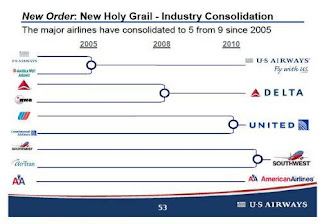 The bottom line is this: if this merger were to happen, the four biggest U.S. airlines — the combined American/US Airways, United, Delta
and Southwest — would
control more than 80 percent of the U.S. commercial air travel market (add in JetBlue and Alaska and you'll get to about 90 percent). These four largest carriers, furthermore, were reduced from nine carriers less than a decade ago (as the figure to the right indicates) It's the very definition of oligopoly, and it's just too much consolidation for the Obama Administration to feel comfortable with. It's also a signal that the benefits to air travelers that began in 1978 when the industry was deregulated have largely run their course. Even when dignity-robbing, bare-bones cattle carriers like Spirit or Allegiant are taken into consideration, there is simply no longer enough competition in the industry to continue to exert a downward pressure on airfares. (A useful compilation of commercial aviation statistics, including average domestic airfare over time, is here.)
The bottom line is this: if this merger were to happen, the four biggest U.S. airlines — the combined American/US Airways, United, Delta
and Southwest — would
control more than 80 percent of the U.S. commercial air travel market (add in JetBlue and Alaska and you'll get to about 90 percent). These four largest carriers, furthermore, were reduced from nine carriers less than a decade ago (as the figure to the right indicates) It's the very definition of oligopoly, and it's just too much consolidation for the Obama Administration to feel comfortable with. It's also a signal that the benefits to air travelers that began in 1978 when the industry was deregulated have largely run their course. Even when dignity-robbing, bare-bones cattle carriers like Spirit or Allegiant are taken into consideration, there is simply no longer enough competition in the industry to continue to exert a downward pressure on airfares. (A useful compilation of commercial aviation statistics, including average domestic airfare over time, is here.)
Don't expect this fight to end anytime soon, however. American and US Airways are determined to become a single carrier, and battle lines are being drawn. This could play out in the courts for months, if not years. Matthew Yglesias, meanwhile, thinks that competition for domestic air travels could be revived by allowing foreign carriers to fly domestic routes: an interesting idea, but not within the realm of political feasibility.
Until this week, when the Justice Department filed suit to block the proposed merger of the airlines’ parent companies, it had been notably lax on airline mergers. What the antitrust division deemed acceptable — even beneficial — for Delta Air Lines and Northwest Airlines (in 2008), and Continental and United Airlines (2010), and Southwest Airlines and AirTran Airways (2011) now “threatens substantial harm to consumers,” the complaint says.It does seem curious why the Justice Department, which has given its blessing to previous mergers that have substantially reduced the number of large domestic carriers, might draw the line with this one. Apparently, they think that American - US Airways is just one too many consolidations for the nation's travelers to bear:
Mr. Baer of the Justice Department told me this week: “We consider every merger one at a time. Here, we had a proposed merger that would reduce the legacy carriers from four to three. That’s not the same as six to five, or five to four. That logic would get you from two to one pretty quickly.”And while he said he couldn’t comment on the earlier airline mergers, since he has been the antitrust chief for just seven months, “if you look at the net effects, what we’ve seen is a reduction in capacity and higher prices, and not the benefits that were promised.”Whatever the recent precedents, the proposed American-US Airways merger violates the Justice Department’s merger guidelines, which the Obama administration finally seems to be taking seriously. The merger would substantially reduce competition because “there are too many routes that would create a monopoly or oligopoly,” Professor Hovenkamp said.According to the Justice Department, the American-US Airways merger would substantially reduce competition in over 1,000 city pairs served by the two airlines. Among the more egregious examples it cited are Charlotte, N.C.-Dallas; Charlotte-Durango, Colo.; Dallas-Philadelphia; and Kahului, Hawaii-Tampa, Fla. It said the merger would create four out-and-out monopolies, albeit on secondary routes, including three that serve St. Croix in the Virgin Islands. And it said the merger would reduce competition on more than 1,000 routes.It’s pretty clear what happens when concentration increases substantially on a route between two cities. After Continental and United merged, the combined airline accounted for 79 percent of the service between O’Hare International Airport in Chicago and George Bush Intercontinental Airport in Houston. During a three-month period after the merger, fares on that route were 57 percent higher than they were three years earlier, according to the aviation industry Web site PlaneStats.com. United’s fares overall increased 16 percent in the same period.
The Continental-United merger's affect on fares between IAH and ORD became apparent to me when I was pondering a trip to Chicago last October.
“Over and over, the airlines have merged, concentration has increased, and prices have gone up,” said Christopher L. Sager, an antitrust professor at Cleveland-Marshall College of Law, who warned about the effects of the American-US Air merger in testimony before the House Judiciary Committee in March “This is what economic theory would predict and it is, in fact, exactly what the carriers have done. They have no incentive to use higher profit margins to lower prices for consumers.”I think a substantial number of flyers would argue that customer service has suffered, as well. After all, why make the extra effort to be nice to your customers if you know they don't have a choice?
Far from benefiting consumers, the department now states flatly, “increasing consolidation among large airlines has hurt passengers” because of higher fares, new fees and add-on costs, reduced service and fewer amenities. The complaint notes disapprovingly that the merged United and Continental “reduced capacity at nearly all its major hubs” and “at many other airports where the two airlines previously competed.”But wait, I thought the reason United had to reduce capacity at its Bush Intercontinental hub was due to the horribly detrimental effect that Southwest's plan to fly internationally out of Hobby would create! United wouldn't have lied to us about its real reason for reducing capacity at IAH, would they?
Speaking of Southwest, it appears that the once-vaunted "Southwest Effect" no longer has the same cachet it once possessed:
Southwest, known for its discount pricing and regarded as a savior two years ago, no longer seems as significant a competitive threat to higher pricing. “Competition from Southwest, JetBlue or other airlines would not be sufficient,” the complaint asserts, suggesting that the antitrust division no longer views Southwest as a feisty upstart.“When Southwest entered a market, it was able to constrain price increases, even in concentrated markets,” Professor Sager said. “The Justice Department took this seriously. But now empirical evidence is suggesting that Southwest has become such a large entity that it’s no longer a reliable constraint.”
 The bottom line is this: if this merger were to happen, the four biggest U.S. airlines — the combined American/US Airways, United, Delta
and Southwest — would
control more than 80 percent of the U.S. commercial air travel market (add in JetBlue and Alaska and you'll get to about 90 percent). These four largest carriers, furthermore, were reduced from nine carriers less than a decade ago (as the figure to the right indicates) It's the very definition of oligopoly, and it's just too much consolidation for the Obama Administration to feel comfortable with. It's also a signal that the benefits to air travelers that began in 1978 when the industry was deregulated have largely run their course. Even when dignity-robbing, bare-bones cattle carriers like Spirit or Allegiant are taken into consideration, there is simply no longer enough competition in the industry to continue to exert a downward pressure on airfares. (A useful compilation of commercial aviation statistics, including average domestic airfare over time, is here.)
The bottom line is this: if this merger were to happen, the four biggest U.S. airlines — the combined American/US Airways, United, Delta
and Southwest — would
control more than 80 percent of the U.S. commercial air travel market (add in JetBlue and Alaska and you'll get to about 90 percent). These four largest carriers, furthermore, were reduced from nine carriers less than a decade ago (as the figure to the right indicates) It's the very definition of oligopoly, and it's just too much consolidation for the Obama Administration to feel comfortable with. It's also a signal that the benefits to air travelers that began in 1978 when the industry was deregulated have largely run their course. Even when dignity-robbing, bare-bones cattle carriers like Spirit or Allegiant are taken into consideration, there is simply no longer enough competition in the industry to continue to exert a downward pressure on airfares. (A useful compilation of commercial aviation statistics, including average domestic airfare over time, is here.)Don't expect this fight to end anytime soon, however. American and US Airways are determined to become a single carrier, and battle lines are being drawn. This could play out in the courts for months, if not years. Matthew Yglesias, meanwhile, thinks that competition for domestic air travels could be revived by allowing foreign carriers to fly domestic routes: an interesting idea, but not within the realm of political feasibility.
Houston, high-rises and NIMBYs
A 17-story office highrise is being planned for a piece of land on the edge of River Oaks, and residents of the wealthy neighborhood are not happy:
Many worry about traffic issues, especially with River Oaks Elementary located a few blocks down the street, and think a high-rise building will make traffic worse.Residents of an affluent, inside-the-loop neighborhood upset about a high-rise being constructed in their midst and creating an organization to oppose it? Where have I heard that story before? Oh, yeah.
“The streets around here are tolerable as-is,” Ed Heller said.
Heller opposes the development and has formed the Stop San Felipe Skyscraper group to organize opposition and provide information for residents.
Heller said most residents are “not opposed to progress… or to development in Houston,” but rather the location of this particular project.This, by the way, is the textbook definition of NIMBY: "you can build it anywhere in the city, just as long as it's Not In My Back Yard." In a non-zoned, developer-friendly city like Houston, however, the cries of the NIMBYs don't carry as much weight as they might in other cities.
Ryan Bernard, who lives near the site of the proposed office building, said the group is hoping to postpone the project long enough for the city and developer to see how unacceptable the project is to nearby residents.Yeah. The folks opposed to the Ashby High Rise on Bissonnet tried that, too. How'd that work out for them? Once again: oh, yeah.
More than 100 people attended a July 22 meeting hosted by Houston city council member Oliver Pennington, who said he received several calls from residents about the project.This is the reason why the San Felipe high rise is going to be built. There's nothing the residents of the neighborhood can do to legally stop it. But it's also another reason why I think the issue of zoning is going to be revisited by the citizens of Houston sometime in the future. A few years ago, when I wrote about why Houston has done well to avoid standard use-based zoning, I predicted this:
“Some see a 17-story building as not compatible” to the neighborhood, Pennington said. “I’m sure a lot of people don’t like the idea of having a high-rise there, but there’s no (legal) basis for complaining.”
Without zoning or deed restrictions, there’s not much residents can do to combat unwanted development in their neighborhoods.
What I am convinced of is this: as Houston's urban core continues to densify, conflicts like the one surrounding the Ashby High Rise that are still relatively rare today are without a doubt going to become more and more common in the future. My fear is that some point, more and more citizens are going to become affected by these controversies and are going to become disillusioned with the City's current approach to land development regulations such that they are going to demand a mechanism to deal with these disputes, including traditional use-based zoning (and in that regard it's worth noting that Houston's last attempt at zoning in 1993 barely failed in a referendum).Now, as the city experiences as surge of inside-the-loop development, we are indeed seeing more and more of these conflicts between developers and residents: not just Ashby High Rise or the San Felipe tower, but also developments near the Heights or in the Museum District. I still think it's only a matter of time before frustrated residents of these affluent neighborhoods, realizing just how little power they have over development that occurs in and around their homes, begin demanding that the city implement some form of zoning code. If and when that happens, I can only hope that the city's citizens, developers, administrators and elected officials agree on something that isn't the antiquated, bureaucratic mess that traditional use-based zoning entails.
Thursday, August 22, 2013
Houston is a very segregated city
Two quick thoughts about this interactive Racial Dot Map of the 2010 Census that was created by the University of Virginia:
1. It's pretty damn impressive. There are over 308 million dots on this map, representing each person who answered the 2010 Census. Emily Badger of The Atlantic Cities calls this map "strangely beautiful" and notes that it is "staggering both visually and statistically." She's right. The one-dot-per-person map shows settlement patterns, density and race distribution in stunning clarity:
 2. Houston is not quite the "melting pot" we like to think ourselves to be. Sure, Houston is ethnically diverse, with no one race comprising a majority of the city's population, and considerable diversity in communities outside of the city's limits. But zoom in, and you'll see a great deal of segregation within the metropolitan area: whites are blue, African-Americans are green, Hispanics are orange and Asians are red. At this scale, the city seems broken up into a "pinwheel" of sectors, each with its own dominant ethnicity. There are some areas of town that are fairly well-integrated, for example the wedge on the west side of town between the Westpark Tollway and US 59, but by and large the Houston region is comprised of a series of racially-segregated neighborhoods.

To be sure, most of urban America is like this; as Badger notes, "many of those metro areas look purple from a distance until [...] you zoom in closer and colors break apart. The city is diverse from a distance, but quite segregated at the neighborhood and even block level."
In other words, even in supposedly "post-racial" 2010, we generally tended to live in places were people who look like us live.
Anyway, click on the link at the top of this post and play with the map yourself. It's quite fascinating.
1. It's pretty damn impressive. There are over 308 million dots on this map, representing each person who answered the 2010 Census. Emily Badger of The Atlantic Cities calls this map "strangely beautiful" and notes that it is "staggering both visually and statistically." She's right. The one-dot-per-person map shows settlement patterns, density and race distribution in stunning clarity:

To be sure, most of urban America is like this; as Badger notes, "many of those metro areas look purple from a distance until [...] you zoom in closer and colors break apart. The city is diverse from a distance, but quite segregated at the neighborhood and even block level."
In other words, even in supposedly "post-racial" 2010, we generally tended to live in places were people who look like us live.
Anyway, click on the link at the top of this post and play with the map yourself. It's quite fascinating.
I'm back. But for how long?
The first games of the 2013 college football season start one week from tonight. Hence, it's time for my summertime blogging hiatus to come to an end.
With that said: I have to admit that I enjoyed not having to worry about coming up with material for this blog over the past couple of months, and I think it's likely that I will be significantly, and permanently, reducing my posting activity here at Mean Green Cougar Red in the not-too-distant future.
There are two reasons for this.
First, not a lot of people read this blog. As my traffic statistics show, I have only a handful of regular readers, and this includes Facebook friends who visit when I share links to my posts. Very few of my posts generate more than a couple of dozen hits, and the overwhelming majority of visitors to this blog come from Google searches. Occasionally I'll get a flurry of hits, for example when I write about a timely topic on which a lot of people are doing Google searches, or when somebody like Kuff graciously links to one of my posts. Most of the time, however, the amount of traffic this blog receives is barely a trickle. Why should I expend time and energy writing things that are hardly going to be read?
Second, blogging is no longer as enjoyable to me as it used to be. When I first started MGCR, I was very excited about having my own little corner of the interwebs where I could write about anything I wanted. Over time, however, that enthusiasm has waned. Some topics that used to interest me have now come to bore me, and I seem to be less inspired to come up with new material. I feel as if this blog has steadily become more of a chore and less of a hobby for me. Why should I expend time and energy doing something that I don't enjoy?
This isn't to say that I don't ever find blogging to be rewarding, cathartic or therapeutic. I oftentimes do, and for that reason, I don't think I'll ever get to the point where I stop blogging entirely and shut this site down. It's just that my posts will probably become fewer and further between; I'm not going to worry about the number of posts I can generate in a given year, like I've done in the past, or the number of hits I get. I'm going to write because I enjoy it, not because I feel obligated to keep this blog "current." The quantity of my posts will go down, but perhaps the quality of them will increase.
I'll make an announcement when this blog enters that phase. But it probably won't occur until football season ends.
With that said: I have to admit that I enjoyed not having to worry about coming up with material for this blog over the past couple of months, and I think it's likely that I will be significantly, and permanently, reducing my posting activity here at Mean Green Cougar Red in the not-too-distant future.
There are two reasons for this.
First, not a lot of people read this blog. As my traffic statistics show, I have only a handful of regular readers, and this includes Facebook friends who visit when I share links to my posts. Very few of my posts generate more than a couple of dozen hits, and the overwhelming majority of visitors to this blog come from Google searches. Occasionally I'll get a flurry of hits, for example when I write about a timely topic on which a lot of people are doing Google searches, or when somebody like Kuff graciously links to one of my posts. Most of the time, however, the amount of traffic this blog receives is barely a trickle. Why should I expend time and energy writing things that are hardly going to be read?
Second, blogging is no longer as enjoyable to me as it used to be. When I first started MGCR, I was very excited about having my own little corner of the interwebs where I could write about anything I wanted. Over time, however, that enthusiasm has waned. Some topics that used to interest me have now come to bore me, and I seem to be less inspired to come up with new material. I feel as if this blog has steadily become more of a chore and less of a hobby for me. Why should I expend time and energy doing something that I don't enjoy?
This isn't to say that I don't ever find blogging to be rewarding, cathartic or therapeutic. I oftentimes do, and for that reason, I don't think I'll ever get to the point where I stop blogging entirely and shut this site down. It's just that my posts will probably become fewer and further between; I'm not going to worry about the number of posts I can generate in a given year, like I've done in the past, or the number of hits I get. I'm going to write because I enjoy it, not because I feel obligated to keep this blog "current." The quantity of my posts will go down, but perhaps the quality of them will increase.
I'll make an announcement when this blog enters that phase. But it probably won't occur until football season ends.
Monday, May 27, 2013
Summertime hiatus
All things considered, Houston had a pretty good spring, with cool temperatures lasting much longer into the season than normal. However, Memorial Day has come and gone, and it's time to accept that another miserable Houston summer is now upon us. I guess it's time for me to finally get my car's air conditioning fixed (although I must say that I've been getting great fuel economy without it...).
It's going to be a busy summer for me for a variety of reasons. I have projects I want to complete, trips I want to take, and other affairs that need tending. So I'm going to remove the distraction of this blog from my life for a few months while I get some other things done. If I feel absolutely compelled to write about something I will do so. Otherwise, this is probably going to be my last entry until late August, when I expect to return with my usual preview of the coming Houston Cougar football season.
Here's to hoping that my regular readers (both of them!), as well as anybody else that might come across this blog, has a safe and happy summer 2013!
It's going to be a busy summer for me for a variety of reasons. I have projects I want to complete, trips I want to take, and other affairs that need tending. So I'm going to remove the distraction of this blog from my life for a few months while I get some other things done. If I feel absolutely compelled to write about something I will do so. Otherwise, this is probably going to be my last entry until late August, when I expect to return with my usual preview of the coming Houston Cougar football season.
Here's to hoping that my regular readers (both of them!), as well as anybody else that might come across this blog, has a safe and happy summer 2013!
Will Super Bowl LI mean the end of the Astrodome?
Houston was awarded Super Bowl LI (that's 51, for those of you who think roman numerals are pretentious) by the NFL last week. The 2017 game will be the city's third time to host the Super Bowl, and the fact that it's coming back is a good thing for the city's exposure and economy. Besides, it's always fun to listen to the whiny coastal sportswriters like this nobody bitch and moan when Houston gets picked.
However, Chronicle blogger Craig Hlavaty seems to think that the fact that Houston was awarded the Super Bowl also means that the Astrodome's fate is sealed, since the NFL would probably like to see that eyesore gone by the time their marquee event comes to Houston:
New York Times sports columnist Jeré Longman bemoans the Astrodome's likely fate:
I like University of Houston Architecture student Ryan Slattery's proposal for the Astrodome: strip it down to its metal skeleton, and make it a multi-use pavilion. Hlavarty says that "Slattery’s vision of skeletonizing the Dome for a pavilion concept is exciting, and you make use of the structure without completely demolishing history," and Longman applauds the idea as well:
Which means Commissioner Goodell will have a great parking space when he comes to Reliant Stadium for the Super Bowl in 2017.
However, Chronicle blogger Craig Hlavaty seems to think that the fact that Houston was awarded the Super Bowl also means that the Astrodome's fate is sealed, since the NFL would probably like to see that eyesore gone by the time their marquee event comes to Houston:
Since the Houston Super Bowl Bid Committee began the hunt to host another Super Bowl, the Astrodome’s days have seemed to have been quietly numbered.As if on cue, a day after the announcement that Houston would host the Super Bowl was made, Harris County set a June deadline for proposals to re-purpose the venerable stadium. And while County Judge Ed Emmett claims that the game "was awarded based on a bid that had nothing to do with the Astrodome," the fact that NFL Commissioner Roger Goodell has hinted that the Dome be demolished for more parking makes me think that Hlavaty is correct and that the Astrodome will be nothing but a memory by the time 2017 rolls around.
Everyone involved in the transaction knows all too well that in order for Houston to open its doors to the NFL party apparatus and everything and everyone that comes with that, the Dome would have to be wiped from the city’s landscape to soothe the NFL’s concerns.
And now we know that Houston is getting Super Bowl LI in 2017.
New York Times sports columnist Jeré Longman bemoans the Astrodome's likely fate:
The Eighth Wonder of the World, as the Astrodome was nicknamed, with its 200-foot-tall roof and nine-acre footprint, became the most important, distinctive and influential stadium ever built in the United States.It gave us domed, all-purpose stadiums and artificial turf and expansive scoreboards. It gave us seminal respect for women’s sports when Billie Jean King beat Bobby Riggs at tennis in 1973. It gave us the inventor of the end zone dance in 1969, Elmo Wright of the University of Houston. It gave us the first prime-time national television audience for a regular-season college basketball game, with the famed 1968 meeting between Houston and U.C.L.A.So it was despairing to hear that the vacant Astrodome might be torn down and its site paved over as Houston prepares to host the 2017 Super Bowl. Demolition would be a failure of civic imagination, a betrayal of Houston’s greatness as a city of swaggering ambition, of dreamers who dispensed with zoning laws and any restraint on possibility.A recent drive past the abandoned Astrodome at night revealed it to be unlit. It has been closed since 2008. The stadium was visible in silhouette, like a waning moon.In daylight, however, beneath the dust and neglect, the Astrodome’s silvery exterior continues to summon a city’s innovative past and futuristic promise. By contrast, Reliant Stadium next door is a dull football arena, designed with all the imagination of a hangar to park a blimp.James Glassman, a Houston preservationist, calls the Astrodome the city’s Eiffel Tower and the “physical manifestation of Houston’s soul.” New York could afford to tear down old Yankee Stadium, Glassman said, because the city had hundreds of other signature landmarks. Not Houston. Along with oil, NASA and the pioneering heart surgeons Michael E. DeBakey and Denton A. Cooley, the technological marvel of the Astrodome put a young, yearning city on the global map.“There was a confluence of space-age, Camelot-era optimism, and we were right there,” said Glassman, founder of the Web site Houstorian.org. “It really set us on the road for a go-go future.”
The Astrodome is indeed an icon, a testament to Houston's mid-century optimism. I will be just as sad as anybody when it is torn down. But as I noted a year ago, when I reluctantly came to the conclusion that it was time for the empty, neglected and dilapidated building to be torn down, "neither the public nor the private sector have the money or willpower
required to rehabilitate the Astrodome into something useful, and it
continues to sit as a sad and embarrassing eyesore" that is costing taxpayer money to maintain even as it wastes away.
I like University of Houston Architecture student Ryan Slattery's proposal for the Astrodome: strip it down to its metal skeleton, and make it a multi-use pavilion. Hlavarty says that "Slattery’s vision of skeletonizing the Dome for a pavilion concept is exciting, and you make use of the structure without completely demolishing history," and Longman applauds the idea as well:
None of these pie-in-the-sky proposals for repurposing the Astrodome, of course, have come to anything approaching reality, and Slattery's idea, as novel and as sensible as it might be, will also cost tens, if not hundreds, of millions of dollars to realize. Slattery's idea will need strong political backing, and that's probably going to be hard to come by when the easiest, and cheapest, option is simply to tear the Astrodome down.Demolition “would symbolize that we’ve just decided to quit,” said Ryan Slattery, whose master’s thesis in architecture at the University of Houston offers a different alternative.Slattery’s plan, which has gained traction, involves a vision of green space. He would strip the Astrodome to its steel skeleton, evoking the Eiffel Tower of sport, and install a park. It could be used for football tailgating, livestock exhibitions, recreational sports. Other ideas have been floated through the years, some more realistic than others: music pavilion, casino, movie studio, hotel, museum, shopping mall, indoor ski resort, amusement park.
Which means Commissioner Goodell will have a great parking space when he comes to Reliant Stadium for the Super Bowl in 2017.
Attila takes a swim
Michelle took this video at the dog park near our house earlier today. Attila really seems to enjoy the water, which is understandable given that he is part Labrador.
Attila's obviously gotten a lot bigger. His fur is also getting lighter.
Attila's obviously gotten a lot bigger. His fur is also getting lighter.
How safe are our state's bridges?
On the heels of last week's collapse of a bridge along Interstate 5 in Washington, Chronicle science blogger Eric Berger points to a recent American Society of Civil Engineers survey of the state of the nation's bridges and discovers that, of the bridges in the state of Texas, 2.6% are considered "structurally deficient" and 16.6% percent are considered "functionally obsolete."
With that said, you would prefer bridges in your state's inventory not to be "structurally deficient" or "functionally obsolete." "Structurally deficient" bridges might have load restrictions on them that impede freight traffic and hamper local economies. The bridge on I-5 was "functionally obsolete," and it collapsed because a trucker with a high load hit the bridge's structure. Would that bridge have collapsed if it had been built to current clearance standards, rather than ones in effect when it was built in 1955?
The reason why so many Texas bridges fall into these two categories, of course, is simply because there's not enough money to maintain or replace them as they age. This problem is only going to get worse, because even as our transportation infrastructure gets older, we are continually reducing funding for its maintenance and construction. The Washington Post notes that spending on roads and highways has fallen off dramatically since 2008:
Fortunately, nobody was killed in last week's I-5 bridge collapse, and a temporary fix for this vital trade route to Canada is in the works. But this incident is just another example about why we need to start having a serious conversation, both at the state and national level, about adequately funding our nation's transportation infrastructure.
Due to the size and extent of its road network Texas has about 60 percent more bridges than any other state in the country, making it numerically the most vulnerable to bridge failures. Moreover, one third of the state’s bridges have been in service for more than half a century.To be fair, bridges that are rated "structurally deficient" or "functionally obsolete" are not inherently unsafe. "Structurally deficient" bridges are those that, because of design, damage or fatigue, are restricted as to the type of load they can carry. "Functionally obsolete" bridges were built under codes that are now out of date and were not designed to carry the volume and type of traffic they are now carrying. According to the Texas Department of Transportation, these bridges "do not have adequate lane widths, shoulder widths or vertical clearance to serve current traffic demands."
“Bridge maintenance spending must increase to ensure that service life expectations are met for new bridges represented by the increasing inventory level as well as for older bridges,” the engineers say.
With that said, you would prefer bridges in your state's inventory not to be "structurally deficient" or "functionally obsolete." "Structurally deficient" bridges might have load restrictions on them that impede freight traffic and hamper local economies. The bridge on I-5 was "functionally obsolete," and it collapsed because a trucker with a high load hit the bridge's structure. Would that bridge have collapsed if it had been built to current clearance standards, rather than ones in effect when it was built in 1955?
The reason why so many Texas bridges fall into these two categories, of course, is simply because there's not enough money to maintain or replace them as they age. This problem is only going to get worse, because even as our transportation infrastructure gets older, we are continually reducing funding for its maintenance and construction. The Washington Post notes that spending on roads and highways has fallen off dramatically since 2008:
How did this happen? States and local governments are the biggest part of the story here. They’ve historically provided the vast majority of spending for roads, highways and bridges, and they’ve been pulling back on spending since 2008 as a result of the economic downturn and requirements to balance their budgets. California’s transportation spending declined by 31 percent from 2007 to 2009, for instance. Texas’s fell by 8 percent.Part of the problem is the federal (18.4 cents per gallon) and state (38.4 cents per gallon) gas tax. Neither has been raised in two decades, they are not indexed to inflation, and there is no political will for either of them to be raised anytime soon. That means less money from that funding source for transportation every year. Another part of the problem is the lack of a "fix it first" mentality in this country: we continue to want to build new roads even as we neglect the maintenance of what we already have. This, again, is rooted in politics: elected officials like to be able to claim credit for the new highways they've provided for their constituents, and there are no ribbon-cutting ceremonies for routine maintenance.
At the same time, Congress hasn’t filled in the gap. There was a one-time $46 billion infusion of transportation spending in the stimulus bill. But that wasn’t enough to offset the drop at the state and local level. Meanwhile, the most recent highway bill out of Congress kept federal spending at current levels rather than increasing it.
Fortunately, nobody was killed in last week's I-5 bridge collapse, and a temporary fix for this vital trade route to Canada is in the works. But this incident is just another example about why we need to start having a serious conversation, both at the state and national level, about adequately funding our nation's transportation infrastructure.
Subscribe to:
Posts (Atom)