Showing posts with label other travel. Show all posts

Tuesday, October 14, 2025

Has Iceland's tourist bubble burst?

A couple of weeks ago, an Iceland-based budget carrier suddenly ceased operations, stranding thousands of travelers:

In an unfortunate turn of events, low-cost Icelandic airline PLAY ceased operations without warning on Monday, September 29, 2025, leaving nearly 1,750 passengers stranded across Europe and North America. The airline, known for its budget-friendly transatlantic routes, issued a brief but jarring message on their website:

“Dear passenger, Fly PLAY hf. has ceased operations, and all flights have been cancelled. We kindly advise you to check flights with other airlines. Some carriers may offer special ‘rescue fares’ considering the circumstances.”

For travelers caught mid-itinerary, the announcement was both confusing and infuriating. With no prior warning, flights bound for cities like Baltimore, Barcelona, Lisbon, Paris, London, and Copenhagen were canceled, and inbound planes to Reykjavik never took off. Many travelers were left scrambling for last-minute alternatives at their own expense.

This isn't the first time an ultra-low-cost carrier based out of Iceland has folded without warning: WOW Air collapsed in 2019. Both WOW and PLAY were centered around a similar business model: connecting budget travelers in Europe and North America through Icelandic capital of Reykjavik, effectively making that city's airport a transatlantic hub. However, as both the demise of WOW and PLAY indicate, this business model is fraught with risk.

PLAY’s shutdown is a reminder of the fragility of ultra-low-cost carriers, especially in smaller markets like Iceland where operational margins are razor-thin. For travelers, it’s also a cautionary tale about the risks of booking with new or financially unstable airlines.

The Telegraph claims that PLAY's demise is proof that Iceland's tourist bubble has burst:

While Iceland’s tourism numbers boomed in the 2010s, things have slowed significantly in recent years. The country’s tourism bureau says international visitors have dropped 6 per cent in the last year. And it wasn’t like they were thriving before then: visitor numbers in 2023 were still lower than they were before the pandemic.

As for what’s causing the slump, analysts point to a drop-off in demand from Iceland’s two largest tourism markets, namely visitors from Britain and the United States. The two English-speaking countries usually account for almost half of all international visitors to Iceland – but it looks like travellers are increasingly getting cold feet.

The data doesn’t shine any light on what might be causing that reticence. But it seems sensible to assume that the ongoing cost-of-living squeeze – particularly on this side of the pond – may have played a part. After all, Iceland is frequently named as one of the world’s most expensive destinations, with a pint of beer often costing well over £10 in Reykjavík.

The Telegraph's claim drew the ire of Icelandic media, which claims that "data from the Icelandic Tourist Board shows that the number of visitors rose by 2.2% in 2024 compared with 2023, with further growth forecast this year." Left uncontested is the observation that fewer visitors are visiting Iceland than before the pandemic, or the likelihood that the sudden collapse of PLAY will have at least some negative effect on tourism to (and through) the country. 

From a purely anecdotal standpoint, I'm no longer being flooded with advertisements for Iceland like I was back in 2018, when the volcanic island was at the peak of its tourist popularity. It's also worth noting that some airlines that were flying to Iceland during that boom, such as American Airlines, are no longer doing so.

For those who still want to travel to Iceland, Icelandair remains operational and serves multiple North American and European destinations from Keflavik Airport. It also offers stopover packages for travelers who want to spend a few days exploring on their way between continents. As for me, my attitude regarding using Iceland as a stopover to Europe remains the same as it was in 2018: until there are direct flights between Houston and Reykjavik, there's no point in me doing so.

Tuesday, August 26, 2025

Video of our trip to Japan

Last month Corinne and I spent a week and a half in Japan. It was my first trip to the country in two decades; she had never before been. 

We stayed in Osaka, spending time exploring that city and making day trips to places like Kyoto, Kobe and Hiroshima. We also attended Expo 2025 - the world's fair - because Corinne has good memories of attending the 1984 World's Fair in New Orleans as child (her father was involved in its organization) and has always wanted to attend another one.

Below is a video I created of our trip:

If I ever have the time and motivation, I might write some additional posts about the trip: what we saw, how we got around, and (most importantly!) what we ate. 

As is usually the case when we travel, this trip simply makes us want to go back and see more of Japan in the future. But we're not going to make any more trips to Japan in the summer - it was just as hot in Osaka as it is in Houston!

Wednesday, November 06, 2024

Philadelphia

A couple of weeks ago, I traveled to Philadelphia, Pennsylvania for a conference, It was my first trip to the City of Brotherly Love and the weather was excellent for some picture-taking:

Logan Square, looking down Benjamin Franklin Parkway towards City Hall


Market Street, with the iconic PSFS building in the distance


Historic churches and modern skyscrapers in downtown Philadelphia


Independence Hall, where the Declaration of Independence was signed


The Liberty Bell, on display across the street from Independence Hall


Reading Terminal Market, a former train station featuring a variety of restaurants and shops


Speaking of trains! Jefferson Station is served by SEPTA's extensive Regional Rail system


Going forward, I need to make a point to either come in to town the day before a convention or stay a day after so I can spend more time exploring. It's kind of hard to sight-see and attend seminars at the same time...

Wednesday, September 18, 2024

Perugia's Minimetrò

One more post about our Thanksgiving trip to Italy almost two years ago. This one is inspired by a YouTube video I recently came across.  

The Italian town of Perugia, where Corinne and I stayed while visiting her nephew and niece-in-law over the holiday, is served by a automated people mover system called the "Minimetrò." Corinne and I rode the Minimetrò during our stay in Perugia, and I took some pictures.


The single-line system is explored in the first six-and-a-half minutes of the YouTube video linked above (the rest of the video is dedicated to another "gadgetbahn" in Bologna) and provides a pretty comprehensive overview of the system. Unlike the person in the video, we did not ride it end-to-end; we just took it a few stops from the Case Bruciate neighborhood (where Corinne's nephew and niece-in-law lived) to the city center to do some exploring and shopping.


The three-kilometer-long line opened in 2008. It has has seven stations and runs from Perugia's medieval city center, located at the top of a hill, to a large park-and-ride on the outskirts of town. The purpose of this line is to reduce automobile traffic in the old city center by giving people a way to get there without using their vehicle.


The system is serviced by small cabs that can probably carry a maximum 15 to 20 passengers each. They come at fairly-frequent intervals - as short as 60 seconds between cabs - so you're never waiting long at a station for one to arrive. Here's a picture of Corinne entering a cab (and carrying a bag of Perugina chocolate!) at the Pincetto station in the city center. 


The cabs are pulled between stations by cables, which are plainly visible in the picture above. A single ride currently costs €1.50, although a variety of fare options are available.

The Minimetrò also provides connectivity to Italy's larger railway network by way of a station near Perugia's main train station. It crosses just north of the main train platform (see photo above) and there is a walkway between the two stations.


The map of the MiniMetrò system on the urbanrail.net website suggests that a second, north-south line connecting to the existing line in the city center is planned. 

My overall impression of the Minimetrò was that it was prompt, comfortable and easy to use (it didn't hurt that the signage was in English as well as Italian). Given the relatively small volumes of people the system can carry, I'm not sure if it is truly an efficient mode of transportation. However, since Perugia's population is just over 160 thousand people, maybe it doesn't need to carry large volumes of people in order to be effective. 

In terms of public transportation technologies, it is certainly unique.

Thursday, August 15, 2024

No, I'm not still bitter

Last June, I made a trip to Nashville, Tennessee for a family reunion. It was my first visit to Music City since I was a kid. 


While I was there, I spent some time walking around downtown. I listened to some live music, enjoyed some Tennessee whiskey, and took in some landmarks.


I got to see the Ryman Auditorium, which is the historic home of the Grand Ole Opry...


...and paid a visit to the interesting Johnny Cash museum. (Did you know Johnny Cash, while working as a radio interceptor for the US Air Force in Germany, was the first American to learn of Joseph Stalin's death? Or that the Man in Black appeared on Sesame Street in the early '70s?)


I also took a stroll across the Cumberland River on the pedestrian bridge. There I saw Nissan Stadium, the home of the Tennessee Titans. It opened in 1999, two years after Bud Adams moved what was then known as the Houston Oilers to Tennessee. 


As somebody who grew up a Houston Oilers fan, I saluted it appropriately.

I'm not still bitter. Not at all.

Assisi

(This entry has been sitting on my computer, half-finished, for almost two years, so I finally decided to complete it.)

As part of our trip to Italy in November 2022, Corinne and I made a brief trip to Assisi. It is just southeast of Perugia, where we stayed with Corinne's nephew and niece-in-law for Thanksgiving. 

Assisi is religiously significant and is a UNESCO heritage site. Its Sister Cities include other pilgrimage towns, such as Bethlehem and Santiago de Compostela, as well as a city in California that is named after Assisi's most famous resident.

Assisi is like so many other villages in central Italy's Umbria region: founded in ancient times, nestled atop a hillside, full of medieval buildings and picturesque cobblestone streets. Here's a view of the town overlooked by the Rocca Maggiore fortress. 


Another Assisi street scene, featuring a small restaurant. Timelessly charming spaces like these can found in almost any medieval Italian hilltop town.


This is Assisi Cathedral, where Francis worshipped. The church was begun in 1140 and completed by 1253. It is an example of Romanesque architecture.

At the door of Assisi Cathedral is a sculpture of a lion eating a Christian martyr: a not-so-subtle reminder of the struggle of the young Christian church within the pagan Roman Empire.


The interior of Assisi Cathedral, with a statue of St. Francis on the left. Born into a wealthy family, Francis swore off that lifestyle in his twenties and embraced a life of poverty and penance. He founded the Franciscan religious order in 1210 and today is one of the most venerated figures in Christianity.


Another Assisi street scene. I could never get tired of walking these quaint, centuries-old cobblestone streets.


One of Francis's first followers was Claire, who founded a Franciscan religious order for nuns. She was canonized in 1255; construction of the Basilica of St. Claire began two years later. The flying buttresses to the left were added in the 1300s. St. Claire's remains are in the church's crypt.


Assisi overlooks the countryside of Umbria. When we visited in late November it was misty but not particularly cold.

The Piazza del Comune, which is Assisi's central square. The Temple of Minerva on the right was built by the Romans in the 1st century BC; it now houses a church. The adjacent bell tower was built in the 13th century. 


The Basilica of Saint Francis of Assisi, which was begun in 1228, the same year Francis was canonized as a saint. Christian pilgrims come to this church to pay respect to Francis, whose remains are located within the church. 


Another view of the Basilica, which features both Romanesque and Gothic architectural elements.

On our way to the Basilica we stopped at a cafe to use the restroom and get a refreshment. A nun came in, spoke to us in English, and upon discovering we were from the United States offered us a blessing: a charming memory of Assisi we'll always have.

Corinne and I downloaded and listened to a Rick Steves audiotour of Assisi as we walked through the town, which we found very helpful. For more Rick Steves commentary on Assisi, check out this video (beginning at the 13:48 mark).

Saturday, August 19, 2023

Remembering Lahaina

A week and a half ago, the deadliest wildfire in the United States in more than a century incinerated the historic Hawaiian town of Lahaina. The town, on Maui's western coast, was the capital of the Kingdom of Hawaii from 1820 to 1845 and was the royal residence of King Kamehameha, who was the first ruler of a unified Hawaii. The city, with its shop-lined streets and historic buildings, was a mandatory stop for any visitor to Maui. 

The wildfires, which were initially fed by tinder-dry grasses on the drought-stricken island and fanned by the winds of an offshore hurricane, wrought unspeakable devastation. 2,200 structures have been destroyed and 114 people have been confirmed dead so far. The death toll will climb as search and rescue crews continue to scour the ruins. It may be weeks before the true extent of the devastation is known, but we already know that so many heirlooms of Lahaina's - and Hawaii's - history and culture are gone forever

I visited Lahaina with my parents about a dozen years ago. I never got around to writing about that trip on this blog, but I did take plenty of pictures. I always expected to return to Lahaina at some point; in fact, Corinne and I originally planned to go to Maui for our honeymoon (unfortunately, COVID forced us to change our plans.) 

Now, there's nothing to return to; these pictures from that 2011 trip can only provide a sense of all that has been lost.


Front Street, as its name suggests, is the street closest to Lahaina's waterfront. It was lined with shops, cafés, art galleries and other attractions. The street was designated by the American Planning Association as one of the Great Places in America. Its wooden buildings were no match for the rapidly-moving wildfire.

Lahaina's iconic banyan tree is the largest such tree in the United States. It was imported from India and planted in front of the Lahaina Courthouse in 1873. In the 150 years since it was planted, its aerial roots have dropped to the ground and become accessory trunks, allowing the tree to sprawl across the city's courthouse square. It provided shade for people to sit, gather, listen to music and sell arts and crafts. 

The tree was badly scorched by the wildfire, but is still standing. Efforts are underway to save the tree, but as of now it is unknown if it will survive the trauma of the fire.

The Old Lahaina Courthouse was originally built in 1859 and restored in 1925 and again in 1990. It housed the Lahaina Heritage Museum. Now, only the masonry exterior shell of the building remains.


A view of Banyan Tree Park from the second story of the Old Lahaina Courthouse. With everything else destroyed, Lahaina residents and business owners are using the tree as a navigation reference to find their burnt-out properties.

The Lahaina Heritage Museum exhibited artifacts from the whaling industry, which was critical to Lahaina's economy in the 1800s. Harpoons, flensing tools and other implements were among the items on display, along with whale teeth scrimshaw and old photographs. These have probably all been destroyed.  

The Pioneer Inn was built in 1901 and was the oldest hotel on Maui as well as the oldest continuously-operating hotel in the state of Hawaii. The Best Western - branded hotel had 34 rooms. It was completely destroyed by the fire. 

The Baldwin House was built in 1834 and was the oldest standing residence on Maui, It is named after the Reverend Dwight Baldwin, a missionary and doctor who moved into the house with his family in 1836. It later became a museum. It was also completely destroyed.

Antique furniture, china and other artifacts of Hawaii's missionary history were on display in the interior rooms of the Baldwin House. It is unlikely that much of it survived the fire.


Another view of Front Street, where it faces the Pacific Ocean. Part of the island of Moloka'i is visible in the distance. The stores on the right side of the photograph all burned to the ground.


The Lahaina Jodo Mission was a Buddhist temple established in 1912 for Maui's migrant Japanese community. It featured a shoro with a bell, seen here with a statue of Buddha in the background. The shoro's bell and the copper Buddha statue survived; the rest of the mission went up in flames.


There was a three-story pagoda at the Lahaina Jodo Mission as well. It no longer exists.

Other sites of historic and cultural importance that were lost in the conflagration included the Waiola Church, the Wo Hing Temple Museum, and the Na 'Aikane o Maui Cultural Center, which contained an archive of Native Hawaiian history and artifacts. 

Lahaina faces a long and expensive rebuilding process, and the effort to salvage the city's surviving artifacts will be painful and tedious. Needless to say, the town and its residents will never be the same. The toll of these wildfires, in terms of lives as well as history lost, is absolutely catastrophic and utterly heartbreaking.

If you want to help, multiple relief organizations are accepting donations.

Tuesday, February 28, 2023

A summer weekend in San Francisco

Rome wasn't the only iconic and historic city I finally visited in 2022. Last June, as part of a larger trip with my family to Lake Tahoe, Corinne and I spent a weekend in San Francisco. (It only took me eight whole months to write about it...)

I had heard horror stories (like this one) about San Francisco's current condition as a hyper-liberal, anything-goes hellscape where legions or homeless people roamed the streets in search of their next fentanyl dose, smash-and-grab burglaries were routine, and shoplifters brazenly pillaged stores with impunity.

However, the San Francisco we discovered last summer didn't seem quite that horrible. In fact, we found it to be a beautiful city that we want to visit again.
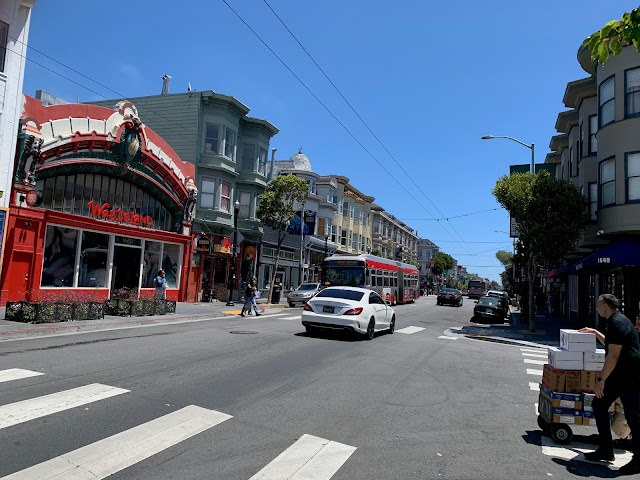
Haight Street, near Ashbury. Unfortunately, the Hippies have long since been gentrified out of this neighborhood.


San Francisco’s “homeless problem” may be overstated by the national media. With the caveat that I did not venture into the Tenderloin, I didn’t see a homeless population in SF any more severe than I might see in Downtown or Midtown Houston. I didn’t have to step over any unhoused person (or their encampments, or their puddles of piss or piles of shit) as I walked along San Francisco’s sidewalks. 

The homeless people that I did see generally kept to themselves and did not accost us for spare change or otherwise make us feel uncomfortable.
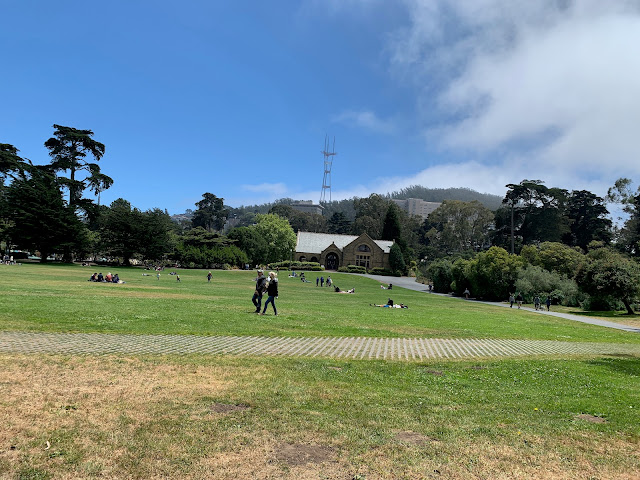
Robin Williams Meadow in Golden Gate Park, with Sharon Art Studio and Sutro Tower in the distance. 


There were, however, signs everywhere around the city warning people not to leave valuables in the their cars. And I noticed that at least one large chain clothing store on Market Street had a line of people waiting to enter; security guards were limiting the number of people who could be in the store at one time, presumably to combat shoplifting.

These were indicators that San Francisco does indeed have a property crime problem that the city is trying to battle. But, as tourists, Corinne and I never felt unsafe anywhere we went.


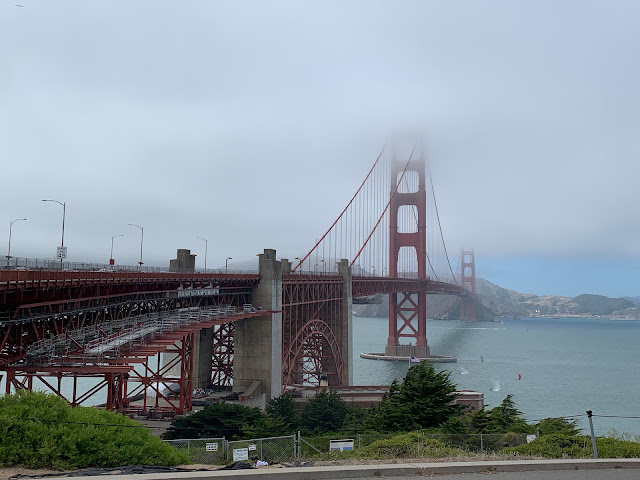
Golden Gate Bridge, as seen from the Visitor's Center on its south end, partially shrouded in fog.


"You just have to see it in person” is a cliché, but in the case of the Golden Gate Bridge, it’s true. I have seen pictures, videos, and movies of the bridge for my entire life, but none of them do it justice. It's hard to appreciate just how big and impressive it is until you've seen it for yourself with your own eyes.  

The bridge, which connects San Francisco with Marin County to the north, opened in 1937.
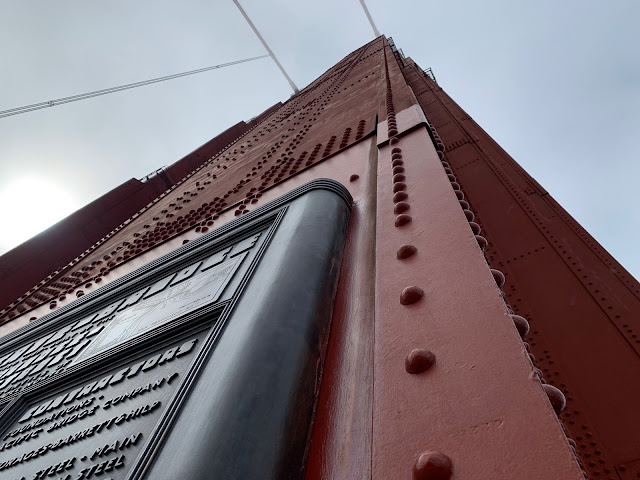
The south tower of Golden Gate Bridge, which rises to a height of 746 feet.


It is possible to bike or walk all the way across the bridge; in fact, we saw people jogging across it. Corinne and I only went as far as the south tower, but we were still treated to a magnificent view of the bay, Alcatraz, and the city. It was cold and windy on the bridge itself, but downtown San Francisco, off in the distance, was bathed in bright sunlight. The city's weather is famously interesting.

The entrance to Fisherman's Wharf. We didn't make it down to Pier 39 to see the sea lions, but we did go to Ghirardelli Square for some chocolate and a beer, so we did a few of the touristy things.


There are so many good seafood restaurants here in Houston. But, respectfully, none of them do crab cakes like they do in Fisherman’s Wharf. Those were surreally delicious. 

In fact, every meal we had in San Francisco, from lunch at a French cafe in Height/Ashbury to dinner at a Thai restaurant in The Castro, was excellent. We weren't in San Francisco long enough to even scratch the surface of all the different cuisines the city has to offer.
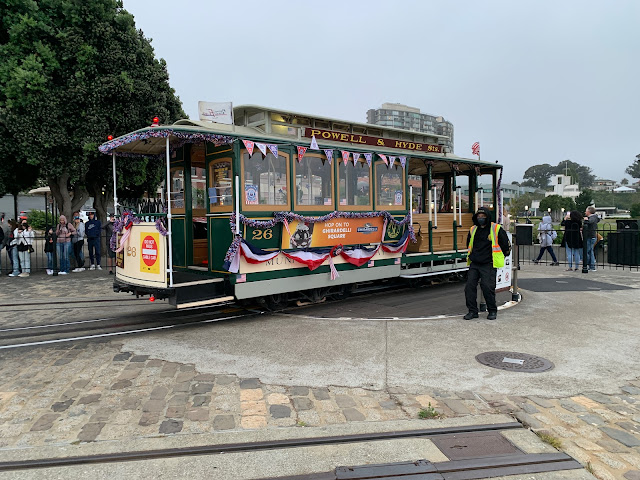
The Powell and Hyde Cable Car turntable near Ghirardelli Square.


We brought the Muni day pass ($5), which allows unlimited rides on buses and light rail for an entire day. This was very convenient for us as we explored the city, although we still did a lot of walking. 

The iconic cable cars are a big tourist draw, and you need a special ticket to ride them (the Muni day pass won't get you on board). We didn't feel like standing in a long line and paying $8 per person just to ride a cable car, but we did have fun watching the cars be manually turned at the end of their route.
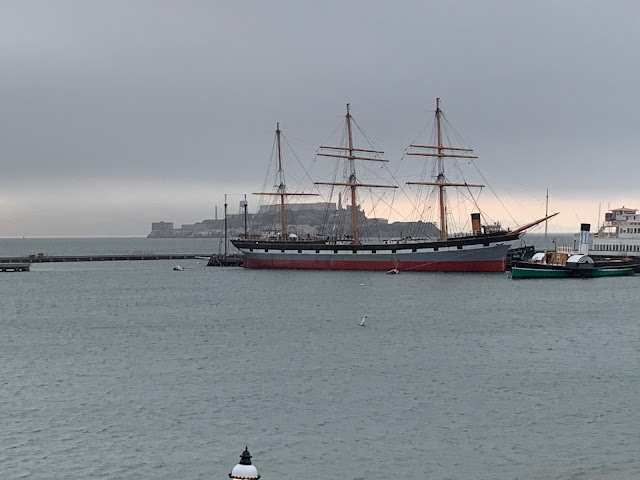
The 1886 rigger Balclutha, with Alcatraz in the background.


As I mentioned previously, San Francisco's weather is famously interesting. During the day, the weather was generally wonderful. Once night fell, however, things got cold rather quickly. "The coldest winter  I ever spent was a summer in San Francisco" may not have been said by Mark Twain, but it's an accurate quote nevertheless.
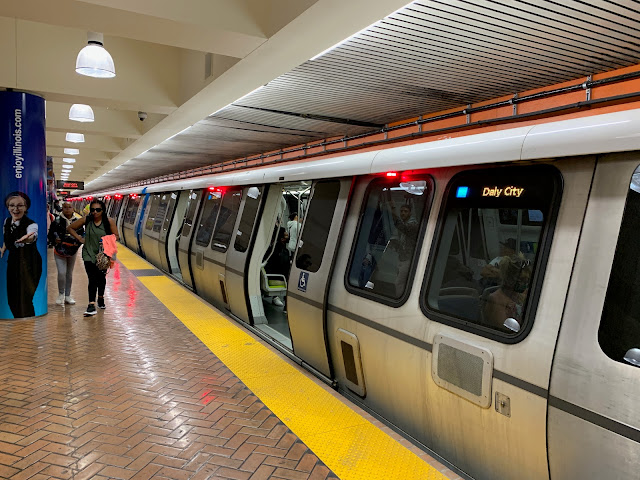
Powell Street BART Station. Along Market Street in downtown San Francisco, MUNI trains run one level below the surface while BART runs two levels below the surface. 


Muni provides transit service in San Francisco itself, while BART (Bay Area Rapid Transit) is a metro system serving the entire Bay Area. Obviously, as a transitgeek I had to take a ride.

As much noterity as the Golden Gate Bridge gets for being an engineering marvel (and it is), the BART Transbay Tube also deserves some recognition. This tunnel, which will celebrate its 50th birthday in just a couple of years, zipped us underneath the Bay from San Francisco to Oakland and back in a matter of minutes. 

Tribune Tower in Downtown Oakland.


The primary purpose of the trip to Oakland was to ride BART; we were in that city just long enough to walk down to Jack London Square and stop in for a drink at a local bar. I was on my best behavior as an Astros fan and refrained from telling A's fans how much their team sucks. 

Jack London Square in downtown Oakland.


The differences in microclimate around the Bay are really amazing. When we took the trip across the bay, it was cold and windy in San Francisco but warm and clear in Oakland. Did I mention that this place has interesting weather?
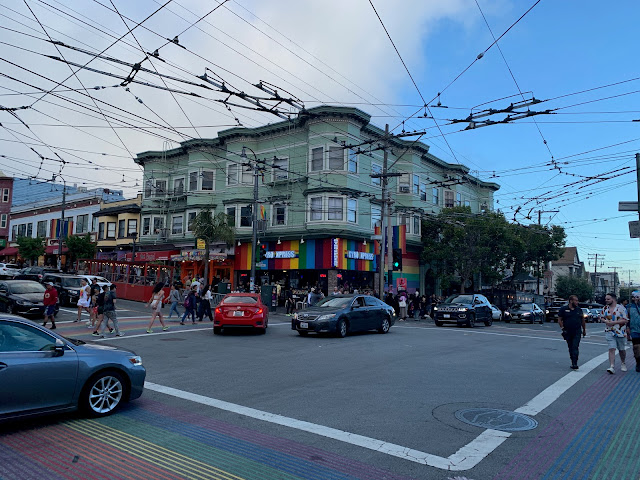
The corner of 18th Street and Castro Street, which is the center of San Francisco's famous "gayborhood." Note the maze of trolleybus catenary wires; the electric motors of Muni's trolleybus fleet handle San Francisco's steep grades better than standard diesel-powered buses. 


Corinne and I have a problem when we travel: we say to ourselves, "let's travel to place X and scratch it off our list of places to see." Then we get there and spend a few days, and realize that there is just so much more to do and see that we have no choice but to return. 

Since we’ve been together, this has been a problem: instead of getting shorter, the travel list keeps getting longer because there are simply so many places we need to return to: Germany, Mexico City, Austria, Venice, Washington DC, Greece, Rome, etc... Now we have to add San Francisco to the list as well. There are entire neighborhoods and attractions - Chinatown, the Embarcadero, the Presidio, Russian Hill, the zoo, Oracle Park, all the museums - that we didn't get a chance to see during our all-too-brief visit.
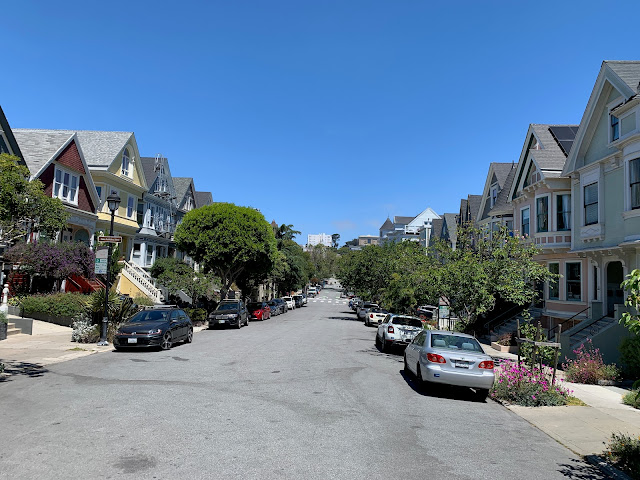
A residential street near Duboce Park.


One final note: Most of what we saw in San Francisco while we walked through it - downtown, Haight/Ashbury, Golden Gate Park, Chrissy Field, Fisherman’s Wharf and the Castro - were normal people doing normal things: hanging out in parks with their kids, fishing off Torpedo Pier, walking their dogs, biking, jogging, having conversations over drinks in outdoor cafes, etc. The city was not a dystopian hellscape.

Does San Francisco have its problems? Yes. Every major city does. However, at a time when this country is horrifically polarized, please do yourself a favor and do not buy into media-driven stereotypes about an entire city.