According to this interesting tool on an Indonesian tourism website, the straight-line distance between Houston, Texas and Dubai, United Arab Emirates is 8,181 miles.
So, when I told people in Houston before I left that I would be traveling halfway around the world for business, I wasn't being completely accurate.
The earth's average circumference is about 24,881.3 miles (I say "average" because the earth is not perfectly round; some measurements have a slightly different circumference than others, for example the circumference along the equator is 25,046.9 miles). That means that, to technically be on "the other side of the world" from Houston, I'd have to be half the earth's average circumference, 12,440.6 miles away. So, I'd have another 4,260 miles to go before I'd be completely halfway around the world from Houston.
But back in the late 80s, when I spent my summers in Ecuador and my friend Colin was living in Malaysia, the two of us were pretty damn close to being exactly on the other side of the world from one another. The straight line distance from Kuala Lumpur to Quito is 12,223 miles: merely 300 miles short of half the earth's circumference at the equator (which both cities are very close to).
How's that for some useless personal trivia!
Anyway, even though I don't have to truly travel halfway around the world to get back to Houston, Friday's trip is sure going to feel like it. Six hours from here to Amsterdam, another nine and a half hours from Amsterdam to Houston, and a four-hour layover in Amsterdam on top of that. I'm not looking forward to the journey, but I am looking forward to coming home.
This will probably be my last post from this trip to Dubai. I expect to in Houston Friday afternoon local time and be there for just over two weeks before coming back here.
Wednesday, August 30, 2006


Tuesday, August 29, 2006
Army invited to a bowl - before the season even begins!
One last preseason college football note: what if your team was invited to a postseason bowl game before the season even began?
That's exactly what's happened to Army. The new Poinsetta Bowl, in San Diego, has invited the Black Knights to participate in their game should they end the season with at least six wins.
It won't be easy for Army. They went 4-7 last season and have road games against Texas A&M and Notre Dame, a home contest against TCU, and their annual service academy rivalry games against Air Force and Navy. Even some of the lesser names on their schedule will be tough: Arkansas State won their conference last year, Connecticut is (at least technically speaking) a BCS school and, as bad as Baylor might be, even that trip to Waco will be formidable for the Black Knights. However, they also play a few real lightweights: Kent State, VMI, Rice and Tulane. Whether they can actually fulfill their early bowl invitation is anyone's guess at this point.
I like Army. I enjoyed playing them every year when they were in Conference USA, and I even watched them play the Coogs once at Michie Stadium in West Point. That is a beautiful place to watch a football game, by the way. However odd their preseason bowl invitation might sound, I hope they can make it a reality.
That's exactly what's happened to Army. The new Poinsetta Bowl, in San Diego, has invited the Black Knights to participate in their game should they end the season with at least six wins.
It won't be easy for Army. They went 4-7 last season and have road games against Texas A&M and Notre Dame, a home contest against TCU, and their annual service academy rivalry games against Air Force and Navy. Even some of the lesser names on their schedule will be tough: Arkansas State won their conference last year, Connecticut is (at least technically speaking) a BCS school and, as bad as Baylor might be, even that trip to Waco will be formidable for the Black Knights. However, they also play a few real lightweights: Kent State, VMI, Rice and Tulane. Whether they can actually fulfill their early bowl invitation is anyone's guess at this point.
I like Army. I enjoyed playing them every year when they were in Conference USA, and I even watched them play the Coogs once at Michie Stadium in West Point. That is a beautiful place to watch a football game, by the way. However odd their preseason bowl invitation might sound, I hope they can make it a reality.
2006 football outlook: the University of Houston
A month and a half ago, I reported that I was trying not to get excited about the upcoming Cougar football season. Well, those days are over. Football season is my favorite time of year and it's only a few days (and a very long, two-legged plane ride; damn you, Emirates, for not flying non-stop to Houston yet!) away, and I am officially excited. I am counting the hours until the 8 pm kickoff at Rice Stadium this Saturday.
The Owls, under the direction of new coach Todd Graham, are abandoning the wishbone of the Ken Hatfield era for a more open style of offense. But it will take some time for the Owls to make the offensive adjustment, and their defense has a lot of improvement to make as well. Nobody is expecting much from the Owls during this year of transition; they even start the season in espn.com's inital Bottom Ten poll. Given those facts, a Cougar victory over Rice seems likely; they're 12-point favorites going into Saturday's Bayou Bucket.
Of course, a victory over Rice is never a given. The new-look Owls are going to come onto their field with a great deal of enthusiasm, and Rice's long-suffering fan base, eager for a fresh start, will be energized as well. The painful shock of the season-opening loss to Rice in 2004 is still fresh in the minds of Coog fans everywhere, and a similar start to the 2006 season would be a catastrophe.
But the Rice game aside, how good will the Cougars really be this fall? There is a sense among the Cougar faithful that this is "the year" for the Coogs. In fact, none other than legendary former coach Bill Yeoman told me that 2006 was the season to look forward to when I ran into him at Love Field in Dallas a year and a half ago. He, like many UH fans, believes that there is enough talent and experience on this fall's team to make the 2006 season a really good one, one that long-suffering Cougar fans have been waiting for for far too long.
The team is loaded at the skill positions: four-year starter Kevin Kolb is at quarterback; senior Vincent Marshall, reliable Donnie Avery and Arizona transfer Brian Ealy are in at wide receiver; Jackie Battle's a pretty good running back, and senior Roshawn Pope has been moved from the defensive side of the ball in order to add some speed to the backfield. The Cougar offensive line struggled in 2004 but made great strides last season; they should be a real strength this year. The defense saw improvement after switching to the 3-4 scheme last year and will hopefully be even better under a new defensive coordinator this year. The linebacking corps is the strength of the defense and is loaded with talent from the likes of Wade Koehl, Brandon Pahulu, Trent Allen and Cody Lubojasky. Will Gulley is back in the secondary after missing last year with an injury and joins key players such as Willie Gaston and Rocky Schwartz in the backfield. Then there's the schedule: the Coogs play eight games in the city of Houston and get tough C-USA rivals such as Tulsa, UTEP and Central Florida at home.
But with the strengths also comes areas of concern. For example, depth. If Kevin Kolb goes down, the Coogs are in serious trouble. The offensive line is thin as well. Then there's offensive efficiency: while the Coogs moved the ball well between the goal lines - they were 19th nationally in terms of yards gained - they weren't as successful in putting the ball into the endzone, coming in 51st in the nation in scoring offense. The offense needs to do a better job of finishing drives this year. There are question marks on the defensive side of the ball as well. Will the Coogs be able to mount an effective pass rush this year? They must improve upon their meager 17 sacks of a year ago. Tackling must improve, too.
And what about penalties? The Coogs got flagged 93 times for 830 yards in 2005, making Houston one of the most penalty-prone teams in the nation last season. Better team discipline is a must. The Coogs need to reduce the number of turnovers as well; the Coogs lost the ball 28 times on the year, making it one of the most turnover-prone teams in all of Division I-A. Special teams are also an area of worry; Houston’s abysmal net punting average – 27.6 yards – was the second-worst in the nation and they only made 13 out of 22 field goal attepts last season.
And, while the Coogs are expected to be an improved team this fall, other teams in the conference are expected to be pretty good as well. UTEP, with experienced coach Mike Price and senior QB Jordan Palmer, is going to be a huge obstacle in the Coogs' path to the western division title this fall. Last year's conference champion, Tulsa, returns sixteen starters and is looking to exact revenge for their close loss to Houston last year, just as the Cougars want revenge for their close losses to Central Florida and UTEP. Speaking of which, Central Florida returns 19 starters from their breakout, eight-win season of a year ago. Southern Miss is always a tough opponent, and, while the Coogs may have dodged a late USM rally to win last year, they have to go play the Golden Eagles in Hattiesburg, where they've never won, this year. Memphis might not have running back D'Angelo Williams anymore, but that hardly matters; they still have Joe Lee Dunn running the defense, and he's proven to be UH head coach (and offensive coordinator) Art Briles' nemesis. There's no doubt that Southern Methodist, under the direction of coach Phil Bennett, is improving. SMU, who upset the Coogs at Robertson last year, gets the Coogs in Dallas. And Tulane is looking to put their hurricane-ravaged season of a year ago behind them and make some serious strides this fall.
And that's just the conference. The out-of-conference schedule includes an improving Louisiana-Lafayette team led by senior QB Jerry Babb that is expected to win their conference this season. Grambling is a pretty strong program by I-AA standards. Oklahoma State is a BCS program that looks to rebound after last year's disappointing season. And Miami... Well, let's just hope that the Coogs make it out of the Orange Bowl without any serious injuries.
Indeed, this season is not going to be a cakewalk for the Cougars, and there are still a lot of unanswered questions on both sides of the ball. But with experience and maturation comes improvement, which makes it probable that the team won't repeat some of the costly mistakes they made a year ago. I'm also hopeful that the team's overall stamina will be improved by a new strength and conditioning coach, so that the Coogs will maintain their physical edge through four quarters. Last season, Houston surrendered third-quarter leads in their losses to Oregon, UTEP and SMU and allowed Tulsa and Southern Miss back into games that should have been over.
This is not a team that is going to compete for a national championship. Just winning their division is going to be a challenge. But the 2006 Houston Cougars are a team that has the potential to put together the most successful season on Cullen Boulevard since the Run and Shoot era.
Over on various UH athletics message boards, of course, the mood is optimistic and expectations are high. There seems to be a consensus that an eight-win season is the bar for 2006, and that anything less than that would constitute a disappointing season. Enthusiasm among UH fans is evident on the Houston Chronicle's UH athletics blog, where blogger Ronnie Turner asked his readers what they thought. Most of the responses were optimistic; a couple of people even predicted an upset win over Miami. "I'll be disappointed if their record is worse than 8-4 in the regular season," one respondent wrote. "10 wins is a given," somebody else said. Not every UH fan is quite as optimistic, it should be noted. One local blogger foresees a break-even, six-win season for Houston this fall.
But fan predictions are one thing; what do national college football resources, which have a tendency to be more objective, say about the Houston Cougars? Collegefootballpoll.com, which uses the Congrove Computer System to predict its games, has come up with a preseason prediction of 7-5 for the Coogs. Collegefootballnews.com predicts a 7-5 record for the Coogs as well. Sports Illustrated, likewise, envisions a 7-win season for the Coogs. And Jeff Sagarin's preseason rankings at usatoday.com, which put Houston 89th to start the season, imply an 8-4 record for the Coogs when the ratings of opponents and the home-field advantage are taken into account.
There are also publications that pick where the coogs will end up in the conference but don't pick a record. As far as the preseason magazines go, Houston is picked to win or tie for the Western Division by Phil Steele, Gold Sheet and ATS Consultants. The rest have the Coogs pegged at third. Sportsline.com has the Coogs pegged at third in the west as well; so does usatoday.com. The C-USA coaches, in their yearly poll, also think that Houston will end up third in the West, behind Tulsa and UTEP.
Of course, preseason predictions are just that - predictions. They play the games for a reason. But that won't stop me from making my own predictions for the 2006 Cougar football season. I think the Coogs' schedule, as well as their talent and experience, will result in eight regular season wins this year.
I believe they will defeat Rice, Tulane, Grambling, ULL and take two of UTEP, UCF and Tulsa at home. They'll exact revenge against SMU in Dallas, and win one of their road games against USM and Memphis. A win over Oklahoma State is also a possibility, but after the Fort Worth Bowl debacle against Kansas I'm not confident enough to predict a Cougar victory over even a struggling Big XII school. And Miami, well, I'd be happy to see the Coogs cover the spread.
If the Coogs can get past both UTEP and Tulsa, then they'll probably end up atop C-USA's western division and play in the conference's championship game in September. But even if eight wins only puts them in second or third place, that will still represent the best UH season since 1990 and almost certainly send them to a postseason bowl for the third time in four years. That's good enough for me. If the Coogs can win their first bowl game since the Carter administration, that'd be even better.
Of course, anything over eight wins would be fantastic. A seven-win would be less thrilling but still acceptable to me. A .500 season would be a bit of a disappointment. And a losing season? Well, I don't want to go there, but it would probably mean the end of the Art Briles era.
Let's hope that doesn't come to pass. The Coogs (and their fans) could really use a breakout season.
This prediction, as well as many other fun discussions regarding UH fans, can also be found in my latest edition of As The World (Wide Web) Turns - Cougar Edition, now posted at coogfun.com.
EDIT: Chronicle columnist John Lopez thinks that the Coogs are in for a good season, too. He is among those pointing to 2006 as a pivotal year:
Exactly. If not this year for the Coogs, then when?
The Owls, under the direction of new coach Todd Graham, are abandoning the wishbone of the Ken Hatfield era for a more open style of offense. But it will take some time for the Owls to make the offensive adjustment, and their defense has a lot of improvement to make as well. Nobody is expecting much from the Owls during this year of transition; they even start the season in espn.com's inital Bottom Ten poll. Given those facts, a Cougar victory over Rice seems likely; they're 12-point favorites going into Saturday's Bayou Bucket.
Of course, a victory over Rice is never a given. The new-look Owls are going to come onto their field with a great deal of enthusiasm, and Rice's long-suffering fan base, eager for a fresh start, will be energized as well. The painful shock of the season-opening loss to Rice in 2004 is still fresh in the minds of Coog fans everywhere, and a similar start to the 2006 season would be a catastrophe.
But the Rice game aside, how good will the Cougars really be this fall? There is a sense among the Cougar faithful that this is "the year" for the Coogs. In fact, none other than legendary former coach Bill Yeoman told me that 2006 was the season to look forward to when I ran into him at Love Field in Dallas a year and a half ago. He, like many UH fans, believes that there is enough talent and experience on this fall's team to make the 2006 season a really good one, one that long-suffering Cougar fans have been waiting for for far too long.
The team is loaded at the skill positions: four-year starter Kevin Kolb is at quarterback; senior Vincent Marshall, reliable Donnie Avery and Arizona transfer Brian Ealy are in at wide receiver; Jackie Battle's a pretty good running back, and senior Roshawn Pope has been moved from the defensive side of the ball in order to add some speed to the backfield. The Cougar offensive line struggled in 2004 but made great strides last season; they should be a real strength this year. The defense saw improvement after switching to the 3-4 scheme last year and will hopefully be even better under a new defensive coordinator this year. The linebacking corps is the strength of the defense and is loaded with talent from the likes of Wade Koehl, Brandon Pahulu, Trent Allen and Cody Lubojasky. Will Gulley is back in the secondary after missing last year with an injury and joins key players such as Willie Gaston and Rocky Schwartz in the backfield. Then there's the schedule: the Coogs play eight games in the city of Houston and get tough C-USA rivals such as Tulsa, UTEP and Central Florida at home.
But with the strengths also comes areas of concern. For example, depth. If Kevin Kolb goes down, the Coogs are in serious trouble. The offensive line is thin as well. Then there's offensive efficiency: while the Coogs moved the ball well between the goal lines - they were 19th nationally in terms of yards gained - they weren't as successful in putting the ball into the endzone, coming in 51st in the nation in scoring offense. The offense needs to do a better job of finishing drives this year. There are question marks on the defensive side of the ball as well. Will the Coogs be able to mount an effective pass rush this year? They must improve upon their meager 17 sacks of a year ago. Tackling must improve, too.
And what about penalties? The Coogs got flagged 93 times for 830 yards in 2005, making Houston one of the most penalty-prone teams in the nation last season. Better team discipline is a must. The Coogs need to reduce the number of turnovers as well; the Coogs lost the ball 28 times on the year, making it one of the most turnover-prone teams in all of Division I-A. Special teams are also an area of worry; Houston’s abysmal net punting average – 27.6 yards – was the second-worst in the nation and they only made 13 out of 22 field goal attepts last season.
And, while the Coogs are expected to be an improved team this fall, other teams in the conference are expected to be pretty good as well. UTEP, with experienced coach Mike Price and senior QB Jordan Palmer, is going to be a huge obstacle in the Coogs' path to the western division title this fall. Last year's conference champion, Tulsa, returns sixteen starters and is looking to exact revenge for their close loss to Houston last year, just as the Cougars want revenge for their close losses to Central Florida and UTEP. Speaking of which, Central Florida returns 19 starters from their breakout, eight-win season of a year ago. Southern Miss is always a tough opponent, and, while the Coogs may have dodged a late USM rally to win last year, they have to go play the Golden Eagles in Hattiesburg, where they've never won, this year. Memphis might not have running back D'Angelo Williams anymore, but that hardly matters; they still have Joe Lee Dunn running the defense, and he's proven to be UH head coach (and offensive coordinator) Art Briles' nemesis. There's no doubt that Southern Methodist, under the direction of coach Phil Bennett, is improving. SMU, who upset the Coogs at Robertson last year, gets the Coogs in Dallas. And Tulane is looking to put their hurricane-ravaged season of a year ago behind them and make some serious strides this fall.
And that's just the conference. The out-of-conference schedule includes an improving Louisiana-Lafayette team led by senior QB Jerry Babb that is expected to win their conference this season. Grambling is a pretty strong program by I-AA standards. Oklahoma State is a BCS program that looks to rebound after last year's disappointing season. And Miami... Well, let's just hope that the Coogs make it out of the Orange Bowl without any serious injuries.
Indeed, this season is not going to be a cakewalk for the Cougars, and there are still a lot of unanswered questions on both sides of the ball. But with experience and maturation comes improvement, which makes it probable that the team won't repeat some of the costly mistakes they made a year ago. I'm also hopeful that the team's overall stamina will be improved by a new strength and conditioning coach, so that the Coogs will maintain their physical edge through four quarters. Last season, Houston surrendered third-quarter leads in their losses to Oregon, UTEP and SMU and allowed Tulsa and Southern Miss back into games that should have been over.
This is not a team that is going to compete for a national championship. Just winning their division is going to be a challenge. But the 2006 Houston Cougars are a team that has the potential to put together the most successful season on Cullen Boulevard since the Run and Shoot era.
Over on various UH athletics message boards, of course, the mood is optimistic and expectations are high. There seems to be a consensus that an eight-win season is the bar for 2006, and that anything less than that would constitute a disappointing season. Enthusiasm among UH fans is evident on the Houston Chronicle's UH athletics blog, where blogger Ronnie Turner asked his readers what they thought. Most of the responses were optimistic; a couple of people even predicted an upset win over Miami. "I'll be disappointed if their record is worse than 8-4 in the regular season," one respondent wrote. "10 wins is a given," somebody else said. Not every UH fan is quite as optimistic, it should be noted. One local blogger foresees a break-even, six-win season for Houston this fall.
But fan predictions are one thing; what do national college football resources, which have a tendency to be more objective, say about the Houston Cougars? Collegefootballpoll.com, which uses the Congrove Computer System to predict its games, has come up with a preseason prediction of 7-5 for the Coogs. Collegefootballnews.com predicts a 7-5 record for the Coogs as well. Sports Illustrated, likewise, envisions a 7-win season for the Coogs. And Jeff Sagarin's preseason rankings at usatoday.com, which put Houston 89th to start the season, imply an 8-4 record for the Coogs when the ratings of opponents and the home-field advantage are taken into account.
There are also publications that pick where the coogs will end up in the conference but don't pick a record. As far as the preseason magazines go, Houston is picked to win or tie for the Western Division by Phil Steele, Gold Sheet and ATS Consultants. The rest have the Coogs pegged at third. Sportsline.com has the Coogs pegged at third in the west as well; so does usatoday.com. The C-USA coaches, in their yearly poll, also think that Houston will end up third in the West, behind Tulsa and UTEP.
Of course, preseason predictions are just that - predictions. They play the games for a reason. But that won't stop me from making my own predictions for the 2006 Cougar football season. I think the Coogs' schedule, as well as their talent and experience, will result in eight regular season wins this year.
I believe they will defeat Rice, Tulane, Grambling, ULL and take two of UTEP, UCF and Tulsa at home. They'll exact revenge against SMU in Dallas, and win one of their road games against USM and Memphis. A win over Oklahoma State is also a possibility, but after the Fort Worth Bowl debacle against Kansas I'm not confident enough to predict a Cougar victory over even a struggling Big XII school. And Miami, well, I'd be happy to see the Coogs cover the spread.
If the Coogs can get past both UTEP and Tulsa, then they'll probably end up atop C-USA's western division and play in the conference's championship game in September. But even if eight wins only puts them in second or third place, that will still represent the best UH season since 1990 and almost certainly send them to a postseason bowl for the third time in four years. That's good enough for me. If the Coogs can win their first bowl game since the Carter administration, that'd be even better.
Of course, anything over eight wins would be fantastic. A seven-win would be less thrilling but still acceptable to me. A .500 season would be a bit of a disappointment. And a losing season? Well, I don't want to go there, but it would probably mean the end of the Art Briles era.
Let's hope that doesn't come to pass. The Coogs (and their fans) could really use a breakout season.
This prediction, as well as many other fun discussions regarding UH fans, can also be found in my latest edition of As The World (Wide Web) Turns - Cougar Edition, now posted at coogfun.com.
EDIT: Chronicle columnist John Lopez thinks that the Coogs are in for a good season, too. He is among those pointing to 2006 as a pivotal year:
That's why the Cougars have reached a now-or-never kind of point in their football program's existence. If, after seasons of football lethargy at UH, this deep, talented, fast and hungry team cannot take the next step and capture some attention, then when will it happen? Ever?
Exactly. If not this year for the Coogs, then when?
Speaking of hurricanes...
Well, it looks like I won't have to worry about Ernesto disrupting my flight home (or, for that matter, the start of football season) after all.
 Can't say the same thing for the people of Florida, however. They need another hurricane like Dubai needs more cars.
(Sorry for the cheesy analogy, but I couldn't help it. My taxi ride back to the hotel this afternoon took over thirty minutes, even though my office is no more than three miles from my hotel. Traffic congestion in this city is beyond horrible, and it gets worse every day.)
 Can't say the same thing for the people of Florida, however. They need another hurricane like Dubai needs more cars.
(Sorry for the cheesy analogy, but I couldn't help it. My taxi ride back to the hotel this afternoon took over thirty minutes, even though my office is no more than three miles from my hotel. Traffic congestion in this city is beyond horrible, and it gets worse every day.)
Katrina plus one year
As everybody who doesn't live under a rock knows by now, today is the one-year anniversary of Hurricane Katrina's landfall. News stories and TV specials will run all day long recounting the horror of that day one year ago: when 80 percent of New Orleans flooded, coastal communities of Louisiana and Mississippi were devastated, and 1,700 people lost their lives. For hundreds of thousands of other people who were displaced by the storm, their lives have changed forever.
Even though it's been an entire year, it's obviously much too soon to evaluate the full effect of Katrina. It will be many more years before a clear picture of the hurricane's true consequences are understood. The Gulf Coast is still in flux; the rebuilding effort, long and painful as it might be, continues.
As I noted when I visited New Orleans two months ago, the pace of recovery in that city is slow. Large parts of the city are still abandoned; the city's population today is only half of what it was a year ago. Only half of New Orleans schools have reopened, and only three of the city's ten hospitals are operational. As I noticed when I was in New Orleans, the city's culture now revolves around Katrina and its amftermath. Any conversation you have with a local resident will eventually turn to a discussion of where that person evacuated to and what condition their home is currently in. The local newscasts are dominated by stories about rebuilding efforts, FEMA reimbursements, canal reconstruction or other storm-related matters. It's clear that, regardless of how successful the rebuilding effort might be, the city will never be quite the same. The French Quarter, the food, the jazz, the Sugar Bowl and Mardi Gras might always be there, but the city as a whole will be different. The only question is how different "New New Orleans" will be from the city that existed pre-Katrina.
While so much attention has been paid to New Orleans, it's worth remembering that several other cities were changed by Katrina as well. For example, Louisiana's capital of Baton Rouge became the largest city in the state following the storm, and there's been widespread speculation that this change is permanent. Some analysts say the Katrina will have the same affect on Baton Rouge as the Galveston hurricane of 1900 (which is still the nation's deadliest natural disaster) had on Houston. Before the storm, Galveston was the state's largest city. After the storm, Houston took that title and continued to grow such that it is now the fourth-largest city in the nation.
And then there's Houston itself. The city was a refuge for hundreds of thousands of Katrina refugees, and upwards of 150,000 displaced New Orleanians remain in the city one year later, putting stress on the local school and hospital systems and placing upward pressure on the crime and unemployment rates. As this Christian Science Monitor article about Katrina's effects on Houston notes, the economic burden of accomodating these refugees - many of whom still have no homes or jobs to return to a year later - is significant, and getting assistance from the federal government has not been an easy task:
Katrina had a variety of psychological effects on the local population as well. Houstonians opened their arms and their wallets when the first busloads of refugees - many having lost everything except the clothes on their backs - began arriving a year ago. So many Houstonians volunteered to help at the Astrodome or the George R. Brown Convention Center that people were turned away. There was an overwhelming sense of civic pride; people were proud of their generousity. However, the destruction wrought by Katrina also gave Houstonians a newfound sense of vulnerability; people realized that what happened in New Orleans could also happen in Houston and that realization became apparent less than a month later when Rita threatened and the local population, in a panic, took to the evacuation routes leading out of the city. The usual four-hour drive to Dallas became a 30-hour ordeal; the 2.5-hour trip to Austin became a day-long nightmare in the sweltering September heat. In the months following the Rita exodus, local leaders and citizens alike realized that their own evacuation plans needed to be rethought.
Indeed, the entire Gulf Coast - not just Louisiana or Mississippi - has been affected physically, economically and emotionally by the storm that landed one year ago today. As we remember the catastrophe and take inventory of all that has changed since then, we much understand that the process of rebuilding, recovering, and re-adapting has only just begun.
Even though it's been an entire year, it's obviously much too soon to evaluate the full effect of Katrina. It will be many more years before a clear picture of the hurricane's true consequences are understood. The Gulf Coast is still in flux; the rebuilding effort, long and painful as it might be, continues.
As I noted when I visited New Orleans two months ago, the pace of recovery in that city is slow. Large parts of the city are still abandoned; the city's population today is only half of what it was a year ago. Only half of New Orleans schools have reopened, and only three of the city's ten hospitals are operational. As I noticed when I was in New Orleans, the city's culture now revolves around Katrina and its amftermath. Any conversation you have with a local resident will eventually turn to a discussion of where that person evacuated to and what condition their home is currently in. The local newscasts are dominated by stories about rebuilding efforts, FEMA reimbursements, canal reconstruction or other storm-related matters. It's clear that, regardless of how successful the rebuilding effort might be, the city will never be quite the same. The French Quarter, the food, the jazz, the Sugar Bowl and Mardi Gras might always be there, but the city as a whole will be different. The only question is how different "New New Orleans" will be from the city that existed pre-Katrina.
While so much attention has been paid to New Orleans, it's worth remembering that several other cities were changed by Katrina as well. For example, Louisiana's capital of Baton Rouge became the largest city in the state following the storm, and there's been widespread speculation that this change is permanent. Some analysts say the Katrina will have the same affect on Baton Rouge as the Galveston hurricane of 1900 (which is still the nation's deadliest natural disaster) had on Houston. Before the storm, Galveston was the state's largest city. After the storm, Houston took that title and continued to grow such that it is now the fourth-largest city in the nation.
And then there's Houston itself. The city was a refuge for hundreds of thousands of Katrina refugees, and upwards of 150,000 displaced New Orleanians remain in the city one year later, putting stress on the local school and hospital systems and placing upward pressure on the crime and unemployment rates. As this Christian Science Monitor article about Katrina's effects on Houston notes, the economic burden of accomodating these refugees - many of whom still have no homes or jobs to return to a year later - is significant, and getting assistance from the federal government has not been an easy task:
Sen. Kay Bailey Hutchison (R) of Texas said one of the most difficult challenges she's faced has been convincing her congressional colleagues and the Bush administration that a hurricane that didn't actually hit Texas has had profound financial implications for the state.
Katrina had a variety of psychological effects on the local population as well. Houstonians opened their arms and their wallets when the first busloads of refugees - many having lost everything except the clothes on their backs - began arriving a year ago. So many Houstonians volunteered to help at the Astrodome or the George R. Brown Convention Center that people were turned away. There was an overwhelming sense of civic pride; people were proud of their generousity. However, the destruction wrought by Katrina also gave Houstonians a newfound sense of vulnerability; people realized that what happened in New Orleans could also happen in Houston and that realization became apparent less than a month later when Rita threatened and the local population, in a panic, took to the evacuation routes leading out of the city. The usual four-hour drive to Dallas became a 30-hour ordeal; the 2.5-hour trip to Austin became a day-long nightmare in the sweltering September heat. In the months following the Rita exodus, local leaders and citizens alike realized that their own evacuation plans needed to be rethought.
Indeed, the entire Gulf Coast - not just Louisiana or Mississippi - has been affected physically, economically and emotionally by the storm that landed one year ago today. As we remember the catastrophe and take inventory of all that has changed since then, we much understand that the process of rebuilding, recovering, and re-adapting has only just begun.
Saturday, August 26, 2006
Oh, great.
Say hello to Ernesto.
Look where Ernesto might be headed. Notice where he might be towards the end of next week, when I'm supposed to fly back into Houston.
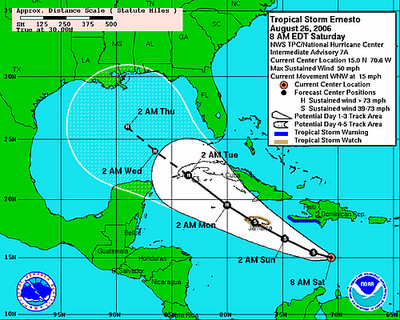
Look where Ernesto might be headed. Notice where he might be towards the end of next week, when I'm supposed to fly back into Houston.
And just in time for the start of football season, too. It figures...
Thursday, August 24, 2006
Dubai Picture Time!
I guess it's time to share a few of the pictures I've taken so far.
Here's a view looking south towards Dubai Creek from my hotel. Traffic is uncharacteristically light on Al Garhoud Road (Emirates Highway 11) headed towards the bridge. In the distance you can see construction well underway on a pair of large towers at Festival City as well as a much-needed third bridge over Dubai Creek.
I'll try to upload more throughout the fall. Unfortunately, no amount of photographs can do this city justice. You just have to be here to really understand the full scale of what is going on.
Here's a view looking south towards Dubai Creek from my hotel. Traffic is uncharacteristically light on Al Garhoud Road (Emirates Highway 11) headed towards the bridge. In the distance you can see construction well underway on a pair of large towers at Festival City as well as a much-needed third bridge over Dubai Creek.
 I took this shot of the Burj Dubai as we drove by. It still has a way to go before it becomes the tallest building in the world, but it's come along way from how it looked in January. Unfortunately, August isn't the best time to take pictures due to all the sand and haze in the air.

 Meanwhile, at the Dubai Marina, dozens of office and condominium highrises are being erected. You can see why I call this place the "City of Cranes." They're everywhere.

Another view of a cluster of high-rises under construction at Dubai Marina. Timeshare, anyone?

I'll try to upload more throughout the fall. Unfortunately, no amount of photographs can do this city justice. You just have to be here to really understand the full scale of what is going on.
Blood on the highway
We are approaching the fifth anniversary of the September 11th terrorist attacks. 3,000 people lost their lives on that horrible day. Could you imagine what it would be like if the United States suffered a September 11th - like event every 25 days or so?
In terms of the number of lives lost, that is exactly what is happening on our nation's highways every year. According to the National Highway Traffic Safety Administration, 43,443 people were killed on the nation's highways in 2005. This is up 1.4 percent from the 42.8 thousand people killed in traffic wrecks in 2004, and is the highest annual highway death toll since 1990. An increase in pedestrian and motorcycle fatalities is blamed for the increase; here's a chart that breaks down the fatalities by mode.
In fairness, it needs to be pointed out that, in spite of this death toll, our highways are about as safe as they have ever been. The average fatality rate per miles traveled is slightly lower today that it was a decade ago (1.48 deaths per 100 million vehicle miles traveled today as opposed to 1.73 deaths per 100 million VMT in 1995) and is much lower than it was in the 1950s and 1960s, when the average fatality rate sat somewhere between 5 and 6 deaths per 100 million VMT.
Nevertheless, 43 thousand people needlessly died on our nation's roads and highways last year. That is a ponderous toll, and one that doesn't get a lot of attention:
Over half of all automobile passengers who died last year were not wearing a seat belt. So buckle up and drive safely.
In terms of the number of lives lost, that is exactly what is happening on our nation's highways every year. According to the National Highway Traffic Safety Administration, 43,443 people were killed on the nation's highways in 2005. This is up 1.4 percent from the 42.8 thousand people killed in traffic wrecks in 2004, and is the highest annual highway death toll since 1990. An increase in pedestrian and motorcycle fatalities is blamed for the increase; here's a chart that breaks down the fatalities by mode.
In fairness, it needs to be pointed out that, in spite of this death toll, our highways are about as safe as they have ever been. The average fatality rate per miles traveled is slightly lower today that it was a decade ago (1.48 deaths per 100 million vehicle miles traveled today as opposed to 1.73 deaths per 100 million VMT in 1995) and is much lower than it was in the 1950s and 1960s, when the average fatality rate sat somewhere between 5 and 6 deaths per 100 million VMT.
Nevertheless, 43 thousand people needlessly died on our nation's roads and highways last year. That is a ponderous toll, and one that doesn't get a lot of attention:
Safety groups said more attention should be placed on traffic issues, arguing that a single airplane crash could lead to public outcries while more than 40,000 deaths on the roads fail to generate much response.That's true, which is why I likened last year's highway death toll to the equivalent of a 9/11 event every 25 days: it puts this unspoken carnage in a different perspective. Perhaps, if people were made more aware of the sheer volume of death occuring on our nation's roads every year, they might be a little more careful in their own driving habits.
Over half of all automobile passengers who died last year were not wearing a seat belt. So buckle up and drive safely.
Monday, August 21, 2006
Happy Birthday, Kirby!
It’s hard to believe, but our son turns two years old today.
Unfortunately, I can’t be there for his big day today, or for the small party he’ll have with Lori, my parents, Lori’s family and his great-grandparents this weekend. I hope he’ll forgive me one of these days.
I’d send him a card and a present, but shipping parcels from here to the United States is expensive and I don’t know if a card would get there before I did. I guess I’ll just bring them back home with me so he and I can have a belated birthday party once I return.
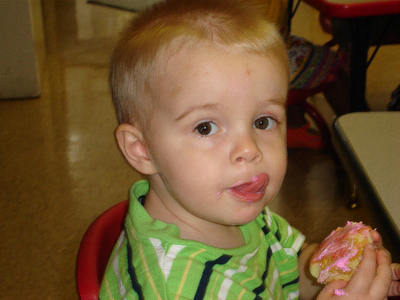
Lori took this picture of Kirby enjoying a birthday cupcake last week. I’ll put more pictures of him on his page once I get back to Houston a little more than a week from now.
Unfortunately, I can’t be there for his big day today, or for the small party he’ll have with Lori, my parents, Lori’s family and his great-grandparents this weekend. I hope he’ll forgive me one of these days.
I’d send him a card and a present, but shipping parcels from here to the United States is expensive and I don’t know if a card would get there before I did. I guess I’ll just bring them back home with me so he and I can have a belated birthday party once I return.
Lori took this picture of Kirby enjoying a birthday cupcake last week. I’ll put more pictures of him on his page once I get back to Houston a little more than a week from now.
2006 football outlook: the University of North Texas
Speaking of North Texas, I really guess I should acknowledge the other half of the title of this blog and make some predictions about the Mean Green’s upcoming season.
Last year was a rough year for the Darrell Dickey’s squad, whose streak of four consecutive conference championships (and New Orleans Bowl appearances) ended with a disappointing 2-9 record.
So how will they do this year? Some preseason prognisticators don’t have much faith in a North Texas rebound this season. Collegefootballnews.com’s preseason outlook places UNT 109th (out of 119 teams) and foresees a 4-8 campaign for the Green. Collegefootballpoll.com also expects a rough year for North Texas, with a 2-10 record. Not exactly good news for the Denton faithful, since the Congrove Computer System cfp.com uses has predicted UNT’s record either perfectly or within a single game for eight out of the last eleven seasons. Sports Illustrated, meanwhile, predicts a 3-9 campaign for the Mean Green. Not all the preseason prognostications are as bleak, however. The folks at msnbc.com foresee North Texas regaining its place atop the Sun Belt this fall (scroll down to the bottom).
To be sure, the Mean Green aren't devoid of talent. For example, Jamario Thomas, who led the nation in rushing in 2004, will figure prominently in the offense as long as he avoids the hamstring problems that hobbled him last year, and Johhny Quinn is as good a receiver as any in the Sun Belt. The big question is quarterback; the departure of Scott Hall left little experience at the quarterback position, and that was one of the reasons for UNT’s troubles last season. Neither of the two main contenders (sophomores Daniel Meager and Matt Phillips) have been particularly impressive. As for the North Texas defense, well… Let’s just say that the good news is that it can’t be any worse than it was last season. Better defense against the run is crucial if the Mean Green hope to compete for their fifth conference championship in six years.
Then there’s the schedule. North Texas will do well to escape their paycheck loss to Texas in Austin without any major injuries, but they also have back-to-back September roadies against two of last year’s conference champions: C-USA champ Tulsa and MAC champ Akron. The conference schedule isn’t exactly favorable, either; the Mean Green have to play the top three Sun Belt teams from last year – Arkansas State, Louisiana-Monroe, and preseason favorite Louisiana-Lafayette – on the road.
Given those facts, I think 2006 is probably going to be another rebuilding year for North Texas. They could surprise – I’d love it if they did – but I honestly think the Mean Green will be able to claim success if they can merely squeak out a break-even, six-win season.
This will, unfortunately, be the third year in a row that I won’t be able to make any trips up to Denton to see the Mean Green play in person.
Last year was a rough year for the Darrell Dickey’s squad, whose streak of four consecutive conference championships (and New Orleans Bowl appearances) ended with a disappointing 2-9 record.
So how will they do this year? Some preseason prognisticators don’t have much faith in a North Texas rebound this season. Collegefootballnews.com’s preseason outlook places UNT 109th (out of 119 teams) and foresees a 4-8 campaign for the Green. Collegefootballpoll.com also expects a rough year for North Texas, with a 2-10 record. Not exactly good news for the Denton faithful, since the Congrove Computer System cfp.com uses has predicted UNT’s record either perfectly or within a single game for eight out of the last eleven seasons. Sports Illustrated, meanwhile, predicts a 3-9 campaign for the Mean Green. Not all the preseason prognostications are as bleak, however. The folks at msnbc.com foresee North Texas regaining its place atop the Sun Belt this fall (scroll down to the bottom).
To be sure, the Mean Green aren't devoid of talent. For example, Jamario Thomas, who led the nation in rushing in 2004, will figure prominently in the offense as long as he avoids the hamstring problems that hobbled him last year, and Johhny Quinn is as good a receiver as any in the Sun Belt. The big question is quarterback; the departure of Scott Hall left little experience at the quarterback position, and that was one of the reasons for UNT’s troubles last season. Neither of the two main contenders (sophomores Daniel Meager and Matt Phillips) have been particularly impressive. As for the North Texas defense, well… Let’s just say that the good news is that it can’t be any worse than it was last season. Better defense against the run is crucial if the Mean Green hope to compete for their fifth conference championship in six years.
Then there’s the schedule. North Texas will do well to escape their paycheck loss to Texas in Austin without any major injuries, but they also have back-to-back September roadies against two of last year’s conference champions: C-USA champ Tulsa and MAC champ Akron. The conference schedule isn’t exactly favorable, either; the Mean Green have to play the top three Sun Belt teams from last year – Arkansas State, Louisiana-Monroe, and preseason favorite Louisiana-Lafayette – on the road.
Given those facts, I think 2006 is probably going to be another rebuilding year for North Texas. They could surprise – I’d love it if they did – but I honestly think the Mean Green will be able to claim success if they can merely squeak out a break-even, six-win season.
This will, unfortunately, be the third year in a row that I won’t be able to make any trips up to Denton to see the Mean Green play in person.
Subscribe to:
Posts (Atom)