 Kirby seemed to enjoy a lazy day at the swimming pool last weekend. At least I hope he enjoyed it, because his summer is coming to an end. Second grade starts next week!
Wednesday, August 17, 2011
Relaxing at the pool
Kirby seemed to enjoy a lazy day at the swimming pool last weekend. At least I hope he enjoyed it, because his summer is coming to an end. Second grade starts next week!


Monday, August 08, 2011
UAE national murdered near Texas Medical Center
Although I've long since become desensitized to the violence that happens in this city, I am nevertheless disgusted by this story:
UPDATE: both suspects in Al Mazrouei's murder have been apprehended.
A 28-year-old military officer from the United Arab Emirates who came to Houston to care for his cancer-stricken father was shot to death by robbers Sunday.
Salem Saif Al Mazrouei was killed about 10:30 p.m., shortly after he and his father returned from prayers at a mosque to their rented apartment in a gated complex in the 8100 block of El Mundo, police said.
The family has been staying at the apartment in south Houston while the father undergoes treatment at the University of Texas MD Anderson Cancer Center.
Al Mazrouei and his father had just returned from prayers at the mosque on Almeda near Old Spanish Trail and had stopped by their apartment to gather sweets for what was probably a Ramadan gathering at another apartment in the same complex. The two were followed inside their apartment by two thugs who tried to rob them. When he and his father tried to escape, Al Mazrouei was fatally shot. The criminals then took off in his rented Toyota Avalon, which was later found on the other side of highway 288.
Although the Chronicle article doesn't mention it, a story about this crime in The National suggests that the father and son, who are from the emirate of Ras al Khaimah in the northern part of the UAE, might have been targeted because they were wearing "national dress," i.e. robe and headdress:
“They were wearing their traditional Middle Eastern dress, and by some accounts you could assume they were targeted because of that, but we don’t know that for certain right now,” said Officer M Miller, a Houston police homicide investigator.
If that's the case, then this might be a hate crime in addition to being a carjacking, robbery and murder. But the investigation is ongoing, and the murderers remain at large.
I am repulsed by this crime not only because it is a senseless murder, but also because it happened to a person whose family had decided to come all the way to Houston from the Emirates to seek cancer treatment for their father.
The National article speaks highly of the M. D. Anderson Cancer Center, and Sheikh Kalifa Bin Zayed Al Nahyan, President of the UAE and Ruler of Abu Dhabi, donated $150 million to M.D. Anderson earlier this year, which says a lot about the esteem with which M.D. Anderson is held in the UAE.
Since this site still gets a fair amount of web traffic from the UAE, I would like to say this to anyone from there that might be reading this, be they Emirati or expat: these scumbags are not representative of the people of Houston. Right now there is nothing to suggest that this crime is anything other than an isolated incident, and the thugs who committed it will eventually be caught and brought to justice. Do not let this horrible crime deter you from seeking treatment at M.D. Anderson.
UPDATE: both suspects in Al Mazrouei's murder have been apprehended.
Colorado 2011
A couple of weeks ago, Kirby and I made our annual summertime trip to Colorado to visit my brother David, see some sights and get away from the oppressive Houston summer. That last part didn't work out too well; Denver was almost as hot as Houston while we were there. But we still had a great time, exploring the mountains as well as seeing some sights in and around Denver and Colorado Springs.
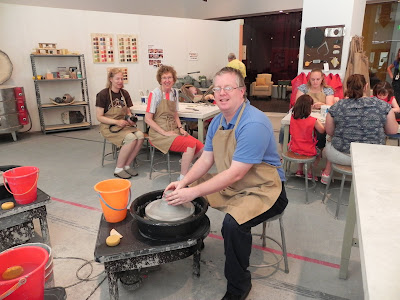 I try my hand at throwing and shaping pottery at the Denver Art Museum. My creation didn't turn out so well, so I think I need a little more practice...
 The Colorado River starts out as a stream on the western side of Rocky Mountain National Park. From here, these waters will head down through western Colorado, through Glen Canyon and the Grand Canyon, and eventually end up in Lake Mead on the Arizona/Nevada border.
 A mother moose and her baby graze along the banks of the Colorado River. They were no more than ten feet away from the walking trail, but didn't seem to mind all of the humans taking pictures of them.
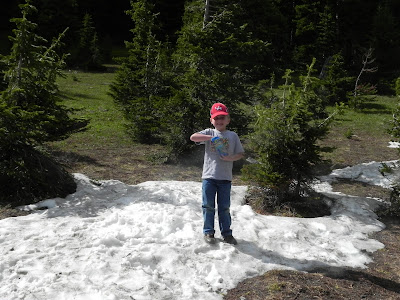 Snow! Well, okay, slush. But it was good enough for Kirby.
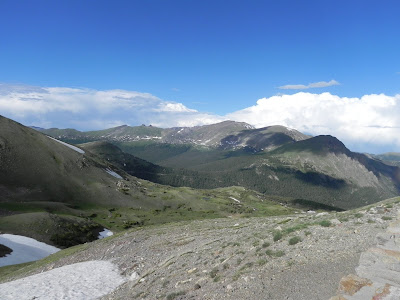 The view from the alpine tundra section of Rocky Mountain National Park, elevation about 11,500 feet.
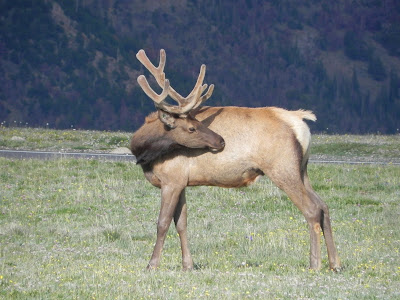 A male elk makes an interesting post for the camera. We were pleasantly surprised by all the wildlife we came across while in the park.
 A yellow-bellied marmot forages along the alpine tundra of Rocky Mountain National Park. Marmots hibernate for eight months of the year; the other four months are spent eating and mating. Not a bad life!
 Kirby tests his carpentry skills at the Denver Childrens Museum. We were only there for a couple of hours; I've mentioned before that the museum is only a fraction of the one he is used to here in Houston, so he ran out of things to explore rather quickly.
 Impressive sandstone rock formations at Garden of the Gods in Colorado Springs.
 Another view of the formations at the Garden of the Gods.
 Kirby, David and I pose in front of some of the formations at the Garden of the Gods. I had to take this picture to make mom happy...
 Not too far from the Garden of the Gods is the Cave of the Winds. It was Kirby's first time inside a cave. He seemed concerned about the lack of light so I'm not sure he was particularly impressed.
 Traveling up the Pikes Peak Highway. There is something amazing and perhaps a bit humbling about seeing a sign informing that, even after you've been climbing up the road for a few miles, you're still a vertical mile below the summit of the mountain, or looking ahead of you and seeing switchbacks far ahead and high above you and thinking, "wow, we still have to go all the way up there?" The toll is $40 per car, so bring your money as well as at least half a tank of gas if you go, but the road is almost completely paved now, there are several places to stop along the way, and the views are absolutely stunning.
 Another way to reach the top of the mountain is to take the Pikes Peak Cog Railway. which operates diesel multiple units from the town of Manitou Springs to the summit. They were sold out the day we went, which is why we used the toll road, but the train might be a fun thing to do if I ever get the chance to visit the mountain again.
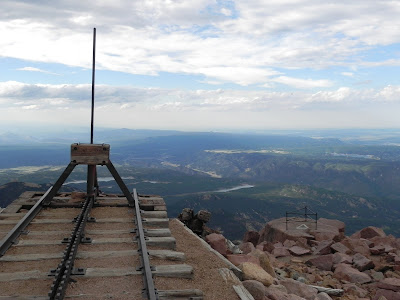 The end of the cog railway almost seems to dangle over the side of Pikes Peak. At 14,110 feet, not only are you well above the tree line, you're also past the point where vegetation grows at all. In Colorado Springs the temperatures were in the 90s, but at the top of the summit the temperature was in the high 40s.
 Pikes Peak is Kirby's second trip atop a fourteener (his first was Mount Evans, two summers ago). I was out of breath up there, but the thin air didn't really seem to bother Kirby.
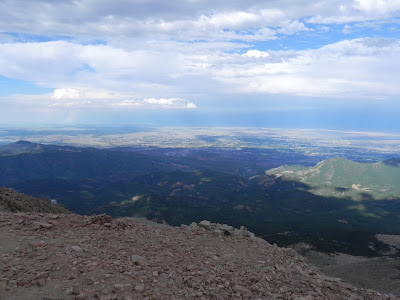 Looking down from the top of Pikes Peak. That's Colorado Springs off in the distance below. After Kirby, David, his girlfriend and I left the summit, we drove back into Colorado Springs for an excellent dinner at the Phantom Canyon brewpub. We then walked around downtown Colorado Springs for a little bit before returning to Denver.
 Kirby cools his feet in a man-made waterfall in the new children's garden of the Denver Botanic Gardens. The gardens have completed a lot of expansions and enhancements, including this children's garden, since the last time I visited.
 I found Japanese section of the Botanic Gardens to be especially picturesque and enjoyable.
 Kirby poses next to another stream in the Botanic Gardens. The plants and flowers might not have impressed him too much, but the water features sure caught his attention...
We had a great time. It helped that this time we spent a few more days in Colorado than we have in the past, and I even got to visit my friend Rebecca, whom I hadn't seen in years. We'll be back soon - hopefully in wintertime, so Kirby can play in the snow and perhaps even learn to ski.
Right now I'm looking forward to my next trip at the end of August. I'm going to Hawaii for the first time. Woohoo!
 I try my hand at throwing and shaping pottery at the Denver Art Museum. My creation didn't turn out so well, so I think I need a little more practice...
 The Colorado River starts out as a stream on the western side of Rocky Mountain National Park. From here, these waters will head down through western Colorado, through Glen Canyon and the Grand Canyon, and eventually end up in Lake Mead on the Arizona/Nevada border.
 A mother moose and her baby graze along the banks of the Colorado River. They were no more than ten feet away from the walking trail, but didn't seem to mind all of the humans taking pictures of them.
 Snow! Well, okay, slush. But it was good enough for Kirby.
 The view from the alpine tundra section of Rocky Mountain National Park, elevation about 11,500 feet.
 A male elk makes an interesting post for the camera. We were pleasantly surprised by all the wildlife we came across while in the park.
 A yellow-bellied marmot forages along the alpine tundra of Rocky Mountain National Park. Marmots hibernate for eight months of the year; the other four months are spent eating and mating. Not a bad life!
 Kirby tests his carpentry skills at the Denver Childrens Museum. We were only there for a couple of hours; I've mentioned before that the museum is only a fraction of the one he is used to here in Houston, so he ran out of things to explore rather quickly.
 Impressive sandstone rock formations at Garden of the Gods in Colorado Springs.
 Another view of the formations at the Garden of the Gods.
 Kirby, David and I pose in front of some of the formations at the Garden of the Gods. I had to take this picture to make mom happy...
 Not too far from the Garden of the Gods is the Cave of the Winds. It was Kirby's first time inside a cave. He seemed concerned about the lack of light so I'm not sure he was particularly impressed.
 Traveling up the Pikes Peak Highway. There is something amazing and perhaps a bit humbling about seeing a sign informing that, even after you've been climbing up the road for a few miles, you're still a vertical mile below the summit of the mountain, or looking ahead of you and seeing switchbacks far ahead and high above you and thinking, "wow, we still have to go all the way up there?" The toll is $40 per car, so bring your money as well as at least half a tank of gas if you go, but the road is almost completely paved now, there are several places to stop along the way, and the views are absolutely stunning.
 Another way to reach the top of the mountain is to take the Pikes Peak Cog Railway. which operates diesel multiple units from the town of Manitou Springs to the summit. They were sold out the day we went, which is why we used the toll road, but the train might be a fun thing to do if I ever get the chance to visit the mountain again.
 The end of the cog railway almost seems to dangle over the side of Pikes Peak. At 14,110 feet, not only are you well above the tree line, you're also past the point where vegetation grows at all. In Colorado Springs the temperatures were in the 90s, but at the top of the summit the temperature was in the high 40s.
 Pikes Peak is Kirby's second trip atop a fourteener (his first was Mount Evans, two summers ago). I was out of breath up there, but the thin air didn't really seem to bother Kirby.
 Looking down from the top of Pikes Peak. That's Colorado Springs off in the distance below. After Kirby, David, his girlfriend and I left the summit, we drove back into Colorado Springs for an excellent dinner at the Phantom Canyon brewpub. We then walked around downtown Colorado Springs for a little bit before returning to Denver.
 Kirby cools his feet in a man-made waterfall in the new children's garden of the Denver Botanic Gardens. The gardens have completed a lot of expansions and enhancements, including this children's garden, since the last time I visited.
 I found Japanese section of the Botanic Gardens to be especially picturesque and enjoyable.
 Kirby poses next to another stream in the Botanic Gardens. The plants and flowers might not have impressed him too much, but the water features sure caught his attention...
We had a great time. It helped that this time we spent a few more days in Colorado than we have in the past, and I even got to visit my friend Rebecca, whom I hadn't seen in years. We'll be back soon - hopefully in wintertime, so Kirby can play in the snow and perhaps even learn to ski.
Right now I'm looking forward to my next trip at the end of August. I'm going to Hawaii for the first time. Woohoo!
Thursday, August 04, 2011
No more panhandling at outside cafes
Good news for outdoor diners:
Whether the law will have any real effect is a different matter. Homeless people, generally speaking, aren't aware of or simply don't care about laws that restrict them from panhandling. I say this as somebody who has been accosted by homeless people seeking change while filling up my tank on multiple occasions, even though panhandling within eight feet of gas pumps is, as the article says, illegal. And the police likely won't put a lot of emphasis on enforcing this ordinance when there are so many higher-profile crimes that require their attention.
Enforcement issues aside, the best way to deal with panhandlers is simply not to give them any money. When somebody gives money to a homeless person, even if only to make that person go away, they're only reinforcing this negative behavior. And aggressive and/or threatening panhandling should always be immediately reported to the police, as this represents a public safety hazard that law enforcement is likely to take seriously.
City Council on Wednesday passed a ban on panhandling within 8 feet of a sidewalk cafe. Violation of the buffer zone is a Class C misdemeanor, punishable by a maximum fine of $500.I certainly don't have a problem with this new ordinance. Jokes about anybody actually eating outside in this weather aside, people should be allowed enjoy their meal or sip their beer in peace without being approached by a foul-smelling bum looking for money to score his next crack rock."You're sitting at an outdoor table at a restaurant. Someone comes and looms over you and starts asking for money. That's an intimidating situation, and you don't have really an opportunity to escape," Mayor Annise Parker said.
City ordinance already prohibited panhandling within 8 feet of ATMs, parking meters, bus shelters and gas pumps. The council extended the rule to outdoor dining establishments.
Whether the law will have any real effect is a different matter. Homeless people, generally speaking, aren't aware of or simply don't care about laws that restrict them from panhandling. I say this as somebody who has been accosted by homeless people seeking change while filling up my tank on multiple occasions, even though panhandling within eight feet of gas pumps is, as the article says, illegal. And the police likely won't put a lot of emphasis on enforcing this ordinance when there are so many higher-profile crimes that require their attention.
Enforcement issues aside, the best way to deal with panhandlers is simply not to give them any money. When somebody gives money to a homeless person, even if only to make that person go away, they're only reinforcing this negative behavior. And aggressive and/or threatening panhandling should always be immediately reported to the police, as this represents a public safety hazard that law enforcement is likely to take seriously.
Sunday, July 31, 2011
Thanks for nothing, Don!
Last May, as the Houston area suffered the effects of a springtime drought, I remarked that I "would prefer that Houston's next opportunity for significant rainfall not come courtesy of a hurricane or something."
Well, as the region prepares to enter my least-favorite month, it still is in sore need of some wet weather. We've had a few storms here and there, but it hasn't been nearly enough and I'm now beginning to think that a tropical system is indeed going to be our best bet for some significant, drought-busting precipitation.
Which is why I wasn't the only Houstonian who spent the last few days hoping that Tropical Storm Don would head this way and dump a few much-needed inches on the city. I can handle the winds and the relentless local media hype of a tropical storm, as long as it brings rain but doesn't become another Allison. Hell, at this point I would even welcome a category 1 hurricane.
Alas, Don veered away from the upper Texas coast this weekend and made landfall in the vicinity of South Padre Island, bringing the Houston area nothing more than a few rainbands' worth of scattered showers. And with a high pressure system firmly in place over the region and highs expected in the 100s for the coming week, there is truly no relief in sight.
Knowing our luck, the region's extended drought is going to be broken sometime in August or September with a massive hurricane, which will trigger another evacuation gridlock nightmare, unleash a storm surge which will wipe out all those nice beach houses that have just been rebuilt after Ike, submerge the city under 20 inches of rain, bring ashore 100-mph winds that will knock over trees and tear roofs off houses, and leave me and my neighborhood without electricity for two weeks.
Well, as the region prepares to enter my least-favorite month, it still is in sore need of some wet weather. We've had a few storms here and there, but it hasn't been nearly enough and I'm now beginning to think that a tropical system is indeed going to be our best bet for some significant, drought-busting precipitation.
Which is why I wasn't the only Houstonian who spent the last few days hoping that Tropical Storm Don would head this way and dump a few much-needed inches on the city. I can handle the winds and the relentless local media hype of a tropical storm, as long as it brings rain but doesn't become another Allison. Hell, at this point I would even welcome a category 1 hurricane.
Alas, Don veered away from the upper Texas coast this weekend and made landfall in the vicinity of South Padre Island, bringing the Houston area nothing more than a few rainbands' worth of scattered showers. And with a high pressure system firmly in place over the region and highs expected in the 100s for the coming week, there is truly no relief in sight.
Knowing our luck, the region's extended drought is going to be broken sometime in August or September with a massive hurricane, which will trigger another evacuation gridlock nightmare, unleash a storm surge which will wipe out all those nice beach houses that have just been rebuilt after Ike, submerge the city under 20 inches of rain, bring ashore 100-mph winds that will knock over trees and tear roofs off houses, and leave me and my neighborhood without electricity for two weeks.
Monday, July 18, 2011
Carmageddon?
This past weekend, a ten-mile section of the I-405 freeway which links western Los Angeles to the San Fernando Valley through the Sepulveda Pass was completely closed for construction. Although there was much worry that the closure of this vital stretch of highway would lead to a "carmageddon" of traffic gridlock in the Los Angeles area, the freeway was reopened ahead of schedule and the feared calamity of paralyzed traffic never came to pass.
A couple of thoughts:
1. What does it say about the cultural gravity of Los Angeles that the closure of 405 was the weekend's biggest national news story? I know LA is the nation's second-largest metropolitan area as well as the country's entertainment center. But it nevertheless seemed a bit strange that a closure of a section of freeway in this city appeared to be the top story of several major media websites, ahead of arguably more important items such as the ongoing debt ceiling negotiations in Washington or a tabloid scandal in Britain that threatens to bring down an entire media empire. Last year The Atlantic's Conor Friedersdorf wrote about "The Tyranny of New York," whereby the city dominates America's media such that everything that happens there becomes national news. Perhaps we can speak of "the tyranny of Los Angeles" as well?
2. Motorists are not water molecules. We describe traffic as analogous to fluid: the movement of vehicles is referred to as "traffic flow." Areas of recurring congestion due to merges and lane closures are referred to as "bottlenecks." As such, there's always a fear that the closure of a major section of roadway will cause massive traffic backups, much as the closure of a valve on a pipe causes water to back up.
However, at the wheel of every vehicle is a human being who makes choices as to where to drive or to drive at all. If motorists are made aware of a major closure - the 405's shutdown was well-publicized - they will choose alternate routes to get to their destination or decide not to make the trip at all. That obviously happened in Los Angeles this past weekend, as there was reported to be 65% fewer automobiles on the LA freeway network than on a normal weekend (the fact that the closure occurred over the weekend also probably helped, although as anybody who's been to Los Angeles knows, heavy traffic is just as frequent on Saturdays and Sundays as it is during the work week).
This is why traffic nightmares did not occur in Manhattan after the West Side Highway was shut down in 1973 or in San Francisco after the Embarcadero Freeway was demolished following the Loma Prieta earthquake in 1989: people were aware of the closures and simply altered their travel habits accordingly. (This, incidentally, is also one of the reasons why widening a freeway does not, in the long term, relieve traffic congestion: people become aware of the added capacity of the widened freeway and begin using it for their trips, and the new capacity is eventually completely absorbed by all those new motorists.)
Another closure of the 405 is scheduled for next year. It will likely be just as much of a non-event as this weekend's closure was, and hopefully the rest of the nation won't be subjected to constantly hearing about it.
A couple of thoughts:
1. What does it say about the cultural gravity of Los Angeles that the closure of 405 was the weekend's biggest national news story? I know LA is the nation's second-largest metropolitan area as well as the country's entertainment center. But it nevertheless seemed a bit strange that a closure of a section of freeway in this city appeared to be the top story of several major media websites, ahead of arguably more important items such as the ongoing debt ceiling negotiations in Washington or a tabloid scandal in Britain that threatens to bring down an entire media empire. Last year The Atlantic's Conor Friedersdorf wrote about "The Tyranny of New York," whereby the city dominates America's media such that everything that happens there becomes national news. Perhaps we can speak of "the tyranny of Los Angeles" as well?
2. Motorists are not water molecules. We describe traffic as analogous to fluid: the movement of vehicles is referred to as "traffic flow." Areas of recurring congestion due to merges and lane closures are referred to as "bottlenecks." As such, there's always a fear that the closure of a major section of roadway will cause massive traffic backups, much as the closure of a valve on a pipe causes water to back up.
However, at the wheel of every vehicle is a human being who makes choices as to where to drive or to drive at all. If motorists are made aware of a major closure - the 405's shutdown was well-publicized - they will choose alternate routes to get to their destination or decide not to make the trip at all. That obviously happened in Los Angeles this past weekend, as there was reported to be 65% fewer automobiles on the LA freeway network than on a normal weekend (the fact that the closure occurred over the weekend also probably helped, although as anybody who's been to Los Angeles knows, heavy traffic is just as frequent on Saturdays and Sundays as it is during the work week).
This is why traffic nightmares did not occur in Manhattan after the West Side Highway was shut down in 1973 or in San Francisco after the Embarcadero Freeway was demolished following the Loma Prieta earthquake in 1989: people were aware of the closures and simply altered their travel habits accordingly. (This, incidentally, is also one of the reasons why widening a freeway does not, in the long term, relieve traffic congestion: people become aware of the added capacity of the widened freeway and begin using it for their trips, and the new capacity is eventually completely absorbed by all those new motorists.)
Another closure of the 405 is scheduled for next year. It will likely be just as much of a non-event as this weekend's closure was, and hopefully the rest of the nation won't be subjected to constantly hearing about it.
Japan claims Women's World Cup
Have I mentioned the the thing I hate the most about soccer is that so many games - especially championship games - are decided by penalty kicks? (Oh yeah: I have. I don't even like them when my team wins.)
Such was the ending of yesterday's thrilling Women's World Cup championship. After playing to a 2-2 tie after 90 minutes of regulation time and 30 minutes of extra time, Japan defeated the United States 3-1 in penalty kicks to clinch their first-ever World Cup title.
It really is a disappointing way to decide a game. But the truth is that it never should have come to PKs. The US took the lead twice - once in regulation and once in extra time - and twice they allowed Japan to equalize. The Americans simply missed too many scoring opportunities on offense - shots on goal that hit the posts or otherwise went wide - and suffered from some sloppy play on defense (Japan's first goal, for example, was created by the fact that the Americans couldn't manage to clear the ball out of the penalty box).
As disappointed as I am in the way the game ended - the fact that the United States lost as well as the fact that it was decided on goofy penalty kicks - I can't help but be impressed by the tenacity and determination of the Japanese team. They were underdogs throughout the tournament and pulled off three compelling upsets in the knockout stage - against host Germany and Sweden as well as the United States - to claim the championship. They also provided some joy and pride for a country that just a few months ago was devastated by an earthquake and tsunami that resulted in 23,000 deaths and a nuclear emergency. That's something that everybody, Americans included, can feel good about.
But I still hate penalty kicks.
Such was the ending of yesterday's thrilling Women's World Cup championship. After playing to a 2-2 tie after 90 minutes of regulation time and 30 minutes of extra time, Japan defeated the United States 3-1 in penalty kicks to clinch their first-ever World Cup title.
It really is a disappointing way to decide a game. But the truth is that it never should have come to PKs. The US took the lead twice - once in regulation and once in extra time - and twice they allowed Japan to equalize. The Americans simply missed too many scoring opportunities on offense - shots on goal that hit the posts or otherwise went wide - and suffered from some sloppy play on defense (Japan's first goal, for example, was created by the fact that the Americans couldn't manage to clear the ball out of the penalty box).
As disappointed as I am in the way the game ended - the fact that the United States lost as well as the fact that it was decided on goofy penalty kicks - I can't help but be impressed by the tenacity and determination of the Japanese team. They were underdogs throughout the tournament and pulled off three compelling upsets in the knockout stage - against host Germany and Sweden as well as the United States - to claim the championship. They also provided some joy and pride for a country that just a few months ago was devastated by an earthquake and tsunami that resulted in 23,000 deaths and a nuclear emergency. That's something that everybody, Americans included, can feel good about.
But I still hate penalty kicks.
Thursday, June 23, 2011
The tragedy of Nauru
The remote Pacific island of Nauru is the world's third-smallest independent nation by land area (it is 8.1 square miles in size; only Monaco and Vatican City are smaller). It's also a nation with a very tragic story, as musician - turned - CNN iReporter Johnny Colt writes:
I'd love to visit one day, even though getting there isn't easy and tourist facilities are minimal.
Nauru is battling a failed economy, widespread poor health and a natural environment ruined from the inside. They're the kinds of things that aren't altogether different from what's facing many of the rest of us, but they're magnified in a place that's only a tenth the size of Washington, D.C.Nauru is a phosphate rock island. The island's economy has historically relied on the mining of phosphate, which is used to make fertilizer and other products. However, these phosphate sources have now been virtually depleted:
Not long ago, Nauru was one of the wealthiest nations on Earth: The phosphate mines, before they dried up, gave the nation the second-highest per-capita GDP in the world. But today, 90% of its residents are unemployed and the nation's economy sags under enormous debt. The phosphate mineral money that brought Ferraris to the island in the 1970s and '80s has dried up, leaving all those sports cars to rust. Today, most Nauruans live on about 90 to 100 Australian dollars a week.As small as Nauru is, only about 20% of the island is actually inhabitable. The other 80% has been rendered uninhabitable and unarable due to mining operations:
[...]Nauru's topography looks kind of like a top hat. The center of the island jumps up in elevation. A small band of greenery about a thousand feet wide and a coral-laden beach create the perimeter, and most of the population lives in the brim.
The middle is called the topside. That's where the phosphate is -- or was, before most of it was mined and shipped off. From the descriptions, getting excited to see this place is like getting excited when your friend smells something totally disgusting and hands it to you to smell. You just have to smell it.
Mining for phosphate is a simple process: You dig it straight up out of the ground while leaving the jagged pinnacles of coral behind. No need for an underground railway. No phosphate miners see a doctor for black lung.
But a hundred years of strip mining -- first by a parade of foreign administrators of the island and eventually by Nauru itself after it gained independence in 1968 -- have left two-thirds of the island uninhabitable and killed about 40% of the surrounding marine life, according to the U.N. Framework Convention on Climate Change.
In Nauru's mining history, no one has bothered to rehabilitate the post-mined topography. So much of the island's green skin has been peeled back and left raw and exposed to the elements. It looks like a moonscape. And like the moon, people can neither live nor grow food there.
The lack of sufficient space for agriculture, as well as the island's remoteness and the grinding poverty of its people, has created yet another problem:
And then there is the issue of climate change, which could possibly result in rise of ocean levels. Nauru's population, as was explained previously, lives along the island's low-lying peripheral ring. If sea levels rise, there's no place for them to escape.Nothing here is fresh. Phosphate mining has left nowhere to produce food. A head of lettuce costs $18 Australian.
So most of what people eat is low-cost and fried to make up for in taste what it lacks in freshness.
Today, about 40% of the population is diabetic, owing at least partly to poor nutrition.
One particularly heartbreaking aspect of Nauru's plight that Colt didn't mention in his report is the manner in which the island's profits from its phosphate mining were squandered. A percentage of the island's phosphate mining earnings were placed into the Nauru Phosphate Royalties Trust, which was intended to support the island's citizens once the phosphate reserves were mined out. However, the trust was very poorly managed; dubious investments were made in everything from real estate to a now-defunct Australian Rules football team to a failed London musical. The Trust has now been decimated and the country is destitute.
I'd love to visit one day, even though getting there isn't easy and tourist facilities are minimal.
All aboard the A-Train
At the beginning of the week, the Denton County Transportation Authority inaugurated its "A-Train" commuter rail service:
I'm admittedly biased; I was part of the team that planned and designed this new transit service and I'm proud to see it come to fruition. But ultimately, the people who live, work and study in Denton and Lewisville will decide if the A -Train is successful or not. The Dallas Morning News has more.
At 4:57 a.m., the Denton County Transportation Authority’s first official A-train ride chugged down the 21-mile track on its first southbound trek to Carrollton, where passengers can connect to DART rail. Passengers hope the train will catch on and become a practical option for residents and commuters here.I have high hopes for this commuter rail line not only because it should have a decent reverse-commute component of UNT and TWU students heading from Dallas into Denton, but also because it parallels an already-congested Interstate 35E which is about to undergo several years of highly-disruptive reconstruction. In fact, I would argue that the A-Train meets Christof Spieler's eight habits of highly-effective commuter rail lines very well.
I'm admittedly biased; I was part of the team that planned and designed this new transit service and I'm proud to see it come to fruition. But ultimately, the people who live, work and study in Denton and Lewisville will decide if the A -Train is successful or not. The Dallas Morning News has more.
Tuesday, June 07, 2011
USC stripped of 2004 BCS title
The hits just keep coming for a USC Trojan program already reeling from a two-year postseason ban and a loss of thirty scholarships over three seasons:
The Bowl Championship Series stripped Southern California of its 2004 title on Monday, leaving that season without a BCS champion.The announcement was no surprise. BCS officials had said USC was in danger of having its championship vacated after the Trojans were hit with heavy NCAA sanctions last year for rules violations committed during the 2004 and '05 seasons.
"The BCS alerted us today that their presidents have voted to vacate USC's 2005 BCS championship game victory," USC athletic director Pat Haden said. "This was not an unexpected outcome. We will comply with all requirements mandated by the result of this BCS vote."
The NCAA ruled star tailback Reggie Bush received improper extra benefits during those seasons and was ineligible when he played.
Subscribe to:
Posts (Atom)