I realize kickoff is only hours away at this point, so I guess I'm better late than never in getting this season's preview up.
Last season was a pretty good one for the University of Houston Cougars. The team adjusted to a new coaching staff and fought through the adversity caused by Hurricane Ike to win eight games, including victories over two ranked teams for first time since 1984 and their first bowl victory since 1980. The team hopes to build on last year's success to have an even better season in 2009. At the top of the to-do list for the team is to win Conference USA's Western Division, contend for the C-USA Championship, and maybe, just maybe, be under consideration as a so-called "BCS buster."Are the pieces in place for any of those goals to be reached?
When it comes to the offensive side of the ball, the answer is most likely "yes." The Cougars return eight starters, including almost all of the skill position players from an offense that finished second in the nation last season in total offense with almost 563 yards per game. That's a pretty impressive feat, considering that going into the 2008 season the conventional wisdom was that the adjustment to a new coaching philosophy and the lack of experience at wide receiver would cause the offense to take a step backward.
The Cougars will be led by junior quarterback Case Keenum, who led the nation in total offense last season with 403.2 all-purpose yards per game and was named Conference USA offensive player of the year. Most of his weapons return, including running back Bryce Beall, who ran for 1,247 yards, caught for another 500 yards, and had 17 touchdowns in a surprising freshman debut, and a bevy of highly capable wide receivers, such as Tyron Carrier (80 receptions for 1,026 yards and 9 touchdowns last year), Patrick Edwards (back in action after a devastating leg injury against Marshall last season) Chaz Rodriguez and Kierrie Johnson. And if that weren't enough, it's likely that the offensive lineup will be joined by highly-rated freshmen such as running back Charles Sims and wide receiver A.J. Dugat, who was just cleared to play earlier this week.
There are concerns about the abilities of the offensive line, which lost three starters from last year's team. The line will be anchored by senior center Carl Barnett and, while there is depth and experience at all five positions, the big question is how quickly this fall's new lineup can come together as a cohesive unit in order to open lanes for runners and protect Keenum (last year's line gave up 27 sacks, which was an improvement over the 34 sacks given up in 2007 but was still too many). Needless to say, an injury to Case Keenum would be a devastating blow to the offense. While backup quarterback Cotton Turner isn't exactly horrible - I've watched him in practice - he simply can't move the offense like Keenum.
So that's the 2009 University of Houston offense, a.k.a. the "good news." Now it's time for the "not-so-good" news, i.e. the defense.
Let's face it: the 2008 University of Houston defense wasn't what could really be considered "good." They gave up over 413 yards per game, enough to be ranked 100th (out of 119 FBS teams) in total defense and, in surrendering almost 31 points per game, almost as bad (91st) in scoring defense. The defense's complete meltdown against Rice last November, in particular, still sticks in the collective craw of the UH faithful. And that was with a defensive line that featured experienced players All-Conference standout Philip Hunt (18.5 tackles for loss, 14 sacks) and Tate Stewart and a secondary that featured several veterans such as Kenneth Fontennette and Earnest Miller. With those players gone, and with many of the holes they left behind being plugged by transfers and true freshman, I simply cannot expect this defense to be any better in 2009. In fact, I fully expect it to be worse.
The only returning starter on the defensive line is junior tackle Isaiah Thompson. He'll be joined by returning lettermen Tyrell Graham and David Hunter and a plethora of true (as in, straight-out-of-high-school) freshmen, including Radermon Scypion, Zeke Riser, Tyrone Campbell, Kelvin King, DeAnthony Sims and walk-on Ameen Behbahani. While the story on some of these incoming freshmen is that they are talented and were highly-recruited, the fact remains that they are probably undersized and definitely inexperienced at this level. The defensive line is going to be the weakest link in the defense this fall.
Things look a little better at linebacker, which returns senior experience in C.J. Cavness and Matt Nicholson as well as sophomore Marcus McGraw, who had an excellent debut last season (he led the team in tackles). Speed and depth are issues at this position, however. The secondary will be led by senior cornerback Brandon Brinkley, who had 74 tackles and four interceptions last year. Opposing quarterbacks will likely avoid throwing his way and instead try to pick on safeties Carson Blackmon and Nick Saenz. There's experience in the secondary, but they'll need help from the defensive line in the form of a pass rush if they're going to have a better overall season than they did last year.
One positive aspect of last year's team is that head coach Kevin Sumlin and his staff did a decent job exorcising away the "Unholy Trinity" of turnovers, penalties and bad special teams play that had plagued the Cougars under the Briles regime. Special teams were markedly improved last season - punter Chase Turner would have been one of the nation's higher-rated punters had the offense given him more opportunities to show his talents last season - and the Cougars were no longer among the top ten most penalized teams in the nation last season. The Coogs still need to work on ball control, however; last year the team gave the ball away 28 times but recovered fumbles and interceptions only 22 times for a -6 turnover margin.
Unfortunately, last season the team showed a tendency to start out slowly and quickly find themselves trailing by several scores in the first half of games. Sometimes they were able to mount furious second-half comebacks in order to win games, as they did against Alabama-Birmingham and UTEP. On other occasions, such as against Colorado State and Marshall, those rallies fell short. I'm willing to attribute last year's slow starts to the adjustments required of a new coaching staff and philosophy or the mental disruption caused by Hurricane Ike. But this pattern simply cannot manifest itself again this season; the coaching staff needs to prepare this team to play for every game and they need to come out of the tunnel swinging.
The Cougars' schedule starts out rather tough. After a season-opening tune-up game against FCS opponent Northwestern State, the Cougars have to travel to Stillwater, Oklahoma, to play an Oklahoma State team that is ranked 9th in the preseason AP poll. After a well-placed bye week, the Coogs return to Houston to play Texas Tech in what should be a sold-out Robertson Stadium. The Cougars then go on a formidable three-game road trip to El Paso to play the revenge-minded UTEP Miners, then to Starkville, Mississippi to play an improving Mississippi State team, and finally to New Orleans to play Tulane. The schedule then lightens up a bit, as the Coogs play four of their final six games in Houston. The Cougars have back-to-back home games against SMU and Southern Miss, then hit the road to play Tulsa and Central Florida, and then return to Robertson Stadium to close out their season against Memphis and Rice. However, none of these games will be gimmes: Southern Miss has historically given the Cougars fits, Tulsa will be seeking to avenge last season's 70-30 thumping at the hands of the Coogs, and anybody who thinks Rice is an easy win for the Coogs wasn't paying attention last year, or the year before, or the year before that.
What does the national sports media expect from the Cougars this fall? Overall, previews for Houston have generally been positive, which a consensus emerging that, due to its prolific offense, the Cougars are in for a pretty good season. Of the college football preseason magazines, Dave Campbell's Texas Football predicts that Coogs will finish 10-2 and win Conference USA. Athlon, Lindy's and The Sporting News all expect the Cougars to, at the very least, win their division. NBC Sports and CBS Sports are also in agreement that the Cougars will win Conference USA West.
Several college football websites are also big on the Coogs. CollegeFootballNews.com envisions a 10-win regular season for Houston, with an undefeated record in conference. SouthernCollegeSports.com concurs with that assessment, as does a columnist for bleacherreport.com who also foresees the Coogs defeating East Carolina in the Conference USA Championship game. The Congrove Computer Ranking system at CollegeFootballPoll.com (which has accurately predicted Houston's record within two games 9 out of the last 15 seasons) is only slightly less optimistic, predicting a 9-3 record for Houston with a loss to Tulsa that would leave the Coogs 2nd in their division. The Quad blog at The New York Times, which provides a thorough write-up for the Coogs, says that Houston is the 30th-best team in FBS, also foresees a 9-3 regular season campaign, and believes a conference championship is in the cards as well.
Sports Illustrated ranks the Coogs #57 to start the season and envisions an 8-4 overall record, with a 6-2 conference record and a second-place finish behind UTEP in C-USA's Western Division. Jeff Sagarin's preseason rankings, meanwhile, have the Coogs slotted 66th with a starting rating of 70.69. When other team's ratings as well as home field advantage are taken into account, this implies that a 8-4 record (with losses to Oklahoma State, Texas Tech, Mississippi State and Tulsa) is predicted for Houston.
So what do I expect? Overall, I think the Cougars are definitely a team on the rise, and there are few teams in the country, even among the BCS elite, that will be able to stop its offense. But while the offense can score points on just about anybody, the defense, likewise, can give up points to almost anybody. The squad simply has too many weaknesses, especially on the defensive line, for me to expect that they'll be able to effectively stop the run or mount a pass rush, and, unless this defense finds a way to play well beyond its abilities, opposing teams with any offensive confidence whatsoever are probably going to be able to score at will. The Cougars are going to be involved in several 56-49 -type games this fall, and whether the Cougars come out ahead or behind will depend on things like turnovers and special teams performance.
I'm going to go on record as predicting an eight-win regular season for the Coogs. I think they will lose their matchups against Big XII teams Oklahoma State and Texas Tech, and I also think that road losses to two of Mississippi State, UTEP and Tulsa will occur as well. Southern Miss will also be very tough, but I think the home-field advantage will give the Coogs the edge. This final regular season record of 8-4 (6-2 in conference) will likely earn the Coogs second place in their division as well as a fifth-consecutive bowl appearance.
If the defense shows improvement over the course of the season, then 2010 could be the season that UH fans are waiting for. But right now, the team is still a year away.
Now, if you'll excuse me, I need to head over to Robertson Stadium. It's tailgating time!
UPDATE: The Coogs took care of business this evening, cruising to a 55-7 victory over Northwestern State.
Saturday, September 05, 2009


Name that Kroger!
In Houston, there seems to be a popular practice of assigning names to inside-the-loop Kroger stores based on characteristics such as the store's appearance, location, or the demographics of its clientele. I don't know how long ago this tradition came about or why it only involves Kroger-brand stores and not Randalls or HEB stores.
Anyway, Jeff Balke runs down the names for four inside-the-loop Kroger stores, starting with the best-known of the "named" Krogers:
Anyway, Jeff Balke runs down the names for four inside-the-loop Kroger stores, starting with the best-known of the "named" Krogers:
Disco Kroger
Montrose at Hawthorne (near Westheimer)The original. I don’t know when people started calling it Disco Kroger. I first started going there when I worked across the street. I also had my truck towed from there when I stupidly parked in its parking lot during a show at Tower Theater (you know it now as Hollywood Video – sigh). But, if you’ve ever been in there later at night, particularly on the weekends, you understand just how it got its name.
Ghetto Kroger
Shepherd at 11thAs far as I know, I’m the one that handed this Signature store with the name dating back to this post about how crappy that store can be. I first started going to Ghetto Kroger when it was decidedly less ghetto many MANY years ago. It was also significantly smaller. I’m told this will be the largest Kroger store in the US when re-modeling is complete. To understand its ghetto nature, all you have to do is go in there, see the construction and note ZERO signs saying “Please excuse our mess” or anything like that. I guess in a few months, we’ll have more ghetto to love.
Zombie Kroger
Shepherd at 20thAs outlined here, Zombie Kroger is so named because it is marked both by really sweet, exceedingly slow elderly people and a dearth of checkers most of the time. Plus, it seems to be in some sort of vortex that swallows normal time and has soda that looks like Windex.
Posh Kroger
West Gray at DunlavyOnly recently this River Oaks store (pictured) got its name for both its clientele and the fact that you feel as if you are walking on diamond-encrusted floors and breathing caviar-infused air as you mill about in this hoity toity market. I see a blog post in my future.
Somebody in the comments also suggested that this last Kroger be named "Deco Kroger" due to the architectural style of the shopping center where it is located. My brother-in-law Danny has referred to this particular store as "Hot Chick" Kroger due to the number of attractive women who shop there.
Continuing Jeff's theme, here are names for four more inside-the-loop Kroger stores:
Combat Kroger
Cullen at Polk
If you attended school at the University of Houston, you probably shopped here. And you probably understood exactly why it was called Combat Kroger. Anyway, it might be an aging, grimy, understaffed, poorly-managed, run-down store in a sketchy part of town, but at least it usually has most of the things I'm looking for when I shop there. An added bonus is that I've never been mugged while shopping there. At least, not yet.
Buffalo Kroger
Westpark at Buffalo Speedway
One of Jeff's commenters suggests that this upscale Kroger Signature store nestled between Greenway Plaza and West University Place be called "Spanish Kroger" due to the Mediterrenean-style architecture of the shopping center in which it is located. Local Kroger management took the recent arrival of HEB's new Buffalo Merket across the street seriously enough to remodel and upgrade the entire store; clearly, they do not want this new competition to one day cause the store to be known as "HEB's Bitch."
Medical Kroger
Old Spanish Trail at Cambridge
Another one of Jeff's commenters believes that this particular store is a "ghetto Kroger" as well, but I've never gotten that impression shopping there (when your home store is Combat Kroger, after all, you're pretty forgiving). I've always called this store "Medical Kroger" simply due to its location near the Texas Medical Center. I'm curious if there are other names for this particular store.
Does-Anybody-Really-Shop-Here Kroger
South Main Street at Kirby Drive
This one isn't too far from Medical Kroger; I guess it could also be called "Reliant Kroger" due to its location close to Reliant Stadium. Visit this store sometime and the name will make sense; every time I've been there, the place has been practically deserted. My understanding is that this store used to be located at the now-moribund shopping center at the corner of Kirby and Braeswood, where it faced the residential neighborhoods it served. Then it was "upograded" into a characterless building down the street with its back turned towards the neighborhoods it used supposed to serve. Therefore nobody shops there anymore, at least in part due to the fact that cheaper groceries are available at both the Super Target and the Fiesta nearby.
Thursday, September 03, 2009
North Texas 20, Ball State 10
It might not have been the prettiest win in the world, but the Mean Green started the season off right with tonight's victory over Ball State in Muncie, Indiana.
Going into the game, all eyes were on Riley Dodge, the son of UNT head coach Todd Dodge, in his first collegiate start as quarterback. He performed admirably, completing 23 of 33 passes for 216 yards, one touchdown and one interception. He scrambled for another 73 yards as well. His lone mistake was an ill-advised pass in the endzone that was picked off: a freshman error that he will learn not to repeat.
Dodge and the passing game aside, and as I suspected in my season preview, the Mean Green relied on the ground game, amassing 296 yards and chewing up the clock in the process (North Texas held the ball for over 37 minutes). In addition to Dodge's scrambles, running backs Cam Montgomery (17 carries for 149 yards) and Lance Dunbar (16 carries for 63 yards and a touchdown) were both as good as advertised in this effort.
The much-maligned Mean Green defense also had a great evening, allowing Ball State a total of only 309 yards and a single touchdown (which occurred following a UNT fumble will inside their own territory). UNT's defense was especially effective in third-down situations, holding the Cardinals to only two conversions on 15 attempts.
To be sure, there were still some problems. Mean Green special teams struggled, as kicker Jeremy Knott missed two field goals (although, to be fair, both were from 47 yards out). North Texas also committed 9 penalties for 81 yards, including an unnecessary hold by linebacker Tobe Nwigwe on Ball State quarterback Kelly Page that negated a Royce Hill interception return for a touchdown. But these are all problems that can be rectified over the course of the season. The main thing is that the Mean Green put together a solid game on both sides of the ball and, in the first game of the season, equaled their entire win total of last year.
It could be argued that Ball State, which has lost a lot of last year's talent especially on the offensive side of the ball, is going to be in for a rough season. But that shouldn't take away from the fact that a team that finished 1-11 last season went on the road to upset a team that finished 12-2 last season. This is an encouraging start to UNT's 2009 campaign, and after last year's disaster it is a performance that Mean Green coaches, players and fans alike can be happy about.
Going into the game, all eyes were on Riley Dodge, the son of UNT head coach Todd Dodge, in his first collegiate start as quarterback. He performed admirably, completing 23 of 33 passes for 216 yards, one touchdown and one interception. He scrambled for another 73 yards as well. His lone mistake was an ill-advised pass in the endzone that was picked off: a freshman error that he will learn not to repeat.
Dodge and the passing game aside, and as I suspected in my season preview, the Mean Green relied on the ground game, amassing 296 yards and chewing up the clock in the process (North Texas held the ball for over 37 minutes). In addition to Dodge's scrambles, running backs Cam Montgomery (17 carries for 149 yards) and Lance Dunbar (16 carries for 63 yards and a touchdown) were both as good as advertised in this effort.
The much-maligned Mean Green defense also had a great evening, allowing Ball State a total of only 309 yards and a single touchdown (which occurred following a UNT fumble will inside their own territory). UNT's defense was especially effective in third-down situations, holding the Cardinals to only two conversions on 15 attempts.
To be sure, there were still some problems. Mean Green special teams struggled, as kicker Jeremy Knott missed two field goals (although, to be fair, both were from 47 yards out). North Texas also committed 9 penalties for 81 yards, including an unnecessary hold by linebacker Tobe Nwigwe on Ball State quarterback Kelly Page that negated a Royce Hill interception return for a touchdown. But these are all problems that can be rectified over the course of the season. The main thing is that the Mean Green put together a solid game on both sides of the ball and, in the first game of the season, equaled their entire win total of last year.
It could be argued that Ball State, which has lost a lot of last year's talent especially on the offensive side of the ball, is going to be in for a rough season. But that shouldn't take away from the fact that a team that finished 1-11 last season went on the road to upset a team that finished 12-2 last season. This is an encouraging start to UNT's 2009 campaign, and after last year's disaster it is a performance that Mean Green coaches, players and fans alike can be happy about.
Houston doesn't need zoning, but it does need better development regulations
Early last week, Andrew at neoHouston had an interesting article about the ongoing controversy regarding the Ashby High Rise, a residential tower proposed to be built amidst a neighborhood of single-family homes near Rice University. Andrew explains that, in other cities, this controversy would be handled by a set of land-use regulations known as zoning. He provides some history of zoning and explains why this form of land-use regulation is not right for Houston, but also laments some of the drawbacks to Houston's current approach towards land development regulation:
Instituting a conventional zoning ordinance in Houston would mean several things: the local planning bureaucracy would need to be enormously expanded in order to handle the tremendous caseload that zoning enforcement and amendment actions in the nation's fourth-largest city would entail. Much of this expanded bureaucracy would be funded through developer application fees, increasing the "cost of doing business" for developers, and there would still probably be at least some supplementary funding required of this larger bureaucracy through the city's general, taxpayer-funded account. Because Houston has been unzoned for so long, there would invariably be kaleidoscopic array of nonconforming uses and structures that would have to be dealt with, and a multitude of variance requests and rezoning applications (following the process I outlined above) would result. Planning Commission and City Council meetings are long enough as it is today; adding a bunch of zoning cases to every meeting's agenda would make these meetings even longer. It also would create a very divisive political process, pitting existing property owners screaming "NIMBY" against developers looking to profitably development property they own. Land use disputes here in Houston are generally rare because people recognize that the city has limited powers to regulate them; indeed, the the controversy surrounding the Ashby High Rise is unique due to its rarity. In Denton, which at the time I worked there had five percent of Houston's population, such controversies occurred with regularity.
As an alternative to Euclidean land-use controls, Andrew suggests a form-based approach to development regulation:
However, because it would divide the city into zones that regulate development, and also because form-based regulations would, at least indirectly, affect the type of use and density of a given property, it is certain that such SmartCode would still be considered a type of zoning and therefore subject to Section 211 of Texas Local Government Code. That suggests that the same drawbacks that a standard zoning ordinance would entail - a larger municipal bureaucracy, a multitude of nonconforming structures that need to be regulated, the slow, expensive and cumbersome zoning amendment process, the power of adjacent property owners to limit development based on supermajority requirements, longer Planning Commission and City Council meetings, owner-versus-developer controversies and a polarized political environment - would also result from a form-based code.
With that said, I don't think these problems would manifest themselves to the same degree as would occur under a traditional, use-based zoning code. As Andrew explains, the relative simplicity of the regulatory framework involved in such a code could keep these issues to a minimum:
Given that outcome, as of right now I am not fully convinced that a form-based code is the type of development control that Houston needs, although I do think Andrew makes a compelling case for it and I'm certain it's a better alternative than traditional land-use-based zoning. What I am convinced of is this: as Houston's urban core continues to densify, conflicts like the one surrounding the Ashby High Rise that are still relatively rare today are without a doubt going to become more and more common in the future. My fear is that some point, more and more citizens are going to become affected by these controversies and are going to become disillusioned with the City's current approach to land development regulations such that they are going to demand a mechanism to deal with these disputes, including traditional use-based zoning (and in that regard its worth noting that Houston's last attempt at zoning in 1993 barely failed in a referendum). The conversation regarding development regulations that Andrew is putting forward is something that the City of Houston needs to have sooner rather than later.
Houston has avoided the worst of these policies by staying away from conventional zoning. Ironically, however, Houston has adopted many of the same ordinances and policies of other cities. As an example: when platting land for development, if the developer does not explicitly denote another land use, the city REQUIRES the land be restricted to single-family residential uses. Because these regulations are hard-coded into the legal description of the land they are extraordinarily difficult to change in the future. Houston also has parking and setback requirements taken straight out of the conventional zoning world.The result of the regulations we have are the same as the results of the regulations in other cities: low density, pedestrian-hostile development disproportionately dominates the city – not because this is all the market demands, but because it’s all that is legal to build. Doing anything different exposes a developer to a regulatory situation that’s a headache at best and a nightmare at worst.
So while we like to think that we’re scarcely regulated, the facts are quite different. Houston has a pretty average amount of land use regulation, but where it is different is the scattered and unpredictable way in which the City enforces its regulations. The Ashby development is the poster-child for the problems with Houston’s approach.
As somebody who served as a development review planner for three years in a Texas city with zoning (Denton), I completely agree that Houston has done well by avoiding this form of regulation. Ideological arguments against zoning aside - I'm no enemy of the free markets myself, although I don't agree with the idea that "markets always know best" and believe that at least some regulations are necessary - I have a pragmatic objection to conventional ("Euclidean") zoning being implemented in Houston. Simply put, trying to implement zoning in a city as developed as Houston is today would be a messy exercise in futility. I liken it to closing the barn door after the horse has escaped, because it would do about as much good.
Instituting a conventional zoning ordinance in Houston would mean several things: the local planning bureaucracy would need to be enormously expanded in order to handle the tremendous caseload that zoning enforcement and amendment actions in the nation's fourth-largest city would entail. Much of this expanded bureaucracy would be funded through developer application fees, increasing the "cost of doing business" for developers, and there would still probably be at least some supplementary funding required of this larger bureaucracy through the city's general, taxpayer-funded account. Because Houston has been unzoned for so long, there would invariably be kaleidoscopic array of nonconforming uses and structures that would have to be dealt with, and a multitude of variance requests and rezoning applications (following the process I outlined above) would result. Planning Commission and City Council meetings are long enough as it is today; adding a bunch of zoning cases to every meeting's agenda would make these meetings even longer. It also would create a very divisive political process, pitting existing property owners screaming "NIMBY" against developers looking to profitably development property they own. Land use disputes here in Houston are generally rare because people recognize that the city has limited powers to regulate them; indeed, the the controversy surrounding the Ashby High Rise is unique due to its rarity. In Denton, which at the time I worked there had five percent of Houston's population, such controversies occurred with regularity.
As an alternative to Euclidean land-use controls, Andrew suggests a form-based approach to development regulation:
Fortunately, there’s a straightforward solution for the issues Houston is facing. The Congress for the New Urbanism is an organization that has been dedicated to the development and advancement of new municipal policies to make urbanism in cities legal again. One of the tools the CNU has advocated is called “SmartCode.”
SmartCode is an effort to combine the many facets of development regulation (subdivision and platting regulations, building regulations, traffic and parking regulations, etc) into a single, streamlined, compact document. Its entire goal is to stay away from land-use controls (which unreasonably inhibit the market and create constant conflict at City Hall), and focus on simple, predictable, results-oriented standards.
In essence, SmartCode divides different scales of buildings into different “transect-zones”, defines how the street should be designed to accommodate the needs of different scales of development, and leaves the rest to the market. Contrary to popular belief, SmartCode is not about “style;” the standard code does not contain any.

However, because it would divide the city into zones that regulate development, and also because form-based regulations would, at least indirectly, affect the type of use and density of a given property, it is certain that such SmartCode would still be considered a type of zoning and therefore subject to Section 211 of Texas Local Government Code. That suggests that the same drawbacks that a standard zoning ordinance would entail - a larger municipal bureaucracy, a multitude of nonconforming structures that need to be regulated, the slow, expensive and cumbersome zoning amendment process, the power of adjacent property owners to limit development based on supermajority requirements, longer Planning Commission and City Council meetings, owner-versus-developer controversies and a polarized political environment - would also result from a form-based code.
With that said, I don't think these problems would manifest themselves to the same degree as would occur under a traditional, use-based zoning code. As Andrew explains, the relative simplicity of the regulatory framework involved in such a code could keep these issues to a minimum:
Because of how few requirements there would be, the most common request for variances would almost certainly be for added height as areas originally categorized as T3 or T4 develop more intensely. The city policy should be for a simple “upgrade” from one category to the next highest so long as the developer builds infrastructure – most importantly street connectivity – appropriate to the intensity of development.Based on my experience in Denton, the greatest controversy surrounding zoning amendments was generated by the proposed land use change itself; the size and placement of what would be permitted under a zoning change oftentimes wasn't an issue or was a secondary issue to the change in land use itself. By eliminating regulations relating to land use or density from a Houston-specific form-based code and limiting the variance and amendment process to building height and placement, the bureaucratic caseload generated relative to a traditional zoning code would likely be reduced, as would the potential for controversy. This is not to say that no proposed changes - upgrading a property from one transect type to another - would generate controversy; there would likely be less of it, and it would be narrowly focused, but it would still be there.
Given that outcome, as of right now I am not fully convinced that a form-based code is the type of development control that Houston needs, although I do think Andrew makes a compelling case for it and I'm certain it's a better alternative than traditional land-use-based zoning. What I am convinced of is this: as Houston's urban core continues to densify, conflicts like the one surrounding the Ashby High Rise that are still relatively rare today are without a doubt going to become more and more common in the future. My fear is that some point, more and more citizens are going to become affected by these controversies and are going to become disillusioned with the City's current approach to land development regulations such that they are going to demand a mechanism to deal with these disputes, including traditional use-based zoning (and in that regard its worth noting that Houston's last attempt at zoning in 1993 barely failed in a referendum). The conversation regarding development regulations that Andrew is putting forward is something that the City of Houston needs to have sooner rather than later.
Monday, August 31, 2009
2009 Preview: North Texas Mean Green
I'll have my season preview for the Cougars up in a few days, but right now it's time to devote some attention to the other of this blog's two namesakes.
Going into the 2009 season, the good news for North Texas fans is, well, things can't get much worse from last year's 1-11 campaign. Last season was without a doubt one of the worst and most disappointing in Mean Green history. The team suffered several blowout losses - only one loss was by less than ten points - and its one win was against a team that was not considered a full member of the NCAA's Football Bowl Subdivision last season.
There was hope, going into 2008, that the Mean Green could build upon what had been a prolific and entertaining spread offense in 2007, as well as an improvement in the defense engineered by the return of coordinator Gary DeLoach, to improve on 2007's 2-10 campaign. Instead, the team took a step backwards on both sides of the ball. The offense, which scored 24.8 points per game in 2007, managed 20.0 points per game in 2008 - 102nd in the 119-team Football Bowl Subdivision in scoring - and turned the ball over 33 times. The defense, as bad as it was in 2007, was even worse in 2008, surrendering an a cringe-inducing 47.6 points per game and ranking dead last in the FBS in both total defense and scoring defense. Special teams were a sore spot as well, as the team finished 111th in punt returns and 114th in kickoff returns.
I saw North Texas in person once last season, when they came to Houston to play Rice. I went to Rice Stadium expecting to see a high-scoring shootout between two prolific offenses, and early in the second quarter, with Rice leading 28-20, it appeared that my expectations would be met. But then the Mean Green fell apart and the Owls ran off 49 unanswered points in route to an ugly 77-20 blowout. Quarterback Giovanni Vizza threw three interceptions, two of which were returned for touchdowns, UNT special teams missed an extra point and a field goal and muffed a kickoff reception, and the North Texas defense simply had no answer for the Owls' passing and receiving combo of Chase Clement and Jarrett Dillard. It was clear at that point that the Mean Green were in for a frustrating season.
Indeed, the best thing that can be said for the 2008 season is that it is over. All that the Eagles, led by third-year head coach Todd Dodge, can do now is shake off their disappointment from last year and resolve not to let such a disaster happen again in 2009.
There will be some changes his fall, most notably behind center. Coming off a disappointing year and realizing that he was in competition for the starting job with the coach's son, Giovanni Vizza saw the writing on the wall and transferred out of North Texas. The task of quarterbacking this team now falls upon Riley Dodge, who is familiar with his father's offense from his time at Southlake Carroll High School. The problem with Dodge is that he's very inexperienced at this level. He spent some time playing at receiver and quarterback last season before being suffering an injury, which garnered him a medical redshirt. If the Mean Green are to have any success at all this fall, Riley Dodge is going to have to adjust to the college game, and do so quickly.
It doesn't help matters that the offense also lost one of its biggest weapons last season, receiver Casey Fitzgerald, to graduation. In fact, there was a great deal of turnover throughout the receiving corps, and a lot of newcomers will be counted upon to catch Dodge's passes this fall. However, the team retains a potent weapon in senior running back Cam Montgomery, who rushed for 928 yards and nine touchdowns last year. His backup, Lance Dunbar, also proved to be capable last season before he was sidelined with an injury. For all of the importance that the spread offense puts on the pass, the lack of experience behind center as well as the receiving corps as well as the strength of the running game suggests that the Mean Green are probably going to rely heavily on the ground game for at least the first portion of the season. This might be a good thing, as it has the potential to eat up clock and keep the porous UNT defense off the field. The offense can take solace in the fact that the offensive line was one of the few areas of improvement last season and returns experienced and intact. They'll be needed to create holes for the running game as well as protect the young quarterback behind them.
The fact that the team is returning nine starters on defense would normally be a good thing. However, given how bad the defense was last season, that may not be the case. Fortunately, the Mean Green defense is not entirely bereft of talent: lineman Eddrick Gilmore and linebackers Tobe Nwigwe (111 tackles and three interceptions last season) and Craig Robertson all had respectable seasons last year. The linebacking corps appears to be solid, and the secondary, which lacked any help in the form of a pass rush, at least showed improvement over the course of the season. The biggest problem is a relatively inexperienced defensive line that could not stop the run and could only manage 11 sacks all last season. They have to get better if North Texas is going to have any chance this fall.
New special teams coach Shelton Gandy has his work cut out for him. Last year, this portion of the Mean Green's game was abysmal: it made only 12 of 17 field goal attempts, gave up an average of 13.1 yards and two touchdowns on punt returns, gave up an average of 31 (!) yards and three touchdowns on kickoff returns, and did not manage a robust return game themselves. At this point, any improvement on special teams would be welcome.
Perhaps unsurprisingly, the national sports media does not expect a lot from North Texas this fall. CollegeFootballNews.com foresees a three-win season for the Eagles, while CollegeFootballPoll.com, whose Congrove Computer algorithm has accurately predicted UNT's season record eight out of the last fourteen years, expects another 2-10 campaign. The New York Times is also on record as expecting a 2-10 campaign. Sports Illustrated ranks UNT 119th out of 120 FBS teams (ahead of FBS newcomer Western Kentucky, who was the only team UNT beat last season) and foresees a 2-10 season for the Mean Green as well, good enough for eighth place in the nine-team Sun Belt Conference. CBS Sports concurs with that projected placement. Jeff Sagarin's preseason rankings put North Texas 165th in all of Division I and dead last in the Football Bowl Subdivision; his numbers would imply that a winless season is in store for UNT.
So what do Todd Dodge, his staff and his players need to do in order to best these bleak predictions and improve on last year's dismal campaign? Well, just about everything. On offense, the team needs to improve its scoring efficiency: with the defense as bad as it is, an average of 20 points per game just isn't going to cut it. Cam Montgomery and Lance Dunbar, as solid as they are, cannot do this by themselves. Riley Dodge and the receiving corps, as inexperienced as they all might be, need to take pressure off the running game by getting the ball down the field and into the endzone. The defense is still going to give up a lot of points, but if they can be more successful stopping the run and mounting a halfway-effective pass rush, both things they did not do with any consistency last season, they can at least keep games close and give their offense a chance to put enough points of their own on the scoreboard to win. Another thing the team as a whole needs to do is improve on a turnover margin that was 116th in the nation last year. That means limiting turnovers on the offensive side of the ball and forcing more turnovers on defense. Better special teams are a must, as well.
These are all things easier said than done, however, and if the team does not improve this fall then the fate of head coach Todd Dodge, a high school coaching legend at Southlake Carroll who came to Denton amidst high hopes and great fanfare, will likely become an issue. UNT Athletics Director Rick Villarreal would have a tough decision to make in that situation, especially due to the fact the Dodge will still have two years remaining on his contract after this season.
For everybody's sake, let's hope that it doesn't come to that. Aside from a trip to Alabama, the Mean Green do not face a particularly onerous schedule in 2009: there are no back-to-back road games and key Sun Belt foes Middle Tennessee and Florida Atlantic come to Denton. If Riley Dodge can grow into his role and lead the offense to greater productivity, and if the defense can at the very least not be as bad as they were last year (and let's face it: there's no place to go but up), then there will be definite hope for the future of the Dodgeball era. It's too much to expect the Mean Green to put together a winning season in 2009, but if the team can manage at least three wins and climb out of the cellar of various offensive, defensive and special teams statistical categories, then the season will be fairly considered a success.
Harry's take on the upcoming season at gomeangreen.com is worth a read as well.
Going into the 2009 season, the good news for North Texas fans is, well, things can't get much worse from last year's 1-11 campaign. Last season was without a doubt one of the worst and most disappointing in Mean Green history. The team suffered several blowout losses - only one loss was by less than ten points - and its one win was against a team that was not considered a full member of the NCAA's Football Bowl Subdivision last season.
There was hope, going into 2008, that the Mean Green could build upon what had been a prolific and entertaining spread offense in 2007, as well as an improvement in the defense engineered by the return of coordinator Gary DeLoach, to improve on 2007's 2-10 campaign. Instead, the team took a step backwards on both sides of the ball. The offense, which scored 24.8 points per game in 2007, managed 20.0 points per game in 2008 - 102nd in the 119-team Football Bowl Subdivision in scoring - and turned the ball over 33 times. The defense, as bad as it was in 2007, was even worse in 2008, surrendering an a cringe-inducing 47.6 points per game and ranking dead last in the FBS in both total defense and scoring defense. Special teams were a sore spot as well, as the team finished 111th in punt returns and 114th in kickoff returns.
I saw North Texas in person once last season, when they came to Houston to play Rice. I went to Rice Stadium expecting to see a high-scoring shootout between two prolific offenses, and early in the second quarter, with Rice leading 28-20, it appeared that my expectations would be met. But then the Mean Green fell apart and the Owls ran off 49 unanswered points in route to an ugly 77-20 blowout. Quarterback Giovanni Vizza threw three interceptions, two of which were returned for touchdowns, UNT special teams missed an extra point and a field goal and muffed a kickoff reception, and the North Texas defense simply had no answer for the Owls' passing and receiving combo of Chase Clement and Jarrett Dillard. It was clear at that point that the Mean Green were in for a frustrating season.
Indeed, the best thing that can be said for the 2008 season is that it is over. All that the Eagles, led by third-year head coach Todd Dodge, can do now is shake off their disappointment from last year and resolve not to let such a disaster happen again in 2009.
There will be some changes his fall, most notably behind center. Coming off a disappointing year and realizing that he was in competition for the starting job with the coach's son, Giovanni Vizza saw the writing on the wall and transferred out of North Texas. The task of quarterbacking this team now falls upon Riley Dodge, who is familiar with his father's offense from his time at Southlake Carroll High School. The problem with Dodge is that he's very inexperienced at this level. He spent some time playing at receiver and quarterback last season before being suffering an injury, which garnered him a medical redshirt. If the Mean Green are to have any success at all this fall, Riley Dodge is going to have to adjust to the college game, and do so quickly.
It doesn't help matters that the offense also lost one of its biggest weapons last season, receiver Casey Fitzgerald, to graduation. In fact, there was a great deal of turnover throughout the receiving corps, and a lot of newcomers will be counted upon to catch Dodge's passes this fall. However, the team retains a potent weapon in senior running back Cam Montgomery, who rushed for 928 yards and nine touchdowns last year. His backup, Lance Dunbar, also proved to be capable last season before he was sidelined with an injury. For all of the importance that the spread offense puts on the pass, the lack of experience behind center as well as the receiving corps as well as the strength of the running game suggests that the Mean Green are probably going to rely heavily on the ground game for at least the first portion of the season. This might be a good thing, as it has the potential to eat up clock and keep the porous UNT defense off the field. The offense can take solace in the fact that the offensive line was one of the few areas of improvement last season and returns experienced and intact. They'll be needed to create holes for the running game as well as protect the young quarterback behind them.
The fact that the team is returning nine starters on defense would normally be a good thing. However, given how bad the defense was last season, that may not be the case. Fortunately, the Mean Green defense is not entirely bereft of talent: lineman Eddrick Gilmore and linebackers Tobe Nwigwe (111 tackles and three interceptions last season) and Craig Robertson all had respectable seasons last year. The linebacking corps appears to be solid, and the secondary, which lacked any help in the form of a pass rush, at least showed improvement over the course of the season. The biggest problem is a relatively inexperienced defensive line that could not stop the run and could only manage 11 sacks all last season. They have to get better if North Texas is going to have any chance this fall.
New special teams coach Shelton Gandy has his work cut out for him. Last year, this portion of the Mean Green's game was abysmal: it made only 12 of 17 field goal attempts, gave up an average of 13.1 yards and two touchdowns on punt returns, gave up an average of 31 (!) yards and three touchdowns on kickoff returns, and did not manage a robust return game themselves. At this point, any improvement on special teams would be welcome.
Perhaps unsurprisingly, the national sports media does not expect a lot from North Texas this fall. CollegeFootballNews.com foresees a three-win season for the Eagles, while CollegeFootballPoll.com, whose Congrove Computer algorithm has accurately predicted UNT's season record eight out of the last fourteen years, expects another 2-10 campaign. The New York Times is also on record as expecting a 2-10 campaign. Sports Illustrated ranks UNT 119th out of 120 FBS teams (ahead of FBS newcomer Western Kentucky, who was the only team UNT beat last season) and foresees a 2-10 season for the Mean Green as well, good enough for eighth place in the nine-team Sun Belt Conference. CBS Sports concurs with that projected placement. Jeff Sagarin's preseason rankings put North Texas 165th in all of Division I and dead last in the Football Bowl Subdivision; his numbers would imply that a winless season is in store for UNT.
So what do Todd Dodge, his staff and his players need to do in order to best these bleak predictions and improve on last year's dismal campaign? Well, just about everything. On offense, the team needs to improve its scoring efficiency: with the defense as bad as it is, an average of 20 points per game just isn't going to cut it. Cam Montgomery and Lance Dunbar, as solid as they are, cannot do this by themselves. Riley Dodge and the receiving corps, as inexperienced as they all might be, need to take pressure off the running game by getting the ball down the field and into the endzone. The defense is still going to give up a lot of points, but if they can be more successful stopping the run and mounting a halfway-effective pass rush, both things they did not do with any consistency last season, they can at least keep games close and give their offense a chance to put enough points of their own on the scoreboard to win. Another thing the team as a whole needs to do is improve on a turnover margin that was 116th in the nation last year. That means limiting turnovers on the offensive side of the ball and forcing more turnovers on defense. Better special teams are a must, as well.
These are all things easier said than done, however, and if the team does not improve this fall then the fate of head coach Todd Dodge, a high school coaching legend at Southlake Carroll who came to Denton amidst high hopes and great fanfare, will likely become an issue. UNT Athletics Director Rick Villarreal would have a tough decision to make in that situation, especially due to the fact the Dodge will still have two years remaining on his contract after this season.
For everybody's sake, let's hope that it doesn't come to that. Aside from a trip to Alabama, the Mean Green do not face a particularly onerous schedule in 2009: there are no back-to-back road games and key Sun Belt foes Middle Tennessee and Florida Atlantic come to Denton. If Riley Dodge can grow into his role and lead the offense to greater productivity, and if the defense can at the very least not be as bad as they were last year (and let's face it: there's no place to go but up), then there will be definite hope for the future of the Dodgeball era. It's too much to expect the Mean Green to put together a winning season in 2009, but if the team can manage at least three wins and climb out of the cellar of various offensive, defensive and special teams statistical categories, then the season will be fairly considered a success.
Harry's take on the upcoming season at gomeangreen.com is worth a read as well.
Friday, August 28, 2009
Another school year and another new school for Kirby
As difficult as the last few months have been due to the untimely and poorly-handled closure of the UH Human Development Lab, Lori and I are relieved to have enrolled Kirby in what we think is an excellent school. On Monday, Kirby began his first day of school at Houston's Mark Twain Elementary. Here are a couple of pictures of the event:

 Since Kirby has been bouncing around from school to school over the past year or so, we are hopeful that we've finally found a place that will meet his needs such that he can stay for a long time. So far, he seems to like it. Yesterday he even started riding the bus! Here's him arriving home this afternoon:
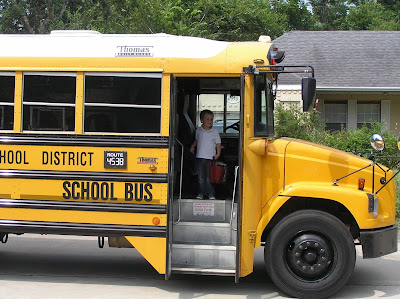

 Since Kirby has been bouncing around from school to school over the past year or so, we are hopeful that we've finally found a place that will meet his needs such that he can stay for a long time. So far, he seems to like it. Yesterday he even started riding the bus! Here's him arriving home this afternoon:
Thursday, August 27, 2009
Pondering the 2009 college football season
One week from tomorrow night, the 2009 college football season will finally kick off. If the preseason pollsters are right, this season will be a very good one for the Florida Gators. Florida was the overwhelming number one team in both the USA Today preseason Coaches' Poll and the AP preseason sportswriters' Poll. Given that this team won the BCS National Championship last year (although I still think Utah really deserved the title) and is returning all of the starters on defense and most of the starters on offense, including Heisman-winning quarterback Tim Tebow, from last year's team, it's really hard to argue that anybody other than the Gators should begin the season in the top position. Whether the Gators, whose favorable schedule includes seven games in Gainesville, can end the regular season in with the same #1 ranking as they begin it may depend a lot on what happens when they travel to Baton Rouge to play LSU in October.
Although Florida is the overwhelming favorite to repeat as BCS national champs, there are plenty of other contenders in the mix as well. The Texas Longhorns come in second in both polls, as several pigskin pundits, including si.com's Stewart Mandel, foresee a Florida-Texas showdown in the BCS National Championship Game. The Longhorns return a potent offense including last year's Heisman runner-up, Quarterback Colt McCoy. UT's national championship hopes will most likely depend on how they handle a three-game October roadtrip to Dallas (Oklahoma), Stillwater (Oklahoma State) and Columbia (Missouri).
Oklahoma, Southern Cal, Alabama, Ohio State and Virginia Tech come in third through seventh, respectively, in both polls, while Mississippi (8th in the AP poll and 10th in the Coaches' poll), Oklahoma State (T-9th and 11th), Penn State (T-9th and 8th) and LSU (11th and 9th) occupy to one position or another the next four spots on both poll. California rounds out the top dozen in both polls. My guess is that any of these teams could, along with Texas, challenge Florida for the BCS championship, although I think USC will continue their annual tradition of losing to an inferior opponent sometime during the course of the season and I think LSU (coming off a disappointing 8-5, unranked season) might be starting the season off in an overrated position. I also continue to believe that the structure of the Big 10 season, wherein all of its teams complete their seasons the week before Thankgiving while schools from other conference continue to play for another couple of weeks (conference championship games included), put Ohio State and Penn State at a relative disadvantage in competing for a shot at the title game.
An amusing quirk of both preseason polls is the notable lack of any Big East (an automatic-qualifiying BCS conference) teams in either the AP or USA Today polls, while the non-automatic-qualifying Mountain West Conference has three. That the voters of these polls believe that the top teams in the MWC, whose champion can only go to a BCS bowl under certain conditions, are better than the top teams in the big East, whose champion automatically gets to go to a BCS bowl, is just yet another shred of evidence to the unfairness of the Bowl Championship Series system. Earlier this year there was a Congressional hearing regarding the injustice of the BCS system, but right now it's clear that Congress is not going to interfere, mainly becuase ofthe political influence of all the states whose schools are currently full BCS participants. That means that, for the foreseeable future, schools whose conferences who do not automatically qualify will have a much tougher road to the BCS championship than those that do, and the schools that have the potential to do so will continue to be patronizingly labelled "BCS Busters." There are four of them - the most ever - in the two preseason polls: TCU (ranked 17 in both polls), Utah (19 in the AP, 18 in USA Today) and BYU (20 and 24) from the Mountain West Conference, and Boise State (14 and 16) from the WAC.
A final note about the polls is the appearance of Notre Dame, which comes in 23rd in both polls. After a 7-6, unranked season last year? While the Irish may indeed have a better season in 2009, the only reason they're even ranked going into the season is because, well, they're Notre Dame. It certainly must be nice to be a program whose name counts for more than its recent accomplishments on the field.
So, who do I think is going to win it all this season? Although I think Texas, Oklahoma, Alabama and even Southern Cal all have a good shot, I'd be a fool to pick against Florida right now. The Gators are simply returning too many weapons from a team that won the BCS title last year.
The main thing is that the wait is almost over. Football season is finally here.
Although Florida is the overwhelming favorite to repeat as BCS national champs, there are plenty of other contenders in the mix as well. The Texas Longhorns come in second in both polls, as several pigskin pundits, including si.com's Stewart Mandel, foresee a Florida-Texas showdown in the BCS National Championship Game. The Longhorns return a potent offense including last year's Heisman runner-up, Quarterback Colt McCoy. UT's national championship hopes will most likely depend on how they handle a three-game October roadtrip to Dallas (Oklahoma), Stillwater (Oklahoma State) and Columbia (Missouri).
Oklahoma, Southern Cal, Alabama, Ohio State and Virginia Tech come in third through seventh, respectively, in both polls, while Mississippi (8th in the AP poll and 10th in the Coaches' poll), Oklahoma State (T-9th and 11th), Penn State (T-9th and 8th) and LSU (11th and 9th) occupy to one position or another the next four spots on both poll. California rounds out the top dozen in both polls. My guess is that any of these teams could, along with Texas, challenge Florida for the BCS championship, although I think USC will continue their annual tradition of losing to an inferior opponent sometime during the course of the season and I think LSU (coming off a disappointing 8-5, unranked season) might be starting the season off in an overrated position. I also continue to believe that the structure of the Big 10 season, wherein all of its teams complete their seasons the week before Thankgiving while schools from other conference continue to play for another couple of weeks (conference championship games included), put Ohio State and Penn State at a relative disadvantage in competing for a shot at the title game.
An amusing quirk of both preseason polls is the notable lack of any Big East (an automatic-qualifiying BCS conference) teams in either the AP or USA Today polls, while the non-automatic-qualifying Mountain West Conference has three. That the voters of these polls believe that the top teams in the MWC, whose champion can only go to a BCS bowl under certain conditions, are better than the top teams in the big East, whose champion automatically gets to go to a BCS bowl, is just yet another shred of evidence to the unfairness of the Bowl Championship Series system. Earlier this year there was a Congressional hearing regarding the injustice of the BCS system, but right now it's clear that Congress is not going to interfere, mainly becuase ofthe political influence of all the states whose schools are currently full BCS participants. That means that, for the foreseeable future, schools whose conferences who do not automatically qualify will have a much tougher road to the BCS championship than those that do, and the schools that have the potential to do so will continue to be patronizingly labelled "BCS Busters." There are four of them - the most ever - in the two preseason polls: TCU (ranked 17 in both polls), Utah (19 in the AP, 18 in USA Today) and BYU (20 and 24) from the Mountain West Conference, and Boise State (14 and 16) from the WAC.
A final note about the polls is the appearance of Notre Dame, which comes in 23rd in both polls. After a 7-6, unranked season last year? While the Irish may indeed have a better season in 2009, the only reason they're even ranked going into the season is because, well, they're Notre Dame. It certainly must be nice to be a program whose name counts for more than its recent accomplishments on the field.
So, who do I think is going to win it all this season? Although I think Texas, Oklahoma, Alabama and even Southern Cal all have a good shot, I'd be a fool to pick against Florida right now. The Gators are simply returning too many weapons from a team that won the BCS title last year.
The main thing is that the wait is almost over. Football season is finally here.
Wednesday, August 26, 2009
Kirby goes to Colorado
Last Thursday, I took Kirby on a brief end-of-summer / birthday vacation to Denver to see his Uncle Dave and to see the mountains for the very first time. Although we were only there until Sunday morning, we had a great time.
On Friday, we celebrated Kirby's 5th birthday with a trip to the Children's Museum of Denver. I was actually surprised by how small it was. Of course, few children's museums can compare to the one we have here in Houston, which was already large before it was recently expanded, and regardless of the Denver museum's size, Kirby had a fun afternoon there. Here, Kirby practices his firefighting skills on the museum's fire engine:
 The museum also had a train room, where Kirby spent time building and playing with various layouts. These two pictures were taken with my cell phone, hence the blurriness:
 Friday evening, we went to a friend's house and celebrated Kirby's birthday with a small party, cake and ice cream.
On Saturday, David took Kirby and me on an excursion up into the mountains. Our first stop was the scenic Red Rocks amphitheater, overlooking Denver. Here, Kirby scratches his head as he ponders the scale and the scenery of the facility:
 Afterwards, we drove up to Mount Evans. The highest paved road in North America leads to the 14,264-foot peak, where a small visitors center and observatory are located. From the top of the peak, you can quite literally look down on the world:
 Given its proximity to Denver as well as the relatively easy access afforded by the paved road, Mt. Evans is a rather popular tourist attraction. Kirby and I took the rocky trek up the pathway from the visitors center to the peak rather slowly, and even then I sometimes felt like I was going to pass out due to the thin air:
 Kirby seemed to do just fine in the high altitude. He has now officially been atop a fourteener!
 David goes up into the mountains rather frequently, but the only time he ever seems to encounter mountain goats is when I'm with him. These guys were grazing below the summit of Mt. Evans:
 The peak of Mt. Evans overlooks Summit Lake, which at 12,830 feet is the highest park in the Denver Mountain Park System. Here's my brother David, posing in front of the lake and the alpine tundra backdrop:
 Saturday night we went into town and dined at the Cherry Cricket, whose burgers (featured on a recent episode of the Travel Channel's Man vs. Food) really are as good as advertised. Kirby also spent some time playing in the pool at Dave's new apartment complex.
All in all, a great trip in spite of its briefness. Kirby had a great time and tells me that he's already ready to go back to the mountains to see Uncle Dave again!
On Friday, we celebrated Kirby's 5th birthday with a trip to the Children's Museum of Denver. I was actually surprised by how small it was. Of course, few children's museums can compare to the one we have here in Houston, which was already large before it was recently expanded, and regardless of the Denver museum's size, Kirby had a fun afternoon there. Here, Kirby practices his firefighting skills on the museum's fire engine:
 The museum also had a train room, where Kirby spent time building and playing with various layouts. These two pictures were taken with my cell phone, hence the blurriness:
 Friday evening, we went to a friend's house and celebrated Kirby's birthday with a small party, cake and ice cream.
On Saturday, David took Kirby and me on an excursion up into the mountains. Our first stop was the scenic Red Rocks amphitheater, overlooking Denver. Here, Kirby scratches his head as he ponders the scale and the scenery of the facility:
 Afterwards, we drove up to Mount Evans. The highest paved road in North America leads to the 14,264-foot peak, where a small visitors center and observatory are located. From the top of the peak, you can quite literally look down on the world:
 Given its proximity to Denver as well as the relatively easy access afforded by the paved road, Mt. Evans is a rather popular tourist attraction. Kirby and I took the rocky trek up the pathway from the visitors center to the peak rather slowly, and even then I sometimes felt like I was going to pass out due to the thin air:
 Kirby seemed to do just fine in the high altitude. He has now officially been atop a fourteener!
 David goes up into the mountains rather frequently, but the only time he ever seems to encounter mountain goats is when I'm with him. These guys were grazing below the summit of Mt. Evans:
 The peak of Mt. Evans overlooks Summit Lake, which at 12,830 feet is the highest park in the Denver Mountain Park System. Here's my brother David, posing in front of the lake and the alpine tundra backdrop:
 Saturday night we went into town and dined at the Cherry Cricket, whose burgers (featured on a recent episode of the Travel Channel's Man vs. Food) really are as good as advertised. Kirby also spent some time playing in the pool at Dave's new apartment complex.
All in all, a great trip in spite of its briefness. Kirby had a great time and tells me that he's already ready to go back to the mountains to see Uncle Dave again!
Wednesday, August 19, 2009
Creepy critter of the day
Lori caught this thing hanging out on our front porch a few days ago:
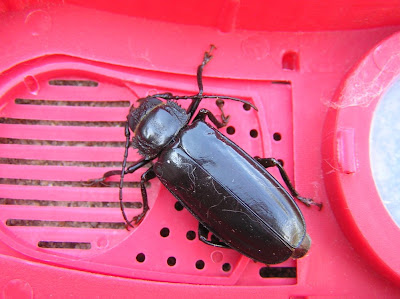 It was a dark, smooth beetle, about 1 1/2 inches long, sporting a rather fearsome pair of pinchers:
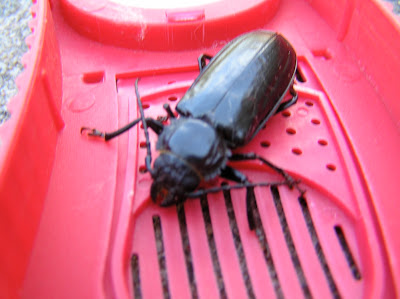 I had never noticed this particular insect around the house before, so I spent some time trying to identify it. It wasn't an easy task, considering the fact that there are somewhere on the order of 350,000 known species of beetles, but I finally determined that this intimidating-looking bug is a hardwood stump borer (Mallodon dasystomus), a member of the longhorn beetle family. It is so named because its larvae reside within the trunks of hardwood trees such as oaks. The adults feed on ants and other tiny insects, which is what the pinchers are for. If they are handled improperly, of course, they can deliver a painful bite to humans as well.
Houston, with its location in the southern United States and its abundance of oaks and other hardwood trees, is indeed part of this beetle's habitat. I had just never been aware of them before. Apparently, neither had the staff of the Houston Museum of Natural Science, either, until recently.
After photographing and identifying this critter, I sent him on his way. However, I'm sure this won't be the last exotic insect I find lurking around the house.
 It was a dark, smooth beetle, about 1 1/2 inches long, sporting a rather fearsome pair of pinchers:
 I had never noticed this particular insect around the house before, so I spent some time trying to identify it. It wasn't an easy task, considering the fact that there are somewhere on the order of 350,000 known species of beetles, but I finally determined that this intimidating-looking bug is a hardwood stump borer (Mallodon dasystomus), a member of the longhorn beetle family. It is so named because its larvae reside within the trunks of hardwood trees such as oaks. The adults feed on ants and other tiny insects, which is what the pinchers are for. If they are handled improperly, of course, they can deliver a painful bite to humans as well.
Houston, with its location in the southern United States and its abundance of oaks and other hardwood trees, is indeed part of this beetle's habitat. I had just never been aware of them before. Apparently, neither had the staff of the Houston Museum of Natural Science, either, until recently.
After photographing and identifying this critter, I sent him on his way. However, I'm sure this won't be the last exotic insect I find lurking around the house.
Saturday, August 08, 2009
I wish August had a fast forward button
My season tickets arrived in the mail last Wednesday. USA Today released their preseason coaches' poll yesterday morning. And the University of Houston football team held their first workout yesterday afternoon.
Football season, to me, is like Christmas to a child: the closer it gets, the harder it becomes to wait.
Football season, to me, is like Christmas to a child: the closer it gets, the harder it becomes to wait.
Subscribe to:
Posts (Atom)