While doing my semi-regular perusal of this site's visitor paths on StatCounter, I discovered that somebody came across this blog while doing a Google search for nude pictures of children's musician Laurie Berkner.
I don't know what disturbs me more: that somebody would be looking for naked pictures of her, or that this blog would be involved in such a search...
Friday, April 27, 2007


Friday, April 20, 2007
The Houston Rockets, one year later
Exactly one year ago, I was bemoaning the fact that the Houston Rockets had concluded their disappointing 2005-06 season with a loss to San Antonio. The Rockets ended that injury-plagued season with a rather poor 34-48 record and a distinct lack of local attraction. As I noted at the time, the Rockets were "something of an afterthought on the local sports scene;" a team that many local sports fans, myself included, just didn't care all that much about.
Exactly one year later, the Rockets, having just ended a reasonably successful 52-30 regular season campaign, are preparing to start the first round of the playoffs against the Utah Jazz tomorrow night. Improvement on the court has resulted in improvement in the stands as well; the 2006-07 Rockets averaged 16,542 fans per game during the regular season; an improvement of over one thousand fans/game from the previous season. Not a dramatic change, but enough to jump the Rockets from 28th to 21st in the 30-team league's attendance rankings. From a more subjective point of view, it seems clear that the Rockets have managed to create a bit of a buzz about themselves among the local populace as well, a buzz that simply did not exist one year ago.
Nevertheless, there's still a perception that the Rockets remain "something of an afterthought in the local pro sports scene;" the Astros still command the city's attention, the Texans - as woeful as they might be - still generate considerable attraction simply because they're a football team in a football-rabid locale, and even the Dynamo managed to upstage the Rockets when they won the MLS championship last fall. The Rockets, improved though they might be, still have a lot to prove to the jaded and fickle Houston sports fan who still remembers those halcyon years of the mid-90s, when Rudy Tomjonavich, Hakeem Olajuwon, Clyde Drexler and the rest won those two NBA championships. A win over the Jazz in the first round of the playoffs - something the team hasn't managed to do since they defeated the Minnesota Timberwolves in the first round of the 1997 playoffs, one decade ago - would be a big step forward for the Rockets.
I'm not going to pretend that I like the Rockets' owner, Leslie Alexander, or their insufferably whiny head coach, Jeff Van Gundy. But I'll be paying close attention to, and heartily rooting for, the Rockets as they begin the playoffs tomorrow night. I am undoubtedly not the only local sports fan who is paying more attention to the Rockets now than they have in many years, and that's a good thing for a franchise that is desperately trying to succeed, and recapture the city's imagination in the process.
UPDATE: The Rockets, once again, were unable to get past the first round of the playoffs, losing the series to Utah 3 games to 4. This only adds to the aura of disappointment that has hung over the Rockets for the last decade; it appears that the Rockets will just have to try to "recapture the city's imagination" once again next season.
Exactly one year later, the Rockets, having just ended a reasonably successful 52-30 regular season campaign, are preparing to start the first round of the playoffs against the Utah Jazz tomorrow night. Improvement on the court has resulted in improvement in the stands as well; the 2006-07 Rockets averaged 16,542 fans per game during the regular season; an improvement of over one thousand fans/game from the previous season. Not a dramatic change, but enough to jump the Rockets from 28th to 21st in the 30-team league's attendance rankings. From a more subjective point of view, it seems clear that the Rockets have managed to create a bit of a buzz about themselves among the local populace as well, a buzz that simply did not exist one year ago.
Nevertheless, there's still a perception that the Rockets remain "something of an afterthought in the local pro sports scene;" the Astros still command the city's attention, the Texans - as woeful as they might be - still generate considerable attraction simply because they're a football team in a football-rabid locale, and even the Dynamo managed to upstage the Rockets when they won the MLS championship last fall. The Rockets, improved though they might be, still have a lot to prove to the jaded and fickle Houston sports fan who still remembers those halcyon years of the mid-90s, when Rudy Tomjonavich, Hakeem Olajuwon, Clyde Drexler and the rest won those two NBA championships. A win over the Jazz in the first round of the playoffs - something the team hasn't managed to do since they defeated the Minnesota Timberwolves in the first round of the 1997 playoffs, one decade ago - would be a big step forward for the Rockets.
I'm not going to pretend that I like the Rockets' owner, Leslie Alexander, or their insufferably whiny head coach, Jeff Van Gundy. But I'll be paying close attention to, and heartily rooting for, the Rockets as they begin the playoffs tomorrow night. I am undoubtedly not the only local sports fan who is paying more attention to the Rockets now than they have in many years, and that's a good thing for a franchise that is desperately trying to succeed, and recapture the city's imagination in the process.
UPDATE: The Rockets, once again, were unable to get past the first round of the playoffs, losing the series to Utah 3 games to 4. This only adds to the aura of disappointment that has hung over the Rockets for the last decade; it appears that the Rockets will just have to try to "recapture the city's imagination" once again next season.
The search for answers
I hadn't planned on writing anything about the Virginia Tech massacre. What kind of insight could I provide, after all? What could I say about the horrible event that hasn't already been said by somebody else?
But, in the wall-to-wall media frenzy that has followed this tragedy, one particular and oft-repeated phrase has caught my attention: "the search for answers." People, naturally, want an explanation for Monday's events. What happened? How did it happen? Why did it happen? How could it have been prevented?
The "what" part is really very simple: an angry, lonely sociopath purchased a couple of guns, went on a rampage, and murdered 32 people. It's the search for the deeper explanations - the "how" and the "why" - that has, over the course of the week, become the focus of national discussion. Why wasn't the killer, whose disturbing writings had caused at least one professor to remove him from her class and who was, at one point, detained for a psychiatric assessment, deemed a threat and removed from campus? Why was the killer allowed to purchase firearms even though he had been detained as a psychiatric risk? Was the police response to the shooting adequate? Everyone - experts, analysts, professors, pundits, pop psychologists, editorialists and next-door neighbors alike - is offering up their own take on "what really happened." Over the next several months and perhaps even years, a flurry of investigations will take place to determine the "why"" and "how" behind this horrific event: to get the answers everybody seeks, to assign blame, if any, and to make recommendations aimed at preventing a further tragedy of this type from occurring.
But what if, after all the investigations and analyses take place, "the search for answers" comes up empty? What if it is determined that the psychiatric evaluation that allowed the killer to remain on the Virginia Tech campus was handled correctly, that the system of background checks that allowed the killer to legally purchase his firearms worked exactly as it was designed and that no reasonable restrictions on handgun ownership would have prevented this tragedy (after all, the killer could conceivably have killed just as many people if he had gone on a stabbing spree instead of a shooting spree), or that the police response to the shootings was appropriate relative to what the authorities knew at the time? What if Monday's tragedy was, essentially, nothing more than "an angry, lonely sociopath purchased a couple of guns and went on a rampage" - a random, isolated act of violence that could not have reasonably been foreseen or prevented? What if there is nothing or nobody to blame, other than the killer himself?
Today I came across a story about the families of the Columbine victims who, eight years to the day after that massacre, are still "searching for answers." It's human nature to want to make sense out of the senseless, to understand the incomprehensible. This is especially true for the friends and families of the victims: "because a guy went crazy and decided to shoot people" probably isn't a satisfactory answer for people trying to understand why their child or their best friend - be they a student at Columbine or Virginia Tech - was gunned down while he or she innocently sat in a classroom. But, at the end of the day, it might be the only explanation: there are crazy people amongst us, and sometimes they do crazy, violent things, and sometimes people are just in the wrong place at the wrong time.
But, in the wall-to-wall media frenzy that has followed this tragedy, one particular and oft-repeated phrase has caught my attention: "the search for answers." People, naturally, want an explanation for Monday's events. What happened? How did it happen? Why did it happen? How could it have been prevented?
The "what" part is really very simple: an angry, lonely sociopath purchased a couple of guns, went on a rampage, and murdered 32 people. It's the search for the deeper explanations - the "how" and the "why" - that has, over the course of the week, become the focus of national discussion. Why wasn't the killer, whose disturbing writings had caused at least one professor to remove him from her class and who was, at one point, detained for a psychiatric assessment, deemed a threat and removed from campus? Why was the killer allowed to purchase firearms even though he had been detained as a psychiatric risk? Was the police response to the shooting adequate? Everyone - experts, analysts, professors, pundits, pop psychologists, editorialists and next-door neighbors alike - is offering up their own take on "what really happened." Over the next several months and perhaps even years, a flurry of investigations will take place to determine the "why"" and "how" behind this horrific event: to get the answers everybody seeks, to assign blame, if any, and to make recommendations aimed at preventing a further tragedy of this type from occurring.
But what if, after all the investigations and analyses take place, "the search for answers" comes up empty? What if it is determined that the psychiatric evaluation that allowed the killer to remain on the Virginia Tech campus was handled correctly, that the system of background checks that allowed the killer to legally purchase his firearms worked exactly as it was designed and that no reasonable restrictions on handgun ownership would have prevented this tragedy (after all, the killer could conceivably have killed just as many people if he had gone on a stabbing spree instead of a shooting spree), or that the police response to the shootings was appropriate relative to what the authorities knew at the time? What if Monday's tragedy was, essentially, nothing more than "an angry, lonely sociopath purchased a couple of guns and went on a rampage" - a random, isolated act of violence that could not have reasonably been foreseen or prevented? What if there is nothing or nobody to blame, other than the killer himself?
Today I came across a story about the families of the Columbine victims who, eight years to the day after that massacre, are still "searching for answers." It's human nature to want to make sense out of the senseless, to understand the incomprehensible. This is especially true for the friends and families of the victims: "because a guy went crazy and decided to shoot people" probably isn't a satisfactory answer for people trying to understand why their child or their best friend - be they a student at Columbine or Virginia Tech - was gunned down while he or she innocently sat in a classroom. But, at the end of the day, it might be the only explanation: there are crazy people amongst us, and sometimes they do crazy, violent things, and sometimes people are just in the wrong place at the wrong time.
Saturday, April 14, 2007
Blog update and other thoughts
As is obvious, I haven’t been very active with this blog lately. I've been busy with other things, and there just hasn't been anything I've felt a pressing need to write about. After all, it's too early in the season for me to begin fretting about the Astros, even though they stumbled out of the opening gate (and yes, I know that they're now on a three-game winning streak), and I just haven't had much to say about anything else that passes for news these days, whether it be the real father of Anna Nicole's daughter or the furor over racist comments made by a has-been radio shock jock or the latest round of American Idol voting. I do have a few random thoughts I wanted to throw out, which I'll get to in a moment.
As is also obvious, I've finally decided to upgrade to the "new" version of Blogger. This allows me to assign topic tags to all of my blogs, and I've done so for the entire archive. It's interesting to see which topics I've written about the most: college football comes in at the top, which is no surprise (I hadn't realized that I'd written so many posts about Dubai, however). I've also taken the opportunity to update some old links and add a few new ones. I'll probably add a few more new links in the coming weeks.
Anyway:
• Lori used one of those ubiquitous online tax programs to figure our 2006 taxes. After entering all of the required information and letting the program do its thing, she discovered that we apparently owed money to Uncle Sam this year, to the tune of about $250. When she announced this to me I thought I was a bit odd; last year, after all, we received a tax refund well in excess of $1000, and no changes to our financial status had occurred between 2005 and 2006.
So I took a look at the online return myself. It appeared that Lori had entered all of the data correctly. Maybe we did owe money this time around. Nevertheless, I decided to work out a tax return by hand as a way of confirmation.
And I'm glad I did. The result I came up with was much different than the result the online program provided. I double-checked my math; I had calculated everything correctly. So we took a closer look at the online program and eventally found the problem: while the program had correctly figured in the personal exemptions for Lori and myself, it did not do so for Kirby. The reason it did not do so is because Lori overlooked a small and barely-noticable box on the program that dealt with Kirby's residency. Even though she had filled out all of Kirby's other information correctly, the fact that she didn't check the box asking if Kirby lived at home with us caused the program not to count him as an exemption. Lori checked the box, and voila! The program's outcome immediately matched mine; instead of owing $250, we were due a refund in excess of $1,600.
We filed the corrected return online, and should be getting our refund in a few weeks. It will go towards our home's biggest need at the moment, which is a new roof for the sunporch which we intend for Kirby to use as a playroom.
The moral of the story is this: if you're using an online program to figure your taxes, be sure to carefully check evrything you've entered and make certain that you haven't overlooked anything. These programs aren't always perfectly-designed; in this case, one small, poorly-placed check box was the difference between a $250 debt and a $1,600 refund. And although it's a pain in the ass, it's never a bad idea to calculate a return the old-fashioned way even if you're using one of these easy online programs to do your taxes. The program Lori was using, like many online tax return programs, simply collects your data and spits out a few resulting numbers: your adjusted gross income was x, the taxes you paid were y, your refund or amount you owe is z, etc. It doesn't really show you the process it used to arrive at the result, and therefore makes errors or omissions harder to spot.
• Believe it or not, the only Kurt Vonnegut book I've ever read is Galapagos. People have recommended Slaughterhouse-Five or Breakfast of Champions to me, but I've never bothered to read them and that's pretty sad. I guess I need to start reading more.
In spite of the fact that I've only read one of his books, I was saddened to learn of his death earlier this week. Although Vonnegut himself always dismissed such flattering evaluations, the comparisons being made between him and another acerbic and darkly witty American author - Mark Twain - are probably apt.
• You know you're getting old when you discover that the younger generation has begun to develop its own sense of nostalgia. Such was the case when I ran across this "Tribute to Old School Nickelodeon" on YouTube. I was expecting to find clips or scenes from programs I consider to be the "old school" Nickelodeon of the 1980s: Mr. Wizard's World, Belle and Sebastian, Pinwheel, Out of Control, Danger Mouse, Turkey Television, and, of course, You Can't Do That on Television. Instead, the clip turned out to be a montage of shows Nickelodeon aired during the '90s that, aside from a few like Ren and Stimpy, I didn't even recognize. One of the YouTube commenters pointed this out on the clip's page, and the creator of the clip responded that all those "old old school" Nickelodeon shows were before his time. What a youngster!
If you're my age, however, you'll probably appreciate this classic bit of childhood television nostalgia, from Sesame Street:
I've always liked that funky 70's synthesized music.
Hopefully I'll be able resume regular (or at least semi-regular) blog postings in the near future. In the meantime, be sure to check out my brother's account of his recent trip to San Francisco, which included a long train ride from Denver.
As is also obvious, I've finally decided to upgrade to the "new" version of Blogger. This allows me to assign topic tags to all of my blogs, and I've done so for the entire archive. It's interesting to see which topics I've written about the most: college football comes in at the top, which is no surprise (I hadn't realized that I'd written so many posts about Dubai, however). I've also taken the opportunity to update some old links and add a few new ones. I'll probably add a few more new links in the coming weeks.
Anyway:
• Lori used one of those ubiquitous online tax programs to figure our 2006 taxes. After entering all of the required information and letting the program do its thing, she discovered that we apparently owed money to Uncle Sam this year, to the tune of about $250. When she announced this to me I thought I was a bit odd; last year, after all, we received a tax refund well in excess of $1000, and no changes to our financial status had occurred between 2005 and 2006.
So I took a look at the online return myself. It appeared that Lori had entered all of the data correctly. Maybe we did owe money this time around. Nevertheless, I decided to work out a tax return by hand as a way of confirmation.
And I'm glad I did. The result I came up with was much different than the result the online program provided. I double-checked my math; I had calculated everything correctly. So we took a closer look at the online program and eventally found the problem: while the program had correctly figured in the personal exemptions for Lori and myself, it did not do so for Kirby. The reason it did not do so is because Lori overlooked a small and barely-noticable box on the program that dealt with Kirby's residency. Even though she had filled out all of Kirby's other information correctly, the fact that she didn't check the box asking if Kirby lived at home with us caused the program not to count him as an exemption. Lori checked the box, and voila! The program's outcome immediately matched mine; instead of owing $250, we were due a refund in excess of $1,600.
We filed the corrected return online, and should be getting our refund in a few weeks. It will go towards our home's biggest need at the moment, which is a new roof for the sunporch which we intend for Kirby to use as a playroom.
The moral of the story is this: if you're using an online program to figure your taxes, be sure to carefully check evrything you've entered and make certain that you haven't overlooked anything. These programs aren't always perfectly-designed; in this case, one small, poorly-placed check box was the difference between a $250 debt and a $1,600 refund. And although it's a pain in the ass, it's never a bad idea to calculate a return the old-fashioned way even if you're using one of these easy online programs to do your taxes. The program Lori was using, like many online tax return programs, simply collects your data and spits out a few resulting numbers: your adjusted gross income was x, the taxes you paid were y, your refund or amount you owe is z, etc. It doesn't really show you the process it used to arrive at the result, and therefore makes errors or omissions harder to spot.
• Believe it or not, the only Kurt Vonnegut book I've ever read is Galapagos. People have recommended Slaughterhouse-Five or Breakfast of Champions to me, but I've never bothered to read them and that's pretty sad. I guess I need to start reading more.
In spite of the fact that I've only read one of his books, I was saddened to learn of his death earlier this week. Although Vonnegut himself always dismissed such flattering evaluations, the comparisons being made between him and another acerbic and darkly witty American author - Mark Twain - are probably apt.
• You know you're getting old when you discover that the younger generation has begun to develop its own sense of nostalgia. Such was the case when I ran across this "Tribute to Old School Nickelodeon" on YouTube. I was expecting to find clips or scenes from programs I consider to be the "old school" Nickelodeon of the 1980s: Mr. Wizard's World, Belle and Sebastian, Pinwheel, Out of Control, Danger Mouse, Turkey Television, and, of course, You Can't Do That on Television. Instead, the clip turned out to be a montage of shows Nickelodeon aired during the '90s that, aside from a few like Ren and Stimpy, I didn't even recognize. One of the YouTube commenters pointed this out on the clip's page, and the creator of the clip responded that all those "old old school" Nickelodeon shows were before his time. What a youngster!
If you're my age, however, you'll probably appreciate this classic bit of childhood television nostalgia, from Sesame Street:
I've always liked that funky 70's synthesized music.
Hopefully I'll be able resume regular (or at least semi-regular) blog postings in the near future. In the meantime, be sure to check out my brother's account of his recent trip to San Francisco, which included a long train ride from Denver.
Sunday, April 08, 2007
My new toy
Although I use Windows for much of my computing activities, I'm still a Mac person at heart, and my primary personal computer will always be an Apple. Such is the case with my newest machine:
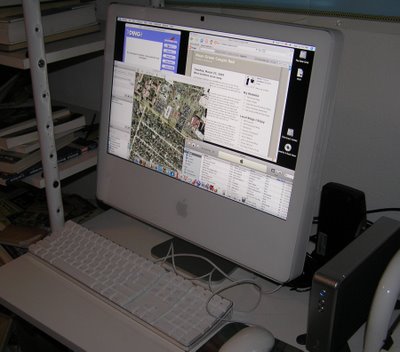
This iMac replaces the venerable G4, which has served me well over the past seven-and-a-half years (I was still living in Lewisville when I purchased it in the fall of 1999; it really seems like eons ago). I made upgrades to it from time to time to keep it from becoming totally obsolete: adding more memory, upgrading the system to OS X, even replacing the processor. Over the past few months, however, the G4 had become increasingly unstable. Screen freezes and kernel panics began to occur with increasing frequency, and none of the fixes I tried - running the disk repair utility, making more space on the hard drive, booting the computer in safe mode, testing the memory - seemed to make any difference. It got to the point were the computer crashed so frequently that it was all but unusable; my only remaining option was to erase the hard drive and re-install the system software.
But why even bother? I could erase and re-install (and then spend the next several hours re-configuring the machine, re-installing application software, downloading all the necessary patches and upgrades, etc.), and maybe that would fix the problem and maybe I could squeeze another year or two out of the venerable yet increasingly obsolete G4 before I finally had to break down and get a new machine. Why not just go ahead and get a new computer now? The time had simply come.
I was originally thinking about an iBook, but eventually I decided that I wanted something with a bigger display. So I settled on the 20" iMac and made the purchase.
And I'm glad I did. The 2.16 Ghz Core Duo processor is speedy and smooth. The fact that the entire computer is built into the display means less clutter underneath my desk. The faster processor as well as the larger hard drive will make it possible for me to do video and music editing on this machine that I couldn't do on the G4. Programs that used to overwhelm the G4, such as SimCity 4 or Google Earth, run just fine on this iMac. Apple's switch to Intel processors means that I'll be able to run Windows software on this machine, should I ever need to do so (and right now, I really don't; between my Dell work laptop, Lori's HP laptop, and even the old Compaq that Danny left here when he moved to DC, I already have plenty of opportunities to use Windows applications). And I really like the 20" display. All in all, this new iMac perfectly fits my computing needs, and should continue to do so for the next several years.
I don't know if this machine will last me as long as the venerable G4 did; one of the drawbacks to the iMac is that the only user-upgradable component is the memory (the only other thing I don't like about the iMac is the tiny, difficult-to-control four-way trackball on the mouse; I guess I'll get used to it sooner or later). However, it's nice to finally feel that my personal computer is "up to date" with the rest of the world.
This iMac replaces the venerable G4, which has served me well over the past seven-and-a-half years (I was still living in Lewisville when I purchased it in the fall of 1999; it really seems like eons ago). I made upgrades to it from time to time to keep it from becoming totally obsolete: adding more memory, upgrading the system to OS X, even replacing the processor. Over the past few months, however, the G4 had become increasingly unstable. Screen freezes and kernel panics began to occur with increasing frequency, and none of the fixes I tried - running the disk repair utility, making more space on the hard drive, booting the computer in safe mode, testing the memory - seemed to make any difference. It got to the point were the computer crashed so frequently that it was all but unusable; my only remaining option was to erase the hard drive and re-install the system software.
But why even bother? I could erase and re-install (and then spend the next several hours re-configuring the machine, re-installing application software, downloading all the necessary patches and upgrades, etc.), and maybe that would fix the problem and maybe I could squeeze another year or two out of the venerable yet increasingly obsolete G4 before I finally had to break down and get a new machine. Why not just go ahead and get a new computer now? The time had simply come.
I was originally thinking about an iBook, but eventually I decided that I wanted something with a bigger display. So I settled on the 20" iMac and made the purchase.
And I'm glad I did. The 2.16 Ghz Core Duo processor is speedy and smooth. The fact that the entire computer is built into the display means less clutter underneath my desk. The faster processor as well as the larger hard drive will make it possible for me to do video and music editing on this machine that I couldn't do on the G4. Programs that used to overwhelm the G4, such as SimCity 4 or Google Earth, run just fine on this iMac. Apple's switch to Intel processors means that I'll be able to run Windows software on this machine, should I ever need to do so (and right now, I really don't; between my Dell work laptop, Lori's HP laptop, and even the old Compaq that Danny left here when he moved to DC, I already have plenty of opportunities to use Windows applications). And I really like the 20" display. All in all, this new iMac perfectly fits my computing needs, and should continue to do so for the next several years.
I don't know if this machine will last me as long as the venerable G4 did; one of the drawbacks to the iMac is that the only user-upgradable component is the memory (the only other thing I don't like about the iMac is the tiny, difficult-to-control four-way trackball on the mouse; I guess I'll get used to it sooner or later). However, it's nice to finally feel that my personal computer is "up to date" with the rest of the world.
Wednesday, March 28, 2007
When brothers move away
I just received a call from my brother David informing me that he has safely made it to Denver, Colorado. Dave needs to get settled up there (i.e. find a job, get his own place, etc.), but otherwise, the Mile High City will be his new home.
Dave had been planning this move for several months. When he returned to Houston from Japan two Decembers ago, he understood that his stay here would only be temporary and that he would one day move to another part of the country. This wasn't because he dislikes Houston; he simply wanted to live elsewhere (someplace where they "actually have four real seasons," as he put it). He had considered living in places other than Denver - he even took a trip to Portland, Oregon last year to see the area for himself - but decided that, since he had lived there previously (before he spent several years teaching English in Prague and Osaka) and has several friends there, Denver was the right place for him.
David's move to Denver comes on the heels of my brother-in-law Danny's move to the Washington, DC area almost two weeks ago. After flying up there January to see the nation's capital and to visit friends of his, Danny immedidately began contemplating relocating there. He finally decided to do, and is currently living with a friend in Herndon, Virginia while he gets settled. Danny decided to move because he felt that there would be more job opportunities in his line of work in the DC area than here in Houston, and he also thought that there would be better mobility options for him there (Danny is visually impaired and cannot drive, and DC's public transportion network is much more extensive than Houston's). Like David in Denver, he has a lot of friends there.
But, more than anything else, Danny simply felt like it was time for a change. A short stint in San Antonio aside, he had lived his entire life in Houston. The time had come for him to move on, to experience a new life in another part of the country.
Things here in Houston certainly won't be the same without them; my life will be a little less lively and a little more boring. But I certainly won't begrudge either Danny or Dave for making decisions that they feel are in their best interests. And perhaps their absence is not an entirely bad thing for me. The truth is, my practice of spending a few nights every week hanging out with Danny at the Dog House Tavern - as enjoyable as it has been - probably needed to come to an end anyway. I'm getting to a point in my life where I need to live a bit healthier, a bit more temperate, and this is as good a time as any to start.
And it's not like I'll never see them again. They'll make regular trips back to Houston to see Kirby, Danny's daughter Cheyenne, my parents, Danny and Lori's parents, their friends here and me. And I now have an excellent excuse to make quick trips to Denver and Washington. I think I'll be paying a lot more attention to Southwest's Ding! fare sale alert program on my computer from now on.
Best of luck to Danny and David in their new lives.
Dave had been planning this move for several months. When he returned to Houston from Japan two Decembers ago, he understood that his stay here would only be temporary and that he would one day move to another part of the country. This wasn't because he dislikes Houston; he simply wanted to live elsewhere (someplace where they "actually have four real seasons," as he put it). He had considered living in places other than Denver - he even took a trip to Portland, Oregon last year to see the area for himself - but decided that, since he had lived there previously (before he spent several years teaching English in Prague and Osaka) and has several friends there, Denver was the right place for him.
David's move to Denver comes on the heels of my brother-in-law Danny's move to the Washington, DC area almost two weeks ago. After flying up there January to see the nation's capital and to visit friends of his, Danny immedidately began contemplating relocating there. He finally decided to do, and is currently living with a friend in Herndon, Virginia while he gets settled. Danny decided to move because he felt that there would be more job opportunities in his line of work in the DC area than here in Houston, and he also thought that there would be better mobility options for him there (Danny is visually impaired and cannot drive, and DC's public transportion network is much more extensive than Houston's). Like David in Denver, he has a lot of friends there.
But, more than anything else, Danny simply felt like it was time for a change. A short stint in San Antonio aside, he had lived his entire life in Houston. The time had come for him to move on, to experience a new life in another part of the country.
Things here in Houston certainly won't be the same without them; my life will be a little less lively and a little more boring. But I certainly won't begrudge either Danny or Dave for making decisions that they feel are in their best interests. And perhaps their absence is not an entirely bad thing for me. The truth is, my practice of spending a few nights every week hanging out with Danny at the Dog House Tavern - as enjoyable as it has been - probably needed to come to an end anyway. I'm getting to a point in my life where I need to live a bit healthier, a bit more temperate, and this is as good a time as any to start.
And it's not like I'll never see them again. They'll make regular trips back to Houston to see Kirby, Danny's daughter Cheyenne, my parents, Danny and Lori's parents, their friends here and me. And I now have an excellent excuse to make quick trips to Denver and Washington. I think I'll be paying a lot more attention to Southwest's Ding! fare sale alert program on my computer from now on.
Best of luck to Danny and David in their new lives.
Sunday, March 25, 2007
Life imitates art, basketball edition
Chances are, you missed yesterday's NCAA Division II Championship basketball game between Winona State (Winona, Minnesota) and Barton College (Wilson, North Carolina). The game's ending was absolutely amazing:
The last few seconds of the game, in fact, are eerily reminiscent of this Nike Air Jordan commercial that's been running recently:
(The music is the Lacrimosa from Mozart's Requiem, in case you're wondering.)
Anyway, there are few things that hurt more than losing a championship game in the final seconds. I can sympathize with Winona State; I know all too well how it feels. Ugh.
The last few seconds of the game, in fact, are eerily reminiscent of this Nike Air Jordan commercial that's been running recently:
(The music is the Lacrimosa from Mozart's Requiem, in case you're wondering.)
Anyway, there are few things that hurt more than losing a championship game in the final seconds. I can sympathize with Winona State; I know all too well how it feels. Ugh.
The EU's "open skies" agreement and Houston
This past week, the European Union approved an "open skies" deal that scraps most restrictions on trans-Atlantic flights. The deal, which has already been approved by the United States, is intended to enhance competition among airlines by allowing them to fly anywhere in Europe to anywhere in the United States, and vice versa. The arrangement, which goes into effect on March 30, 2008, replaces the current patchwork of agreements between individual European nations and the United States which restrict the overseas destinations of airlines on either side of the Atlantic; some of these existing arrangments date back to the end of the Second World War. The EU estimates that the deal will cause 25 million more people to fly between the United States and Europe within the first five years of the agreement's implementation, and that fliers would see almost $16 billion in savings as a result. Sounds good to me.
Hometown airline Continental is not wasting any time taking advantage of the new agreement; they've announced plans to ask for permission to begin flying between Bush Intercontinental and London Heathrow as the agreement goes into effect. (Continental already flies between Houston and London's Gatwick Airport, but there seems to be a consensus that Heathrow is London's preferred airport).
This is fine, but what I'd really like to see is for Continental use this opportunity to offer more non-stop service between Houston and cities in Europe. I realize that Continental prefers Newark to be their hub for European flights and Houston to be their hub for Latin American flights, but c'mon! Right now, only four European destinations are served by nonstop flights from Houston: London (Continental and British Airways), Paris (Continental and Air France), Amsterdam (Continental and KLM) and Frankfurt (Lufthansa). It only seems logical that the nation's fourth-largest city, and a city of such critical importance to the world's energy economy, should have nonstop connections to more than just four European cities.
I find it hard to believe, for example, that there isn't sufficient demand to make nonstop service between Houston and major European cities like Madrid and Rome profitable. What about Dublin? Berlin? Barcelona? Moscow?
The bid for direct flights to Heathrow is a good start. Let's hope Continental doesn't stop there and that they use this new agreement to their full advantage by persuing more European destinations from Bush Intercontinental. An expansion of European service from Houston would be an advantage to the city's economy and a boon to the city's travelers (myself included, of course).
Hometown airline Continental is not wasting any time taking advantage of the new agreement; they've announced plans to ask for permission to begin flying between Bush Intercontinental and London Heathrow as the agreement goes into effect. (Continental already flies between Houston and London's Gatwick Airport, but there seems to be a consensus that Heathrow is London's preferred airport).
This is fine, but what I'd really like to see is for Continental use this opportunity to offer more non-stop service between Houston and cities in Europe. I realize that Continental prefers Newark to be their hub for European flights and Houston to be their hub for Latin American flights, but c'mon! Right now, only four European destinations are served by nonstop flights from Houston: London (Continental and British Airways), Paris (Continental and Air France), Amsterdam (Continental and KLM) and Frankfurt (Lufthansa). It only seems logical that the nation's fourth-largest city, and a city of such critical importance to the world's energy economy, should have nonstop connections to more than just four European cities.
I find it hard to believe, for example, that there isn't sufficient demand to make nonstop service between Houston and major European cities like Madrid and Rome profitable. What about Dublin? Berlin? Barcelona? Moscow?
The bid for direct flights to Heathrow is a good start. Let's hope Continental doesn't stop there and that they use this new agreement to their full advantage by persuing more European destinations from Bush Intercontinental. An expansion of European service from Houston would be an advantage to the city's economy and a boon to the city's travelers (myself included, of course).
Thursday, March 15, 2007
Missing out on March Madness
The NCAA Men's Division I Basketball Championship (more commonly known as "March Madness" or "The Big Dance") has begun. The tournament, which over the course of three weeks whittles a field of sixty-five schools down to just one, is the biggest sporting event of the spring; it ranks among the World Series and the Super Bowl as one of the nation's premier sports events.
But I'm not playing close attention to the "Tourney" this year. Which is unusual. Normally, I'd be going onto the internet every so often to monitor the outcome of today's first-round games. Normally, I'd be sitting in front of the TV watching the games on CBS. But this year, I'm not.
It's not because I don't like college basketball. While I don't follow it nearly as closely as I do college football, I've always looked forward to March Madness due to its sheer size and excitement.
And it's not because my Cougars aren't in the tournament. The University of Houston hasn't been to the Big Dance since 1992 (indeed, the days of Phi Slamma Jamma are ancient history), but that's never affected my enjoyment of the event in the past.
The reason I'm not paying close attention to the Big Dance is simple: I didn't fill out a bracket this year.
Yes, filling out a bracket really does make that much of a difference.
There's something special about filling out a bracket - something that trancends mere prognostication. When you out that bracket, when you enter your company's office pool, when you try to pick those upsets, when you attempt to determine who will win it all, when you compare your predictions with those of your friends and co-workers, you become part of the action.
That's why you continually hit the "refresh" button on your computer's web browser, following that major upset that appears to be in the works. That's why you find yourself taking long lunch breaks to watch first-round games between schools you normally don't care about. And that's why you come home and sit on the edge of your couch all evening, anxiously hoping that the the team you picked to win it all won't get knocked out by the scrappy underdog.
It doesn't matter how big or how small that office pool is. It makes no difference how many or how few bragging rights are at stake. It's much more than that: your bracket makes the tournament and its sixty-three games personal to you. The bracket becomes your very own guidebook, your personalized roadmap, to the Big Dance. Without it, you are lost. Without it, you're just not part of the action. Without it, you just don't care.
And that's where I find myself right now. I'm not part of the action. And therefore, I don't really care.
Why did I not fill out a bracket this time around? Why did I choose not to be part of the spectacle that is March Madness this year?
In the past, I've participated in office pools at work. But my current place of employment doesn't do that. Everybody's working on different projects, everybody has different schedules, and I guess we really just don't see each other and don't know each other well enough to initiate a basketball pick 'em contest of our own (this, by the way, is probably why the annual Christmas gift exchange is actually a rather awkward affair because nobody really knows one another). For the past couple of years, I've circumvented this problem by participating in the office pool at Lori's work. But that option ended when her employment there ended a couple of months ago.
I guess I could have participated in one of the tournament-picking contests on any of the online sports forums I frequent. But I didn't. I could even have filled out a bracket just for myself, if for no other reason to see how good my prediction skills were. But I didn't. This year, I didn't even bother to sit down and take a close look at the teams and the matchups.
It's not like I've been too overwhelmed to fill out a bracket; to be sure, I have been dealing with a few distractions over the past several days (for example, I've been busy this week trying to figure out why my computer constantly crashes and freezes; maybe it's just time for a new computer), but nothing would have kept me from taking the few minutes to print out a bracket and fill it out if I had simply decided to do so.
The fact is, for whatever reason I simply neglected to fill out a bracket this year (and no, I can't go back and fill out a bracket now, after the tournament has begun). As a result, I'm missing out on March Madness.
Hopefully I won't make the same mistake next spring.
UPDATE: I'd just like to announce that, had I actually filled out a bracket, I would have picked Virginia Commonwealth to upset Duke. I'm not lying! The Blue Devils just weren't themselves this past season and probably were not deserving of a six seed, and VCU had won 18 out of their last 21 games coming into the tournament.
But I'm not playing close attention to the "Tourney" this year. Which is unusual. Normally, I'd be going onto the internet every so often to monitor the outcome of today's first-round games. Normally, I'd be sitting in front of the TV watching the games on CBS. But this year, I'm not.
It's not because I don't like college basketball. While I don't follow it nearly as closely as I do college football, I've always looked forward to March Madness due to its sheer size and excitement.
And it's not because my Cougars aren't in the tournament. The University of Houston hasn't been to the Big Dance since 1992 (indeed, the days of Phi Slamma Jamma are ancient history), but that's never affected my enjoyment of the event in the past.
The reason I'm not paying close attention to the Big Dance is simple: I didn't fill out a bracket this year.
Yes, filling out a bracket really does make that much of a difference.
There's something special about filling out a bracket - something that trancends mere prognostication. When you out that bracket, when you enter your company's office pool, when you try to pick those upsets, when you attempt to determine who will win it all, when you compare your predictions with those of your friends and co-workers, you become part of the action.
That's why you continually hit the "refresh" button on your computer's web browser, following that major upset that appears to be in the works. That's why you find yourself taking long lunch breaks to watch first-round games between schools you normally don't care about. And that's why you come home and sit on the edge of your couch all evening, anxiously hoping that the the team you picked to win it all won't get knocked out by the scrappy underdog.
It doesn't matter how big or how small that office pool is. It makes no difference how many or how few bragging rights are at stake. It's much more than that: your bracket makes the tournament and its sixty-three games personal to you. The bracket becomes your very own guidebook, your personalized roadmap, to the Big Dance. Without it, you are lost. Without it, you're just not part of the action. Without it, you just don't care.
And that's where I find myself right now. I'm not part of the action. And therefore, I don't really care.
Why did I not fill out a bracket this time around? Why did I choose not to be part of the spectacle that is March Madness this year?
In the past, I've participated in office pools at work. But my current place of employment doesn't do that. Everybody's working on different projects, everybody has different schedules, and I guess we really just don't see each other and don't know each other well enough to initiate a basketball pick 'em contest of our own (this, by the way, is probably why the annual Christmas gift exchange is actually a rather awkward affair because nobody really knows one another). For the past couple of years, I've circumvented this problem by participating in the office pool at Lori's work. But that option ended when her employment there ended a couple of months ago.
I guess I could have participated in one of the tournament-picking contests on any of the online sports forums I frequent. But I didn't. I could even have filled out a bracket just for myself, if for no other reason to see how good my prediction skills were. But I didn't. This year, I didn't even bother to sit down and take a close look at the teams and the matchups.
It's not like I've been too overwhelmed to fill out a bracket; to be sure, I have been dealing with a few distractions over the past several days (for example, I've been busy this week trying to figure out why my computer constantly crashes and freezes; maybe it's just time for a new computer), but nothing would have kept me from taking the few minutes to print out a bracket and fill it out if I had simply decided to do so.
The fact is, for whatever reason I simply neglected to fill out a bracket this year (and no, I can't go back and fill out a bracket now, after the tournament has begun). As a result, I'm missing out on March Madness.
Hopefully I won't make the same mistake next spring.
UPDATE: I'd just like to announce that, had I actually filled out a bracket, I would have picked Virginia Commonwealth to upset Duke. I'm not lying! The Blue Devils just weren't themselves this past season and probably were not deserving of a six seed, and VCU had won 18 out of their last 21 games coming into the tournament.
Monday, March 12, 2007
Subscribe to:
Posts (Atom)