Thursday, March 08, 2007

Is Dubai's development model sustainable?

I've asked this question and examined its effects before, but someone else has explored the possible pitfalls of Dubai's hyperbolic development pattern with more detail and eloquence than I (emphasis mine):

...[T]he Dubai urban model, in spite of its remarkable successes, is facing a number of challenges that seriously threaten its long-term sustainability. On the level of daily life, Dubai’s phenomenal growth is creating excessive traffic-congestion problems that often bring parts of the city to halt. This is in spite of (or possibly because of) the fact that it is a young city that has hired the services of countless international urban planning firms. A metro rail line is being planned for Dubai, but it remains to be seen how a population so dependent on the automobile and living in a city developed for the automobile may be convinced to switch to public transportation.

Also, much of the large quantities of housing and office space being constructed in Dubai is ending up as a commodity in which speculators trade, rather than properties to be used as places of residence or business. Such an excess of real-estate supply over demand is a sure sign of a bubble in the making. Real-estate bubbles burst. Under best-case scenarios, they deflate. In the case of Dubai, the bursting or deflation of the bubble most probably will closely follow any significant drop in international oil prices.

Dubai also is greatly dependent on the availability of cheap energy, and its per capita consumption of energy is amongst the highest in the world. Cheaply available oil is used to desalinize the water that irrigates the lush tropical landscapes implanted in its desert, and that supports the water-spending habits of its leisure tourism. Cheaply available oil is used to air-condition its massive interior spaces during the gruelingly hot summer months. Cheaply available oil also is used to run motor vehicles in a city designed exclusively for automobiles (which increasingly are stuck in traffic) and not for pedestrians. As global warming is becoming a more serious and real threat to the livelihood of the planet, there is a rising awareness that such a lifestyle that is dependent on an intensive consumption of fossil fuels is not sustainable in the long run.

Not to mention the havoc that rising ocean levels possibly caused by global warming could have on this seaside city (and especially its man-made offshore islands).

Indeed, there are great risks - both economic as well as environmental - that accompany Dubai's spectacular growth and development. And, while other places in the Middle East (for example, Qatar and Abu Dhabi) have been trying to "keep up with the Joneses" (or, in this case, the Al Maktoums) by implementing grand-scaled development projects of their own, they would do well to not try to be "just like Dubai:"
There is a rising awareness in Dubai regarding the need to effectively address these challenges, and it will be interesting to see how Dubai will deal with them. They still do not undermine the fact that Dubai has been a tremendous success of the entrepreneurial, can-do spirit. The other cities of the region definitely should adopt this spirit, but, as they do so, each will have to follow its own route. Every city has its own comparative advantages that need to be identified, utilized, and developed. However, the cities of the region cannot all be like Dubai, and there is no reason why they all would want to be like Dubai.

And, of course, although the region and the world have fully welcomed the phenomenon of Dubai, it is very much doubtful that the region will be able to handle more than one Dubai. So let Dubai be Dubai, and let the others explore and be who they are.

Indeed. Dubai is a fascinating city of shimmering skyscrapers, vast construction sites and opulent shopping malls (and unfortunately, I still don't know when or if I'll make my next trip there), but it is also a mind-bogglingly massive, multibillion-dollar experiment in citybuilding, and nobody can predict with certainty the outcome of this experiment. Twenty years from now, Dubai could be the world's premier city: wealthy, powerful, dynamic and amazing. It could also be an economically-shattered wasteland of abandoned skycrapers and half-completed construction projects. While other cities (not just in the Middle East but in the rest of the world as a whole) should pay close attention to, and learn from, Dubai, they should not try to engage in Dubai's experiment for themselves. The costs of doing so are enormous, and the potential risks are even greater.

Cool skyscaper poster

I came across this on HAIF and thought it was pretty cool: a 40" x 20" poster of 33 of the world's most notable skycrapers (you can see a larger view here). Maybe I'll buy a copy. (Or maybe I should wait a few years, after these buildings are finished and the poster is updated...)


It features 33 of the world's tallest and most famous skyscrapers, including the Empire State Building, the Sears Tower, the Petronas Towers, Taipei 101 (currently the world's tallest), and even the Burj al Arab (on the very left). Houston is represented by two buildings on this poster: the red gothic Bank of America Center and the turquoise Wells Fargo Plaza. (And I can't help but point out that Dallas doesn't have any of its skyscrapers represented on this poster. Ha, ha!)

Anyway, there's a lot of fun skyscraper-related images and data on on SkyscraperPage, including a diagrams of the tallest existing buildings in the world, the tallest buildings in Houston, the tallest buildings in Dubai, even a diagram of the world's tallest churches. Check it out when you have a few extra minutes.

Thursday, March 01, 2007

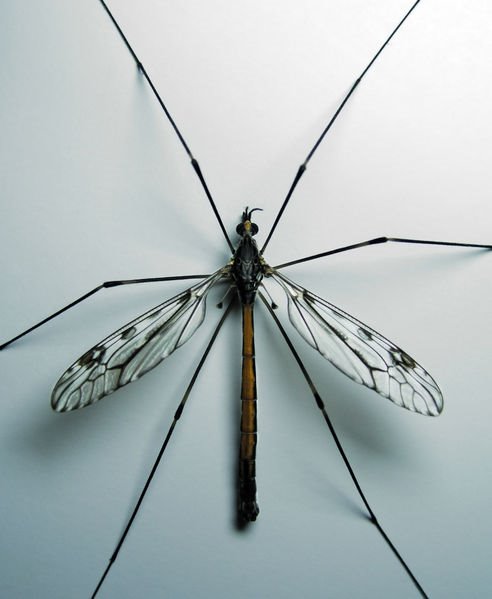
Attack of the crane flies!

The crane flies are here. And, like a bad horror movie, the delicate, gangly flies are everywhere. In spite of our best efforts, they manage to get into the house by the dozens. They congregate around light fixtures, bounce along the ceilings and oftentimes land in inappropriate places. This evening one even landed in Lori's glass of wine, and she took no pleasure in gagging and pulling fly legs off of her tongue after she inadvertently took a sip.

Crane flies have many other names; some people refer to them as "mosquito hawks" even though they (unfortunately) don't eat mosquitoes. My dad calls them "dingle flies" owing to their fragile and gawky nature. They're harmless, and they're little more than an annoyance.

They're only significant in that their arrival, much like the passing-through of the robins, is a sure sign that spring in Houston has begun. Ususally, they emerge a few weeks earlier than they have this year; some late-season cold weather earlier in February might have delayed their arrival somewhat. By the same vein, our semi-annual visit from the robins has lasted a lot longer than normal as well. Usually, they stay for a few days and then disappear. This time, they've hung around for a few weeks, as if they were waiting for the weather to the north to improve. I haven't seen any robins in a couple of days, however, so I assume they've finally decided to continue their migration. They'll be back for a few days in the fall as they fly to warmer climates to the south. The presence of the crane flies, likewise, is only temporary; a weeks from now, they'll all have mated and died off, and we won't see them again for another year.

Indeed, springtime in Houston has begun. The weather, in fact, has been rather nice over the past couple of weeks, and we'll likely enjoy the mild temperatures of the Houston spring for a couple more months before the oppressive heat of the summer finally sets in.

2007 UH football schedule released

With kickoff is exactly six months from today, the University of Houston has released its fall 2007 football schedule:

Sat Sep 01: @ Oregon
Sat Sep 08: open
Sat Sep 15: @ Tulane
Sat Sep 22: Colorado State
Sat Sep 29: East Carolina
Sat Oct 06: @ Alabama
Sat Oct 13: Rice
Sat Oct 20: @ Alabama - Birmingham
Sat Oct 27: @ Texas - El Paso
Sun Nov 04: Southern Methodist
Sat Nov 10: @ Tulsa
Sat Nov 17: Marshall
Sat Nov 24: Texas Southern

This is not a very favorable schedule. In fact, I'd go so far as to say that it generally sucks. First of all, the Cougars, in spite of coming off a ten-win, conference-championship season, are losing a lot of senior talent that made last season's success possible and are likely looking at a period of rebuilding in 2007. Given that stiuation, tough road trips to both Oregon and Alabama are not exactly the types of games the Cougars need to face this fall as they try to fill so many holes on both sides of the ball. The conference roadies to Tulsa and UTEP won't be picnics either.

Then there's the schedule's weakeness from an attendance perspective. The first home game isn't until late September, after the overall buzz from the start of football season has worn off, and it's not likely that home opponents like East Carolina and Marshall are going to draw flocks of curious Houston sports fans, either.

This year's closest thing to a "marquee" home opponent is... Colorado State. Since Art Briles has been coach, the University of Houston has been able to play host to a team from a BCS conference (Mississippi State in 2003, Miami in 2004, Oregon in 2005 and Oklahoma State in 2006). All of these games have been well-attended with the exception of the Oregon game (which was impacted by the influx of Katrina refugees into the Reliant Stadium / Astrodome complex the same night this game was played). The CSU Rams, on the other hand, are a team from the non-BCS Mountain West Conference that aren't likely to travel well and aren't likely to pique the interest of the Houston sports fan.

The Cougars also get screwed by not being able to host the Bayou Bucket game against Rice at the beginning of the season, when excitement from both schools' fans is high and attendance is generally decent. This year, the crosstown rivalry is occurring on October 13th. Sandwiched around this date are two trips to the state of Alabama, where the Cougars have never won single game.

Then there's a peculiar Sunday game against SMU, which is apparently is being scheduled for the benefit of ESPN. I'm assuming this game will be played Sunday evening, and as much as I like the national television exposure for the Cougars I just can't foresee a very big crowd attending this event. A Sunday evening kickoff will probably make it difficult for both out-of-town alumni as well as SMU fans from Dallas to attend, and the result could be rows and rows of empty Robertson Stadium seats broadcast on television for all the world to see. Ugh.

The team’s only open week occurs during the second week of the season, and while I guess that's better than no bye week at all (as was the case last season), it probably would have been more beneficial to the team to have a week off to refresh and recover at midseason.

The Coogs end the season with a home game against TSU. This continues a trend whereby UH hosts a Southwestern Athletic Conference school (we had Grambling at Robertson last year and Southern is apparently on the schedule for 2008), and will be the first time the two schools have met on the football field in spite of the fact that the two campuses are literally blocks away from one another. While it's an intriguing matchup and TSU's "Ocean of Soul" marching band will be fun to watch, the Saturday after Thanksgiving has traditionally been a loser for UH football from an attendance perspective because so many people are out of town. Hopefully the novelty of a UH/TSU matchup make up for that.

Certainly, the Cougars have created a bit of buzz for themselves through last season's success, but I unfortunately don't foresee Houston notching the same number of wins this fall. I'd love to be wrong about that, and I still think the Cougars can manage a winning season in 2007 if the right players fall into place and if the team can avoid a slew of key injuries. However, if the Cougars struggle through what looks to be a rebuilding season, the fickle, fair-weather Houston sports fan will quickly lose interest and crowds will dwindle as the season progresses.

This all adds up to a schedule that, from my perspective, is both difficult and has the propensity to be a loser at the gate. To make it clear, I'm not blaming anybody - Athletics Director Dave Maggard or otherwise - for this lousy schedule; it's simply the result of circumstances such as the need to play a return game in Oregon, or the need to work around other schools' schedules, or the simple fact that Conference USA is a crappy athletics conference full of schools nobody in Houston cares about. There's really not a solution to this schedule other than to win games and hope that things work out in the Cougars' favor when future schedules are created. Besides, as favorable as last season's schedule was, I guess this year's schedule is just a way of things evening out.

Nevertheless, I fear that the Cougars will struggle both on the field, and especially at the attendance box, this fall. Last season, the Cougars were able to average home attendance of over 20,000 fans per game. Not great by a long shot, but not horrible by UH standards, either. In 2007, they might have trouble breaking the 15,000 mark.

Wednesday, February 28, 2007

JetBlue redux

Another week, another weather-related service disruption for JetBlue at its New York City hub. Monday's snowstorm required JetBlue to cancel almost 70 flights, but that was nothing compared to the havoc caused by the "Valentine's Day Massacre" of a couple of weeks ago, which was a public relations nightmare for the popular airline. Newsweek financial columnist Allan Sloan suggests that JetBlue's biggest obstacle in the wake of that meltdown is not its need to change its operational structure to better deal with such weather-related disruptions in the future, but the simple fact that it, as an airline, is part of a money-losing business:

Consider this: since 1947, the first year for which the Air Transport Association has profit-and-loss figures, the U.S. airline industry has lost a cumulative $14 billion. And that's after including the up to $3 billion the association estimates that airlines made last year.

"Grocery stores give you better returns [than airlines]," says the Boyd Group's Michael Boyd, a Colorado-based airline expert. "Airlines are a crummy business, and will always be a crummy business." When people ask about starting an airline, Boyd told me, "first, we say no. Then, if they still want to do it, we say, 'Only if you're using your ex-wife's money'."

Sloan, noting that JetBlue was forced to shut down service to places like Richmond, Virgina; Raleigh-Durham, North Carolina; and Portland, Maine, goes on to bring up this interesting point:

A final note: Amtrak runs trains from New York to Richmond, Raleigh and Portland. I should have asked JetBlue why it didn't put its passengers on trains, but even I—an Amtrak Select Plus customer, yet—never considered rail service as an option. The lesson: we think of government-owned Amtrak as money-losing socialism, but the money-losing airline industry as a bunch of noble capitalists. Maybe we should re-examine our national transportation policies the way JetBlue is rethinking its customer-service policies.

The nation's commercial airline industry is, like the nation's passenger rail network, federally subsidized. Both industries are net money losers. It's funny how we hear so much controversy about one form of transportation in regard to its economic health, but comparatively little controversy about the other.

Tuesday, February 20, 2007

A sad discovery

My aunt found her daughter dead in her College Station apartment Saturday morning.

I cannot say I was particularly close to Evelyn. She was the product of my aunt's first marriage, before she met my mother's brother, and I only met her on a few occasions over the course of my life. Ironically, the last time I saw her was rather recently, at Thanksgiving. This was right after she moved from Kansas to College Station, where my aunt lives.

My family and I are all shocked and saddened, but I don't think any of us are terribly surprised. Evelyn was not in good health; she suffered from a host of chronic physiological problems and was taking a variety of medications for her various ailments. We obviously won't know more until the autopsy and toxicology reports come back, and that will probably take a few weeks.

Right now my thoughts are with my aunt, my uncle and my cousins, who will miss Evelyn terribly. Memorial services will be this weekend.

JetBlue's reputation takes a hit

Last week, popular low-fare airline JetBlue suffered a huge setback after extreme weather conditions at JetBlue's hub at John F. Kennedy Airport in New York City all but shut down the airline. Several planes were grounded on the JFK tarmac, with passengers inside them, for as long as ten or eleven hours. Tempers flared as passengers trapped inside the airplanes became restless, toilets overflowed and cabin crews ran out of food. Inside Terminal Six, events were also chaotic as flight after flight was canceled, leaving thousands of passengers stranded.

JetBlue has apologized for the disruptions, but repercussions from the storm haunted JetBlue all weekend as it struggled to resume normal operations. Flights to several cities, including Houston, were cancelled Sunday and Monday as the airline ferried its equipment to necessary locations and ensured that flight crews had the proper amount of rest, per FAA regulations, before taking to the skies once again. The airline reports that it has returned to operating normally as of today.

JetBlue, which has won fans in the past for its reluctance to cancel flights because of bad weather, is blaming the problems on its inability to cope with rescheduling so many flight crews.

“We had a weakness in our system,” said (JetBlue CEO David) Neeleman. “We were overwhelmed.”

Overwhelmed? That's a bit of an understatement. "Caught with your pants down" is probably more descriptive of what happened, as the incident exposed some serious flaws in the airline's operational philosophy:

When the bad weather struck Feb. 14, JetBlue didn’t have a system in place for many stranded flight crews to call in to be rerouted, something the airline is working to rectify, Neeleman said. The service breakdown “was absolutely painful to watch,” he said Monday.

One travel expert suggested the airline had brought the crisis on itself by trying too hard to accommodate its passengers.

“Most airlines don’t try to operate when there is an ice-storm problem — they’ve learned that it’s better to cancel all flights at the outset and then try to get back to
normal operations as quickly as possible,” said David Stempler, president of the Washington-based Air Travelers Association.

Stempler said the fast growth of airlines such as JetBlue can create demands that are beyond their capability, especially in crises.

“JetBlue tried to do their best — tried to keep the system rolling,” he said. “Their heart was in the right place, but their head was not.”

Neeleman, who has said he was “humiliated and mortified” by his airline's failures as a result of the storm, has promised to fix the problems revealed by last week's service outage, spending up to $30 million on new procedures for operations disruptions and introducing "bill of rights" for its customers.

While JetBlue as a corporation will likely recover from this incident, it remains to be seen how much damage has been done to JetBlue as a brand.

To be sure, massive weather-related disruptions and the accompanying distress placed on the flying public happen to airlines all the time; last December's blizzard-related shutdown of United's operations at Denver, or the recent incident wherein an American Airlines flight en route to Dallas/Fort Worth was stranded on the tarmac at Austin Bergstrom for many hours, are two such examples. But JetBlue takes pride in not being "another airline." It has won a loyal following and has become a popular airline due to its unique perks - in-flight DirecTV and blue potato chips, for example - and an incident such as this carries much more potential damage to an airline with a carefully-cultivated image, such as JetBlue, than it does to many other carriers - the bigger ones, especially - who don't have quite as positive a reputation.

It will be interesting to see if Neeleman's attempts to repair the airline's operational problems - and with it, its image - are successful over the coming months and the airline is able to retain its loyal customer base as well as its reputation as being a unique, passenger-friendly carrier. If not, JetBlue runs the risk of becoming "just another airline." And that, more than any economic damage caused by last week's fiasco, would be a disaster for JetBlue.

Thursday, February 15, 2007

Why the new dollar coin won't work

Today, the United States Mint is unveiling a new dollar coin. The new coin, featuring the likeness of George Washington, will be the first in a series of dollar coins bearing images of the Presidents of the United States. Later this year coins for John Adams, Thomas Jefferson and James Madison will be released into circulation. This program, which follows in the footsteps of the current 50-state quarter program, will last until at least 2016. The Mint hopes that these new dollar coins will succeed where previous attempts at a dollar coin - the Susan B. Anthony and the Sacagawea - have failed.

I'm sure they'll be a hit with coin collectors. I'll probably collect them, just as I currently collect the 50 state quarters (can't wait to get my hands on that James A. Garfield coin!). But will the general public use the coins, instead of the venerable dollar bill, for day-to-day purchases? Don't get your hopes up.

Coin experts, however, questioned whether the rotating designs will be enough to allow the new presidential $1 coin to succeed where the Susan B. Anthony dollar, introduced in 1979, and the Sacagawea dollar, introduced in 2000, failed.

“I don’t know of any country that has successfully introduced the equivalent of a dollar coin without getting rid of the corresponding paper unit,” said Douglas Mudd, author of a new book on the history of money, “All the Money in the World.”

To be sure, by doing away with the dollar bill and requiring everybody to use coins, the federal government could save hundreds of millions of dollars every year. Metal coins, after all, last much longer than paper bills. Other central banks around the world have already done this; Great Britain phased out the one-pound note in favor of the £1 coin during the 1980s, Canada replaced their dollar note with the "loonie" in 1987, and the European Union uses coins instead of notes for its €1 and €2 denominiations.

However, here in the United States, an overwhelming majority of people (including some local bloggers) are opposed to phasing out the dollar note in favor of the dollar coin. Some people like dollar bills because they're lighter and easier to carry than dollar coins. Others like bills simply because they don't like messing with coinage. (An argument I hear amazingly often in favor for the dollar bill is that you can't stick dollar coins into the g-strings of the dancers at topless clubs!) Even if it makes economic sense to phase out the dollar bill in favor of a more durable coin, people have an emotional attachment to the greenback, and the Federal government is loathe to buck that public preference (that's also why the Mint still strikes pennies, even though they now cost more to make than they're worth).

As long as there is both a paper bill and a metal coin in circulation, people are naturally going to prefer using the bill. And that's why this latest incarnation of the dollar coin, as interesting as it might be, is likely destined to flop.

Thursday, February 08, 2007

IAH - DXB nonstops begin December 3rd

Looks like the 8,181-mile journey is about to get a bit shorter, according to the Chronicle:
Emirates will kick off nonstop service between Houston and Dubai beginning in early December.

The new flight will be among the world's longest, but it will shorten travel times between Houston and Dubai, said Nigel Page, senior vice president for Emirates.

"We believe we will have the fastest service from Texas to the Gulf, to Dubai," Page said.

The flight time from Houston to Dubai will be 15 hours and 10 minutes, Page said. That compares to a total of 18 hours and 25 minutes for a flight on British Airways connecting in London, which is one of the shorter flights now.

This new service would compare even more favorably to the 23-hour treks I've taken on KLM via Amsterdam, or on JetBlue and Emirates via JFK. I think I've said before that I've noticed that a good number of the people on KLM flights from Houston to Amsterdam also seem to appear on the flights from Amsterdam to Dubai, and vice versa, which indicates that there is a steady stream of people flying from the two cities. The folks at Emirates obviously believe this, as well, especially given Houston's large Indian and Pakistani communities:

The head of Emirates said in a prepared statement that there is a growing demand for convenient air travel connections between the U.S. and cities in the Middle East and Indian subcontinent.

Houston will be the second gateway city for Emirates, which has three daily flights to Dubai from New York's John F. Kennedy International Airport.


I knew that this route was under consideration, along with routes from Dubai to Chicago and Los Angeles, but I honestly didn't think nonstop service from Houston to Dubai was going to happen this quickly. I am pleasantly surprised.

It's hard to say when, or even if, I'll be sent back to Dubai again. But regardless of how often I'll get to use this service, this is good news for the entire city of Houston.

UPDATE: Ben Mutzabaugh's entry about this new service is here. He links to Emirates' press release. Dubai Informer's story on this new service is here.

ANOTHER UPDATE: According to the Emirates press release, the initial flight numbers and schedule for this new service will be as follows (all times local):

EK211: Departs Dubai (DXB) at 9:05 am on Mondays, Wednesdays and Fridays, and arrives in Houston (IAH) at 4:10 pm

EK212: Departs Houston at 6:25 pm on Mondays, Wednesdays and Fridays and arrives in Dubai at 7:35 pm the next day

Friday, February 02, 2007

If college football writers covered world news...

...this is what the front page would look like:
May 8, 1945

Berlin -- In the end, its capitol lay in ruins. In the end, the "master race" wasn't. In the end, it wasn't even close.

A conflict that started with the hope of world domination for the once top-ranked army on the planet ended in a rout as the Allies defeated Germany yesterday, ending World War II on the European continent. The loss dropped Germany to 0-2 this century in world wars and left its people asking themselves how a plan to rule the world had once again gone so terribly wrong.
[...]

Even before their second crushing defeat in less than 50 years, support was building among the German people to oust their mercurial leader as secret underground printing presses were already beginning to crank out FireAdolfHitler.com and "You can't spell Adolf Hitler without two 'Ls'" newsletters. But, in the waning days of the war, Hitler made the point moot, abandoning the once-proud program by committing suicide in his Berlin bunker.

The Allied victory was especially sweet for United States President Harry "The Buck Stops Here" Truman who was following in the footsteps of legendary President Franklin Delano Roosevelt who died mere days before the U.S.-led victory.

"This one was for FDR!" shouted Truman before being drenched with Gatorade by his war cabinet. "And I think this ends once and for the debate all about which country is tougher."

But Truman added that there was still work to be done. "I'm going to tell my staff, my generals, my soldiers and the American people to enjoy this one for 24 hours.
But then let's turn out attention to the Japanese."

(Hat tip: Patrick McLeod)